


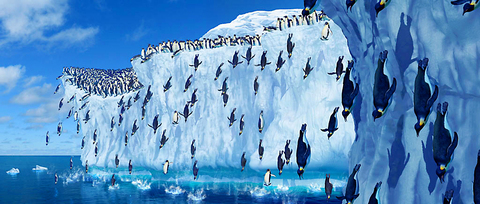
If you were to go just by the commercials, you'd think George Miller's new animated offering, Happy Feet, was one big party movie with wall-to-wall singing and dancing penguins.
What's striking when you see the full film is that Happy Feet contains a strong environmental message that would make Al Gore's heart sing. In the middle of a movie that is, in Robin Williams' words, Riverdance meets March of the Penguins, you have plot points turning on the effects of over fishing, global warming and the fragility of the food chain in Antarctica.
"You can't tell the story of penguins without dealing with the environment," Miller says. "In some sense, Happy Feet is an appeal to humans' better nature. That's what the main character, Mumbles, sets out to do. Because we're all responsible for these amazing creatures."
PHOTOS COURTESY OF WARNER BROS
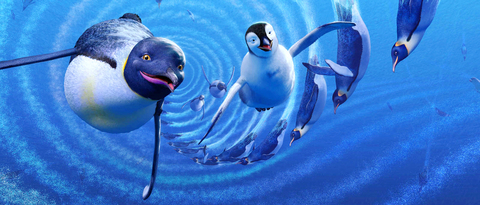
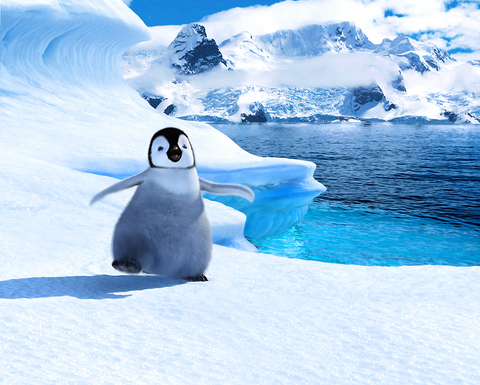
Mumbles (voiced by Elijah Wood) is an emperor penguin born without the ability to sing. If you were one of the millions who saw last year's documentary smash March of the Penguins, you might remember that Antarctica's emperor penguins find their mates and distinguish each other through what's called their "heartsong."
Thus, Mumbles' affliction is viewed as a problem, except by Mumbles.
Because all he wants to do is dance. (Mumbles' tap-dancing came from the filmmakers doing motion-capture work with virtuoso tap dancer Savion Glover.)
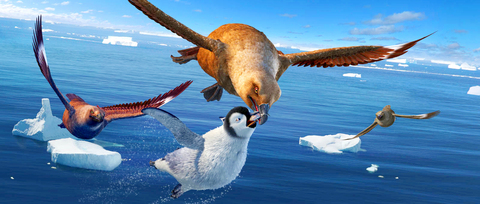
That message of the importance of individuality makes Happy Feet indistinguishable from most other family fare. But Mumbles' journey to happiness takes him to some authentically dark places, leading him to confront the actions of what he and his brethren call the "ugly penguins without feathers on their fat, flabby faces."
Australia's Miller has been down this road before. He was one of the writers and producers of the 1995 Oscar-nominated family film, Babe, where the specter of the ax in the family-farm food chain was never far from the surface.
Miller took 1998 sequel Babe: Pig in the City a step further, moving from the gentle, pastoral charm of the original to a movie disturbing in tone, European art house in feel.
Not surprisingly, Pig in the City bombed with audiences, grossing only US$18 million in the states. (Miller calls the movie's commercial failure "self-inflicted." He delivered the film to the studio late, giving the marketing department little time to prepare audiences for the tonal shift.)
"The moral darkness of Pinocchio and Snow White are huge to me," Miller says. "Happy Feet has a lot in common with Dumbo, another one of my favorites. These dark stories help us negotiate life. They're for the adult in the child and the child in the adult."
Adds Wood: "Life isn't sanitized. I like that the movie throws in a little dark reality."
For the Antarctic penguins in Happy Feet, that reality includes ocean waters where fish aren't swimming and ice temperatures that are, relatively speaking, sweltering. One penguin, Lovelace (voiced by Williams), wears a plastic six-pack ring around his neck.
Initially, the other penguins see the ring as an exotic talisman, a sign of Lovelace's power. Then Lovelace begins to have trouble breathing, and Mumbles realizes something more sinister is at hand.
"To George's credit, it's funny and ridiculous and heartbreaking, all at the same time," says Brittany Murphy, who voices Gloria, Mumbles' singing love interest. "The message is there, but he isn't beating you over the head with it. It is unexpected, though. Most people are just expecting happy penguins."
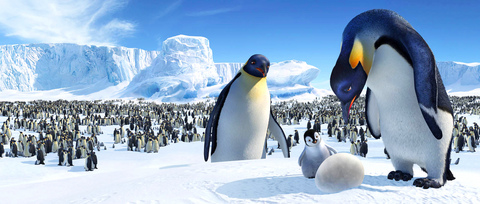
Miller was developing Happy Feet several years before the success of March of the Penguins. Initially, it wasn't planned as a musical. Nor was it intended to tell a story about the environment where the lead penguin rails to the humans: "Why are you taking our fish? You're causing an awful lot of grief!"
Miller just liked emperor penguins, finding their existence nothing short of incredible.
"I was struck by he way they live in community and share the load," he says. "Their incredible efficiency. The way they waddle on land but then virtually fly underwater.
"These penguins don't have to sing and dance," Miller adds. "They're amazing all on their own. I'd love for people to feel that and feel their responsibility to care for these creatures and their environment. They have such a tenuous hold on life. You can't take them for granted."

Last week Joseph Nye, the well-known China scholar, wrote on the Australian Strategic Policy Institute’s website about how war over Taiwan might be averted. He noted that years ago he was on a team that met with then-president Chen Shui-bian (陳水扁), “whose previous ‘unofficial’ visit to the US had caused a crisis in which China fired missiles into the sea and the US deployed carriers off the coast of Taiwan.” Yes, that’s right, mighty Chen caused that crisis all by himself. Neither the US nor the People’s Republic of China (PRC) exercised any agency. Nye then nostalgically invoked the comical specter

Relations between Taiwan and the Czech Republic have flourished in recent years. However, not everyone is pleased about the growing friendship between the two countries. Last month, an incident involving a Chinese diplomat tailing the car of vice president-elect Hsiao Bi-khim (蕭美琴) in Prague, drew public attention to the People’s Republic of China’s (PRC) operations to undermine Taiwan overseas. The trip was not Hsiao’s first visit to the Central European country. It was meant to be low-key, a chance to meet with local academics and politicians, until her police escort noticed a car was tailing her through the Czech capital. The
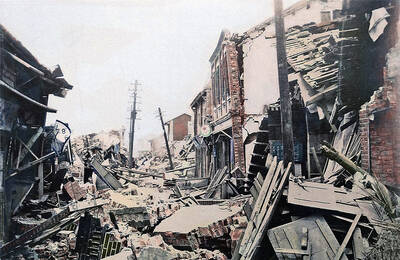
April 15 to April 21 Yang Kui (楊逵) was horrified as he drove past trucks, oxcarts and trolleys loaded with coffins on his way to Tuntzechiao (屯子腳), which he heard had been completely destroyed. The friend he came to check on was safe, but most residents were suffering in the town hit the hardest by the 7.1-magnitude Hsinchu-Taichung Earthquake on April 21, 1935. It remains the deadliest in Taiwan’s recorded history, claiming around 3,300 lives and injuring nearly 12,000. The disaster completely flattened roughly 18,000 houses and damaged countless more. The social activist and

Over the course of former President Ma Ying-jeou’s (馬英九) 11-day trip to China that included a meeting with Chinese Communist Party (CCP) leader Xi Jinping (習近平) a surprising number of people commented that the former president was now “irrelevant.” Upon reflection, it became apparent that these comments were coming from pro-Taiwan, pan-green supporters and they were expressing what they hoped was the case, rather than the reality. Ma’s ideology is so pro-China (read: deep blue) and controversial that many in his own Chinese Nationalist Party (KMT) hope he retires quickly, or at least refrains from speaking on some subjects. Regardless


 RSS
RSS