


Deep inside the bowels of storied Zhongshan Hall in Taipei something was stirring. A stone-faced security guard watched as colored, polygonal boxes were carted into the venue and crates containing electronic equipment were unpacked.
On the second floor, under the elegant chandeliers of the building built in 1936, strange contraptions were being brought to life. Their lights winked, screens animated, projectors beamed images and speakers started making otherworldly noises.
Obviously, this was not your usual Taiwanese opera or classical music show. There were too many young people buzzing around and some of the visiting performers and artists were dressed in hoodies rather than suits.
Taipei's first Digital Art Festival opens today at 6pm and promises to be a breath of fresh air for those of us who are tired of the same-old, uninspired productions from the art scene of our capital city.
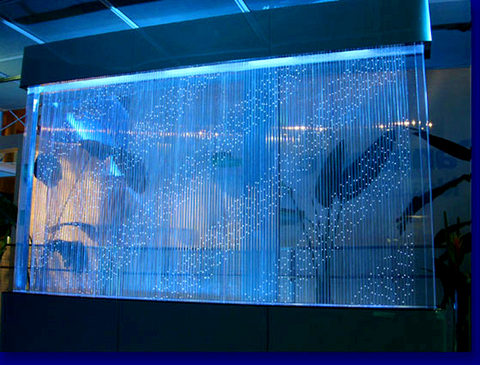
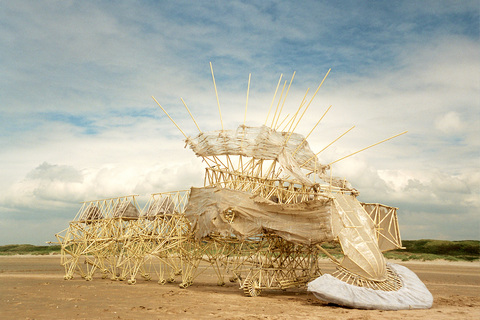
So, expect the unexpected. Singing water, sounds that become visions, works of art made from bubbles, skeleton-like animal structures that walk using wind power, clothes that make music and improvised performances will all be on show.
These are extraordinary constructs that are intended to enlighten, entertain and challenge preconceptions about the world. Think fantastical 21st century William Heath Robinson inventions or the "pataphysical" world of Alfred Jarry brought to life. Digital art is not just about computers and Photoshop, nerds and their toys.
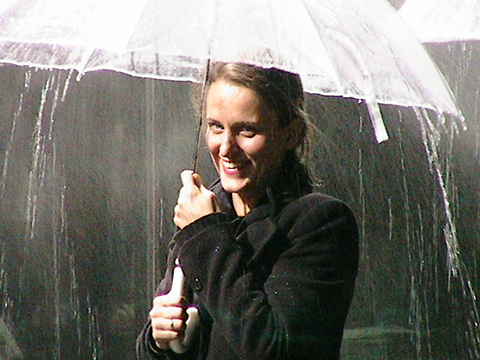
PHOTO COURTESY OF DAF
It makes sense for Taiwan to be hosting such an event. As Taipei Mayor Ma Ying-jeou (馬英九) pointed out when he announced the event a couple of weeks ago, the country "plays a crucial role in the global development of high technology."
Despite this and a history of local digital art that stretches back to 1985, Taiwan has been nowhere near the cutting edge and has failed to make the most of its natural advantages: clever, resourceful people and a high-tech environment.
As such one of the aims of the curatorial team that has put together the Digital Art Festival is to "cultivate a lifestyle that integrates creativity," according to its mission statement. Translated, this means we may be computer savvy and wired up, but we have failed to make the most of this by incorporating art into everyday life and producing great works.
Festival curator Alf Chang (張賜福) was involved in the Navigator event held two years ago in Taichung that tried to enliven the digital arts scene. It was a success among those who knew about it, but preaching to the converted didn't change anything for the majority.
"We have plenty of people with good computer or engineering skills and there is government and business support for this. What we don't have much of is people like these who have an art sense," said Chang, seated among piles of electronica at his temporary Zhongshan Hall office earlier this week.
"We are bringing over some of the best digital artists in the world as part of a project to inspire digital art here. This is a different kind of exhibition and could [herald] the start of a new tradition."
Paul de Marinis, artist and associate professor of studio art at Leland Stanford Junior University in California, said digital artists are "in a tradition rather than traditional" and believes if they introduce something that is different, then it has a kind of magical quality that can be inspiring.
Many of De Marinis' pieces draw on "19th century technologies that are not part of the dominant discourse." For instance, the work RainDance, which he is showing at the festival, consists of overhead pipes that stream water. Walk under the jets with an umbrella and you will hear tunes such as Singing in the Rain, Begin the Beguine and the Blue Danube waltz.
"The thing is," De Marinis said, "You are not used to water being used as an amplifier, but in fact it can amplify as much as electricity." For instance, a stream of 440 water droplets per second creates the note A, whereas 260 is a middle C. When these jets of water hit the umbrella it vibrates and thus a sound is made that the ear can hear.
When asked whether aesthetics followed technology and this is why digital arts are becoming an important medium, De Marinis answered technology not only forms our culture, but also vice versa, culture creates our future tools. Art can inspire scientific innovation, he said.
"Technology comes out of dreams and yearnings. It comes as much from aesthetics as it does from science. There is a kind of breathing, a back-and-forth between the two. Artists see the shadows and make forms and artifacts from them."
As an example he said new cultural forms included digital images or sounds that have been copied, pixilated, distorted and "amplified." They have now become part of the mainstream visual spectrum, from adverts to movies.
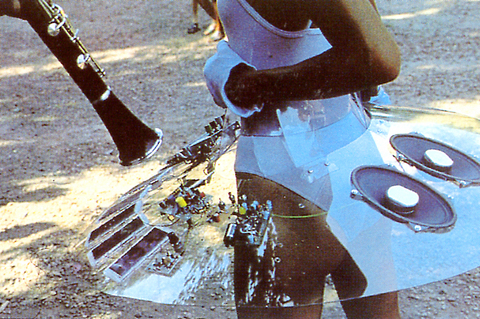
Taipei City Government is backing the festival because digital arts fit like a glove around its intention for Taipei to be a leader not just in technology but also in the culture of technology. It has poured in money to bring over international artists such as Benoit Maubrey, whose invited piece Audio Ballerinas will feature performers walking from Zhongshan Hall to the Red House Theater in nearby Ximending wearing "audio costumes."
Kaffe Matthews from the UK will present her ARS Electronica prize-winning Worldwide Bed Project. The US' Golan Levin, Japan's Taro Suzuki and Theo Jansen from the Netherlands will show off their distinctive works, while Taiwan's only improvised dance group, founded by Ku Ming-shen (古名伸), will also perform.
The city government plans to open a Digital Arts Center in October next year and is also offering awards at the festival to encourage young artists. Nominee Lunc Lin (林昆穎) will present his installation Vanish into Space IV, which involves putting widgets in holes to create soundscapes. The 27-year-old represents what the city government hopes is a new breed of local artists spawned in Taipei's technically challenging environment.
"Our ideas are not the same as previous artists. A drawing is just a drawing, but what we do is reflect the mess or chaos around us," Lin said. "Taiwan has a lot of electronic shops and factories so it is a good environment for us."
Another young, local artist, Chen Zhi-jian (陳志建), said tools like computers and digital cameras could create alternative descriptions of our environment and has produced a time-lapse video of Ximending titled Dateline.
"When people see our stuff they like it. The problem at the moment is that people don't know it. So this festival can bring about understanding," Chen said.

Last week Joseph Nye, the well-known China scholar, wrote on the Australian Strategic Policy Institute’s website about how war over Taiwan might be averted. He noted that years ago he was on a team that met with then-president Chen Shui-bian (陳水扁), “whose previous ‘unofficial’ visit to the US had caused a crisis in which China fired missiles into the sea and the US deployed carriers off the coast of Taiwan.” Yes, that’s right, mighty Chen caused that crisis all by himself. Neither the US nor the People’s Republic of China (PRC) exercised any agency. Nye then nostalgically invoked the comical specter

Relations between Taiwan and the Czech Republic have flourished in recent years. However, not everyone is pleased about the growing friendship between the two countries. Last month, an incident involving a Chinese diplomat tailing the car of vice president-elect Hsiao Bi-khim (蕭美琴) in Prague, drew public attention to the People’s Republic of China’s (PRC) operations to undermine Taiwan overseas. The trip was not Hsiao’s first visit to the Central European country. It was meant to be low-key, a chance to meet with local academics and politicians, until her police escort noticed a car was tailing her through the Czech capital. The
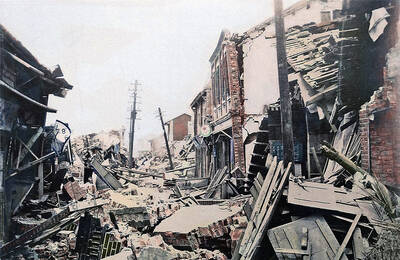
April 15 to April 21 Yang Kui (楊逵) was horrified as he drove past trucks, oxcarts and trolleys loaded with coffins on his way to Tuntzechiao (屯子腳), which he heard had been completely destroyed. The friend he came to check on was safe, but most residents were suffering in the town hit the hardest by the 7.1-magnitude Hsinchu-Taichung Earthquake on April 21, 1935. It remains the deadliest in Taiwan’s recorded history, claiming around 3,300 lives and injuring nearly 12,000. The disaster completely flattened roughly 18,000 houses and damaged countless more. The social activist and

Over the course of former President Ma Ying-jeou’s (馬英九) 11-day trip to China that included a meeting with Chinese Communist Party (CCP) leader Xi Jinping (習近平) a surprising number of people commented that the former president was now “irrelevant.” Upon reflection, it became apparent that these comments were coming from pro-Taiwan, pan-green supporters and they were expressing what they hoped was the case, rather than the reality. Ma’s ideology is so pro-China (read: deep blue) and controversial that many in his own Chinese Nationalist Party (KMT) hope he retires quickly, or at least refrains from speaking on some subjects. Regardless


 RSS
RSS