


For the last 17 years, William Dalrymple's travel and history books have celebrated syncretism. Nothing pleases him more than the “fluidity” and “tolerance” displayed by such champion integrators as Sir David Ochterlony, who processed around 19th-century Delhi each evening with his 13 Indian wives, each on the back of her own lavishly caparisoned elephant. The roots of violently polarized religions and cultures, Dalrymple is famous for arguing, are surprisingly entwined: al-Qaeda and the evangelical neocons are branches of the same spreading tree. But cheerleaders for pluralism have a thin time of it these days.
Dalrymple's works are elegies for tolerance: tales of things falling apart, splintering communities and growing religious fundamentalism. The Last Mughal, which traces the brutal destruction of Bahadur Shah Zafar II's Delhi court in the Indian uprising of 1857-8, shows this process — a falling-off from the late-18th century heyday of liberal coexistence described in its predecessor, White Mughals — in fast-forward.
Delhi in the 1850s was home to the last vestige of the once-sprawling Mughal empire: a refined but ineffectual court presided over by an emperor whose authority barely ran beyond the palace walls. Hemmed in by growing British influence, the emperor and upper-class Delhi residents spent their time designing gardens, visiting Sufi shrines, “enjoying the moonlight” and competing to write the most beautiful ghazals, or Urdu love poems. Tolerance flourished; Delhi's half-Hindu, half-Muslim population lived peacefully side by side.

An unashamed fan of Sufism, Dalrymple is impressed by the declining court's “tolerant Sufi ways” and by its poet-emperor, the most “talented, tolerant and likeable” of his dynasty. But it is difficult to share his straightforward delight in a culture that sprang from impoverishment and political emasculation. By 1857, the 82-year-old Zafar's ghazal contests and state processions amounted to little more than gilding the bars of his British-made cage.
Zafar's oasis of mangoes and theological debate was, admittedly, more attractive than the forces surrounding it. Dalrymple argues convincingly for the contribution of colonialism to the rise of religious radicalism in India. As the British administration became increasingly bigoted and its evangelical missionaries more aggressive, the East India Company's Hindu sepoys became preoccupied by caste and ritual, while their Muslim counterparts were drawn to the militant new Wahhabi ideology spreading from Saudi Arabia.
Caught between resurgent religious radicalism and a violent tussle for political and economic control, Zafar's court had little chance of survival once the sepoys made him the reluctant figurehead of their resistance. The bulk of The Last Mughal is an account of Delhi during the uprising: a breakneck yarn of disguise, escape, spies, collaborators, strategic errors, venality, deception, love affairs and spectacular brutality. Dalrymple proves a sure-footed narrator who only occasionally succumbs to melodrama and skillfully paces the crescendo of the conflict towards the final siege, fall and destruction of the rebel city.
The real villains of The Last Mughal are the brutal, narrow-minded British military and civil administrators. When they insist the elderly emperor is “the evil genius and linchpin behind an international Muslim conspiracy,” the parallels Dalrymple draws between the sack of Delhi and recent Western misadventures in the Middle East suddenly come alive. Like their counterparts in the Green Zone, the victors are ostentatiously righteous (celebrating the fact that Zafar's throne room, which “once echoed to the mandates of a despotic emperor ... now echoed the peaceful prayers of a Christian people”) and legally bankrupt. Show trials of the imperial family, which invariably resulted in the death sentence, were a legal nonsense, as the company still owed Zafar the allegiance it had sworn his family in the 18th century.
But while Zafar's tale, ending in his exile and death in Rangoon, is moving, Dalrymple's insistence that there are “clear lessons” to be learnt from his “peaceful and tolerant attitude to life” is puzzling.
However literate and charming, Zafar was out of touch with all but the elite of his people. Apolitical both by necessity and inclination, he constantly begged for “retreat and seclusion” and threatened to “go off into retirement in Mecca,” which makes Dalrymple's assertion that “realism and acceptance were always qualities Zafar excelled in” rather eccentric.
Dalrymple is forced into such contradictions by the rhetoric of The Last Mughal, in which Zafar's Delhi has to act as the type of every liberal golden age threatened by the forces of extremism. Similarly, Sufism becomes a shorthand for the qualities Dalrymple, along with many liberal Westerners, would like to see in Islam today: tolerance, pluralism, artistic sophistication and an essential apoliticism. Aesthetically, this may be understandable — a ghazal is more melodious than a fatwa — politically, it is nonsensical. But these are arguments with the superstructure of The Last Mughal rather than its substance. This is a skillfully written, impeccably researched history. It should not have to be, in addition, a prescription for our contemporary woes.

Last week Joseph Nye, the well-known China scholar, wrote on the Australian Strategic Policy Institute’s website about how war over Taiwan might be averted. He noted that years ago he was on a team that met with then-president Chen Shui-bian (陳水扁), “whose previous ‘unofficial’ visit to the US had caused a crisis in which China fired missiles into the sea and the US deployed carriers off the coast of Taiwan.” Yes, that’s right, mighty Chen caused that crisis all by himself. Neither the US nor the People’s Republic of China (PRC) exercised any agency. Nye then nostalgically invoked the comical specter

Relations between Taiwan and the Czech Republic have flourished in recent years. However, not everyone is pleased about the growing friendship between the two countries. Last month, an incident involving a Chinese diplomat tailing the car of vice president-elect Hsiao Bi-khim (蕭美琴) in Prague, drew public attention to the People’s Republic of China’s (PRC) operations to undermine Taiwan overseas. The trip was not Hsiao’s first visit to the Central European country. It was meant to be low-key, a chance to meet with local academics and politicians, until her police escort noticed a car was tailing her through the Czech capital. The
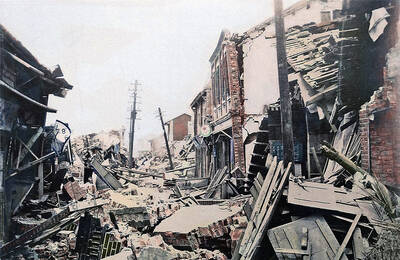
April 15 to April 21 Yang Kui (楊逵) was horrified as he drove past trucks, oxcarts and trolleys loaded with coffins on his way to Tuntzechiao (屯子腳), which he heard had been completely destroyed. The friend he came to check on was safe, but most residents were suffering in the town hit the hardest by the 7.1-magnitude Hsinchu-Taichung Earthquake on April 21, 1935. It remains the deadliest in Taiwan’s recorded history, claiming around 3,300 lives and injuring nearly 12,000. The disaster completely flattened roughly 18,000 houses and damaged countless more. The social activist and

Over the course of former President Ma Ying-jeou’s (馬英九) 11-day trip to China that included a meeting with Chinese Communist Party (CCP) leader Xi Jinping (習近平) a surprising number of people commented that the former president was now “irrelevant.” Upon reflection, it became apparent that these comments were coming from pro-Taiwan, pan-green supporters and they were expressing what they hoped was the case, rather than the reality. Ma’s ideology is so pro-China (read: deep blue) and controversial that many in his own Chinese Nationalist Party (KMT) hope he retires quickly, or at least refrains from speaking on some subjects. Regardless


 RSS
RSS