


Steven Levy, the author of The Perfect Thing, is madly in love. So what if the object of his affections is inanimate and very, very petite? It makes great company and is fun to fondle. It makes him feel good and bolsters his self-confidence. And size is no problem: The more it shrinks, the more “adorable” it becomes.
Levy is also acutely image conscious about his taste in music. He may be a baby boomer (he refers to top record-company executives as “nasty cats”), but forget the Paul McCartney concert tickets: he prides himself on a cutting-edge sensibility. He seeks out songs by musicians “young enough to be grandchildren of the Beatles” and prefers artists “off the radar of anyone whose name is inked on a mortgage.” His example of mortification is to be caught with Michael McDonald in your iPod library.
And he shows other signs of insecurity. His position as chief technology correspondent for Newsweek ought to underscore his authority on this subject. But he is overly fond of emphasizing his backstage access to Steve Jobs, and of locutions like “I once found myself in a heated discussion with Bill Gates about….”
At least he can claim to have been the first person to hand Gates a Microsoft-unfriendly iPod and asked “Have you seen this yet?” As Gates absorbed every detail about the rival product, Levy says, “I could almost hear the giant sucking sound.”
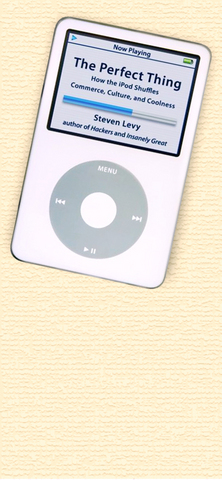
Gates' interest in the Apple iPod could not have surpassed that of Levy, who has written an entire book about one item and even modeled it on that device's hallowed image. The cover of The Perfect Thing looks as much like an iPod as it can, given the necessity for pages and binding. And the book's structure is iPod-mimetic too. Levy has deliberately mimicked the shuffle feature so that different editions of The Perfect Thing present their chapters in different orders. This has less novelty than it promises. There are plenty of books with chapters that address separate themes and don't follow any logical progression.
The Perfect Thing raises one big question: is it possible to spin a whole book out of such literally lightweight subject matter? Answer: yes, if you don't mind repetition and don't expect to learn anything new. The Perfect Thing is more entertaining than informative, but it makes a very satisfactory mash note. Gushing aside (“this is its universally celebrated, endlessly pleasing, devilishly functional, drop-dead gorgeous design”), it does a handy job of crystallizing and commemorating the dawn of the iPod age.
“No wonder that iPods have replaced toasters as bank premiums,” Levy writes, offering a measure of how fully the iPod has pervaded everyday life. Though the idea of walking around with one's own music library was inconceivable two decades ago (a 1985 disk drive for a primitive MP3 player was insufficient to hold Neil Young's nine-minute Down by the River), it has become second nature to a new, wired breed of consumer. “Pity the poor beggars and street musicians who must now compete with the personal concerts buzzing in the heads of potential donors,” Levy writes. With the selective obliviousness of any iPod fetishist, he screens out the thought that beggars might be pitied for other reasons.
This iPod success story also virtually screens out a pivotal factor in its earth-shaking influence: The actual earth-shaking of Sept. 11. The iPod was unveiled in October 2001, and the world was eager for distraction. “This is the freedom to be deaf to the loudspeakers of history,” says one iPod fan.
The rest of that section, Personal, is similarly devoted to the iPod's capacity to isolate. It comes to the predictable conclusion that this is fabulous, not dangerous, and that commuters in cars already enjoy the same kind of privacy zone. It's just that a car weighs a lot more than 6.4 ounces (for the jumbo iPod) and does not require wires in the user's ears.
The Download chapter is one of its best. It describes the anti-download indignation of record companies that are otherwise “spotty on the morality thing.” As Levy nicely puts it: “their history was an unbroken litany of publishing credits pilfered from artists, unpaid royalties and envelopes stuffed with illegal payola. Their plea against downloading came across like an etiquette lesson from the Green River Killer.”
The Identity chapter is similarly lively as it outlines the extreme forms of music snobbery in a world of dueling playlists. The Shuffle section is mathematically interesting, since it examines the complaint that iPods' random song shuffling favors certain artists over others. As Levy discovers, true randomness is likelier to produce repetition than a chain of totally unrelated selections. As Apple tries to fix this, “we're making it less random to make it feel more random,” Jobs says.
This book's chapter shuffling is occasionally trounced by chronology. It's odd to get halfway through the book and then read: “A thousand songs — an entire record collection — in your pocket? It sounded like a dream.” And its Coolness section is fawningly uncool. Is the iPod's bright white really reminiscent of Moby-Dick?
It's even less cool that the Apple chapter sounds like advertising. It takes the reader to “the trippy world of Apple, where productivity, great design and fun are in a constant group hug.” Levy does his share of hugging, too.

Last week Joseph Nye, the well-known China scholar, wrote on the Australian Strategic Policy Institute’s website about how war over Taiwan might be averted. He noted that years ago he was on a team that met with then-president Chen Shui-bian (陳水扁), “whose previous ‘unofficial’ visit to the US had caused a crisis in which China fired missiles into the sea and the US deployed carriers off the coast of Taiwan.” Yes, that’s right, mighty Chen caused that crisis all by himself. Neither the US nor the People’s Republic of China (PRC) exercised any agency. Nye then nostalgically invoked the comical specter

Relations between Taiwan and the Czech Republic have flourished in recent years. However, not everyone is pleased about the growing friendship between the two countries. Last month, an incident involving a Chinese diplomat tailing the car of vice president-elect Hsiao Bi-khim (蕭美琴) in Prague, drew public attention to the People’s Republic of China’s (PRC) operations to undermine Taiwan overseas. The trip was not Hsiao’s first visit to the Central European country. It was meant to be low-key, a chance to meet with local academics and politicians, until her police escort noticed a car was tailing her through the Czech capital. The

April 15 to April 21 Yang Kui (楊逵) was horrified as he drove past trucks, oxcarts and trolleys loaded with coffins on his way to Tuntzechiao (屯子腳), which he heard had been completely destroyed. The friend he came to check on was safe, but most residents were suffering in the town hit the hardest by the 7.1-magnitude Hsinchu-Taichung Earthquake on April 21, 1935. It remains the deadliest in Taiwan’s recorded history, claiming around 3,300 lives and injuring nearly 12,000. The disaster completely flattened roughly 18,000 houses and damaged countless more. The social activist and

Over the course of former President Ma Ying-jeou’s (馬英九) 11-day trip to China that included a meeting with Chinese Communist Party (CCP) leader Xi Jinping (習近平) a surprising number of people commented that the former president was now “irrelevant.” Upon reflection, it became apparent that these comments were coming from pro-Taiwan, pan-green supporters and they were expressing what they hoped was the case, rather than the reality. Ma’s ideology is so pro-China (read: deep blue) and controversial that many in his own Chinese Nationalist Party (KMT) hope he retires quickly, or at least refrains from speaking on some subjects. Regardless


 RSS
RSS