


Has there ever been such a smorgasbord of circuses incorporating so many styles from so many different countries in Taiwan at one time? The Great Moscow Circus has been touring the island since the beginning of this month. At the end of October, Spotlight on New Circus will showcase various contemporary circuses and experimental theater groups in the square between the National Theater and National Concert Hall. And beginning tomorrow, the Flying Wallendas will bring their version of circus to Asia for the first time to dazzle and delight audiences with some acrobatic drama and tightrope titillation.
The Wallenda family has a rich history of entertainment that dates back to 1780 when it wandered Europe as a traveling circus troupe composed of acrobats, jugglers, clowns, aerialists and animal trainers.
By the early 20th century, the Great Wallendas — as they were known at the time — had established themselves as one of the preeminent circus performance troupes touring the world with and headlining circus acts such as Ringling Brothers and Barnum and Bailey. Once in Akron, Ohio, the wire slipped while they were performing and all four members fell to the wire, yet they were relatively unhurt. The next day a headline in a local paper proclaimed them “The Flying Wallendas,” and the name has stuck ever since.
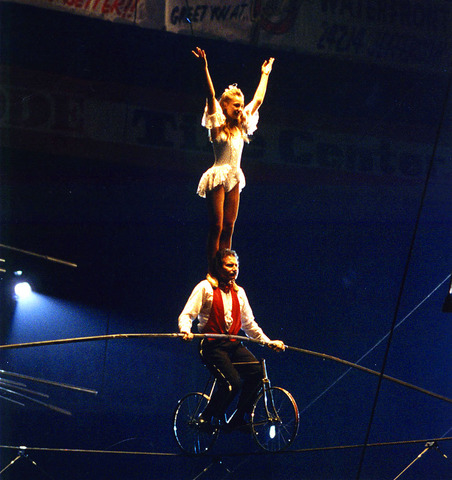
PHOTOS COURTESY OF KUANG HONG ARTS
In 1947, Karl Wallenda began building a circus of his own. It was also at this time that he created his death-defying Seven-Person Pyramid consisting of four men standing on a wire 10.5m in the air, two pairs yoked together by shoulder bars. On top of them stood two more men and at the pinnacle was a woman sitting and then standing on a chair. This feat, like all other acts on the tightrope, is performed without using any kind of safety net.
Tino Wallenda, who now leads the troupe, started out on the wire at the age of seven when his grandfather took him into his backyard, put a balance-pole in his hands, taught him how to place his feet, control his body and where to focus his eyes. By the age of 17, he was a full-fledged member of the troupe.
When he was young, all he could think about was performing and didn't think too much about the tradition that his grandfather had established.
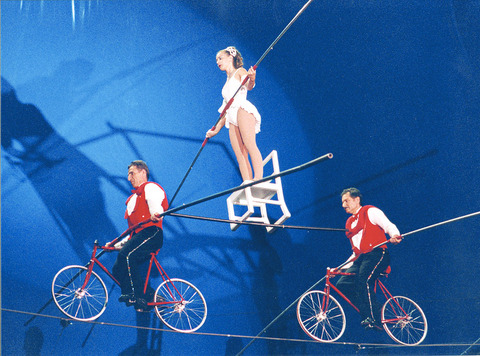
“The legacy that it involved didn't hit me until later on. It's like my kids right now: When you are younger you only want to perform. But now that I'm getting older, I've begun to realize the significance [of what I do],” he said in an interview with the Taipei Times.
The lineup of top-notch performers coming to Taipei will be overseen by Charley van Buskirk — a ring master complete with handle-bar mustache and black top hat — and includes trapeze artists, aerialists, trampoline acts along with jugglers and comedy clowns that perform on and off the high wire. A highlight of the show is the man who sets himself on fire 12m in the air and then dives into a small air mattress. And of course no Flying Wallenda performance would be complete without their Guinness World Record seven-person pyramid.
Tragedy strikes
The success of the family has also been marked by tragedy, most famously in 1962 when a pyramid collapsed in Detroit, leaving two performers dead and Mario Wallenda — Tino's uncle — paralyzed from the waste down. Family patriarch Karl Wallenda died in a 1978 fall from the wire in Puerto Rico.
Tino Wallenda searches carefully for an answer before commenting on these events.
"We learn from these experiences," he muses. "But we are also very strong — like my grandfather was — and there is a perfect saying: the show must go on."
But the circus itself is under threat.
"The level of circus has in some ways diminished because of the commercialism that is used. And so sometimes people have gone to see what they thought would be a quality circus and it was more of a promotional package that was sold to them and they got less than what they deserved. And so people get disappointed and don't want to come back to the circus," Wallenda said.
Compounding this was the development of the animal rights movement in the 1960s, which resulted in traditional circuses losing much of their appeal. As a consequence, circus performances began a gradual decline up until the 1970s when a new kind of circus began to emerge. Beginning at the end of that experimental decade, a new generation of circuses known as the New Circus — or Cirque Nouveau — began appearing in France.
New Circus
The new circus — most recently popularized by troupes such as Cirque du Soleil — features highly physical activities and no animal tricks. Known also as physical theater, many of these new circus groups have vague narratives that are closer to theater than the entertainment found in the traditional circuses. The island will have a chance to see this newer kind of circus performance beginning Oct. 27 with a festival called Spotlight on New Theater.
"The new circus in some ways feels that the traditional circus is inferior. But I always think that there is going to be room for the traditional circus," Wallenda said when asked about the differences between the two styles.
"But the thing about the new circus that is good is that it's brought a new interest to circus [overall]," he added.
Andrew Guild, a producer from the Great Moscow Circus agrees. "Today, [the] circus relies much more on human skills," he said in an email interview. "Circus is now an art form — in Russia it is likened to opera and ballet," he added.
The Great Moscow Circus has some of the world's best performers and, like the new theater, also has a line-up of world-class athletes.
"Some of our artists have performed at the Olympics," he said.
But their Taiwan performances have not been without controversy. Last week a conservation group called on the legislature to amend the law to ban animal shows in circuses.
But Guild pointed out that even though watching animals in circuses have gone out of vogue in certain quarters, "the people of Taiwan want to see performing animals." Guild is also at pains to express that animal cruelty is not something his circus condones.
"[The animals] have grown up in the circus. They are well cared for and loved by their trainers," he said.
Though the Flying Wallendas typically incorporate animals into their show, there will be none for their Taipei performance. Wallenda says this decision has nothing to do with activism, but rather is due to the logistics of getting them over to Taiwan.

Last week Joseph Nye, the well-known China scholar, wrote on the Australian Strategic Policy Institute’s website about how war over Taiwan might be averted. He noted that years ago he was on a team that met with then-president Chen Shui-bian (陳水扁), “whose previous ‘unofficial’ visit to the US had caused a crisis in which China fired missiles into the sea and the US deployed carriers off the coast of Taiwan.” Yes, that’s right, mighty Chen caused that crisis all by himself. Neither the US nor the People’s Republic of China (PRC) exercised any agency. Nye then nostalgically invoked the comical specter

Relations between Taiwan and the Czech Republic have flourished in recent years. However, not everyone is pleased about the growing friendship between the two countries. Last month, an incident involving a Chinese diplomat tailing the car of vice president-elect Hsiao Bi-khim (蕭美琴) in Prague, drew public attention to the People’s Republic of China’s (PRC) operations to undermine Taiwan overseas. The trip was not Hsiao’s first visit to the Central European country. It was meant to be low-key, a chance to meet with local academics and politicians, until her police escort noticed a car was tailing her through the Czech capital. The
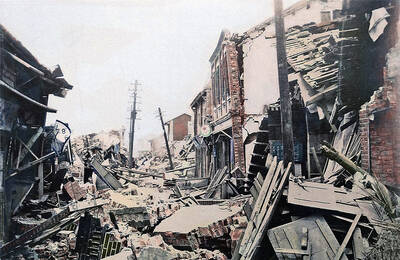
April 15 to April 21 Yang Kui (楊逵) was horrified as he drove past trucks, oxcarts and trolleys loaded with coffins on his way to Tuntzechiao (屯子腳), which he heard had been completely destroyed. The friend he came to check on was safe, but most residents were suffering in the town hit the hardest by the 7.1-magnitude Hsinchu-Taichung Earthquake on April 21, 1935. It remains the deadliest in Taiwan’s recorded history, claiming around 3,300 lives and injuring nearly 12,000. The disaster completely flattened roughly 18,000 houses and damaged countless more. The social activist and

Over the course of former President Ma Ying-jeou’s (馬英九) 11-day trip to China that included a meeting with Chinese Communist Party (CCP) leader Xi Jinping (習近平) a surprising number of people commented that the former president was now “irrelevant.” Upon reflection, it became apparent that these comments were coming from pro-Taiwan, pan-green supporters and they were expressing what they hoped was the case, rather than the reality. Ma’s ideology is so pro-China (read: deep blue) and controversial that many in his own Chinese Nationalist Party (KMT) hope he retires quickly, or at least refrains from speaking on some subjects. Regardless


 RSS
RSS