


Has there ever been such a smorgasbord of circuses incorporating so many styles from so many different countries in Taiwan at one time? The Great Moscow Circus has been touring the island since the beginning of this month. At the end of October, Spotlight on New Circus will showcase various contemporary circuses and experimental theater groups in the square between the National Theater and National Concert Hall. And beginning tomorrow, the Flying Wallendas will bring their version of circus to Asia for the first time to dazzle and delight audiences with some acrobatic drama and tightrope titillation.
The Wallenda family has a rich history of entertainment that dates back to 1780 when it wandered Europe as a traveling circus troupe composed of acrobats, jugglers, clowns, aerialists and animal trainers.
By the early 20th century, the Great Wallendas — as they were known at the time — had established themselves as one of the preeminent circus performance troupes touring the world with and headlining circus acts such as Ringling Brothers and Barnum and Bailey. Once in Akron, Ohio, the wire slipped while they were performing and all four members fell to the wire, yet they were relatively unhurt. The next day a headline in a local paper proclaimed them “The Flying Wallendas,” and the name has stuck ever since.
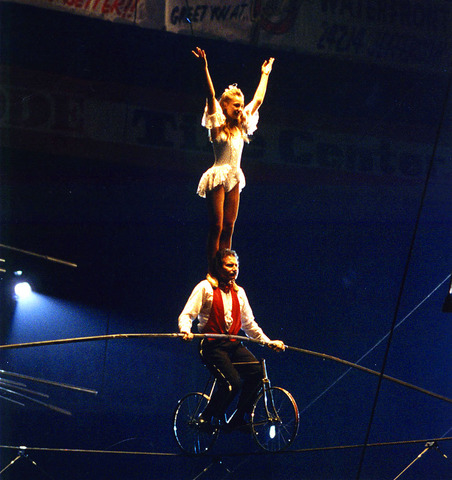
PHOTOS COURTESY OF KUANG HONG ARTS
In 1947, Karl Wallenda began building a circus of his own. It was also at this time that he created his death-defying Seven-Person Pyramid consisting of four men standing on a wire 10.5m in the air, two pairs yoked together by shoulder bars. On top of them stood two more men and at the pinnacle was a woman sitting and then standing on a chair. This feat, like all other acts on the tightrope, is performed without using any kind of safety net.
Tino Wallenda, who now leads the troupe, started out on the wire at the age of seven when his grandfather took him into his backyard, put a balance-pole in his hands, taught him how to place his feet, control his body and where to focus his eyes. By the age of 17, he was a full-fledged member of the troupe.
When he was young, all he could think about was performing and didn't think too much about the tradition that his grandfather had established.
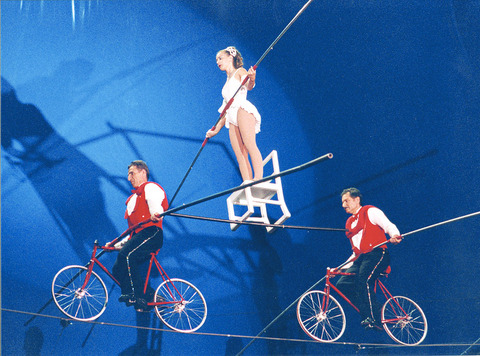
“The legacy that it involved didn't hit me until later on. It's like my kids right now: When you are younger you only want to perform. But now that I'm getting older, I've begun to realize the significance [of what I do],” he said in an interview with the Taipei Times.
The lineup of top-notch performers coming to Taipei will be overseen by Charley van Buskirk — a ring master complete with handle-bar mustache and black top hat — and includes trapeze artists, aerialists, trampoline acts along with jugglers and comedy clowns that perform on and off the high wire. A highlight of the show is the man who sets himself on fire 12m in the air and then dives into a small air mattress. And of course no Flying Wallenda performance would be complete without their Guinness World Record seven-person pyramid.
Tragedy strikes
The success of the family has also been marked by tragedy, most famously in 1962 when a pyramid collapsed in Detroit, leaving two performers dead and Mario Wallenda — Tino's uncle — paralyzed from the waste down. Family patriarch Karl Wallenda died in a 1978 fall from the wire in Puerto Rico.
Tino Wallenda searches carefully for an answer before commenting on these events.
"We learn from these experiences," he muses. "But we are also very strong — like my grandfather was — and there is a perfect saying: the show must go on."
But the circus itself is under threat.
"The level of circus has in some ways diminished because of the commercialism that is used. And so sometimes people have gone to see what they thought would be a quality circus and it was more of a promotional package that was sold to them and they got less than what they deserved. And so people get disappointed and don't want to come back to the circus," Wallenda said.
Compounding this was the development of the animal rights movement in the 1960s, which resulted in traditional circuses losing much of their appeal. As a consequence, circus performances began a gradual decline up until the 1970s when a new kind of circus began to emerge. Beginning at the end of that experimental decade, a new generation of circuses known as the New Circus — or Cirque Nouveau — began appearing in France.
New Circus
The new circus — most recently popularized by troupes such as Cirque du Soleil — features highly physical activities and no animal tricks. Known also as physical theater, many of these new circus groups have vague narratives that are closer to theater than the entertainment found in the traditional circuses. The island will have a chance to see this newer kind of circus performance beginning Oct. 27 with a festival called Spotlight on New Theater.
"The new circus in some ways feels that the traditional circus is inferior. But I always think that there is going to be room for the traditional circus," Wallenda said when asked about the differences between the two styles.
"But the thing about the new circus that is good is that it's brought a new interest to circus [overall]," he added.
Andrew Guild, a producer from the Great Moscow Circus agrees. "Today, [the] circus relies much more on human skills," he said in an email interview. "Circus is now an art form — in Russia it is likened to opera and ballet," he added.
The Great Moscow Circus has some of the world's best performers and, like the new theater, also has a line-up of world-class athletes.
"Some of our artists have performed at the Olympics," he said.
But their Taiwan performances have not been without controversy. Last week a conservation group called on the legislature to amend the law to ban animal shows in circuses.
But Guild pointed out that even though watching animals in circuses have gone out of vogue in certain quarters, "the people of Taiwan want to see performing animals." Guild is also at pains to express that animal cruelty is not something his circus condones.
"[The animals] have grown up in the circus. They are well cared for and loved by their trainers," he said.
Though the Flying Wallendas typically incorporate animals into their show, there will be none for their Taipei performance. Wallenda says this decision has nothing to do with activism, but rather is due to the logistics of getting them over to Taiwan.

In late October of 1873 the government of Japan decided against sending a military expedition to Korea to force that nation to open trade relations. Across the government supporters of the expedition resigned immediately. The spectacle of revolt by disaffected samurai began to loom over Japanese politics. In January of 1874 disaffected samurai attacked a senior minister in Tokyo. A month later, a group of pro-Korea expedition and anti-foreign elements from Saga prefecture in Kyushu revolted, driven in part by high food prices stemming from poor harvests. Their leader, according to Edward Drea’s classic Japan’s Imperial Army, was a samurai

The following three paragraphs are just some of what the local Chinese-language press is reporting on breathlessly and following every twist and turn with the eagerness of a soap opera fan. For many English-language readers, it probably comes across as incomprehensibly opaque, so bear with me briefly dear reader: To the surprise of many, former pop singer and Democratic Progressive Party (DPP) ex-lawmaker Yu Tien (余天) of the Taiwan Normal Country Promotion Association (TNCPA) at the last minute dropped out of the running for committee chair of the DPP’s New Taipei City chapter, paving the way for DPP legislator Su
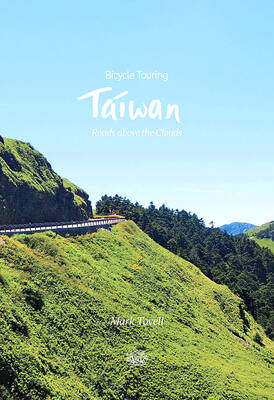
It’s hard to know where to begin with Mark Tovell’s Taiwan: Roads Above the Clouds. Having published a travelogue myself, as well as having contributed to several guidebooks, at first glance Tovell’s book appears to inhabit a middle ground — the kind of hard-to-sell nowheresville publishers detest. Leaf through the pages and you’ll find them suffuse with the purple prose best associated with travel literature: “When the sun is low on a warm, clear morning, and with the heat already rising, we stand at the riverside bike path leading south from Sanxia’s old cobble streets.” Hardly the stuff of your

Located down a sideroad in old Wanhua District (萬華區), Waley Art (水谷藝術) has an established reputation for curating some of the more provocative indie art exhibitions in Taipei. And this month is no exception. Beyond the innocuous facade of a shophouse, the full three stories of the gallery space (including the basement) have been taken over by photographs, installation videos and abstract images courtesy of two creatives who hail from the opposite ends of the earth, Taiwan’s Hsu Yi-ting (許懿婷) and Germany’s Benjamin Janzen. “In 2019, I had an art residency in Europe,” Hsu says. “I met Benjamin in the lobby


 RSS
RSS