


There was a time in Japan before television and radio when new businesses advertised their opening by using the catchy tunes of street musicians, who would parade around city streets banging drums and playing a variety of brass instruments.
Tapping into this tradition of street music, Cicala-Mvta (pronounced “Chicala Muta”) will be playing from their third album Ghost Circus tonight at Zhongshan Hall. Formed in 1994 by Wataru Ohkuma — who in an earlier incarnation played guitar in a punk rock band — Cicala-Mvta has revived chindon music by mixing it with jazz and processional styles.
The band's name means “mute cicada” and is written as the epitaph on the gravestone of Soeda Azembo, the greatest street singer-songwriter of popular music in Japan before the 1920s.
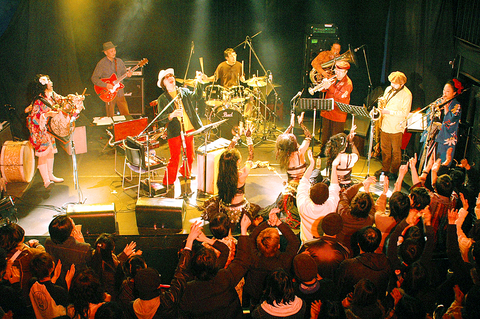
PHOTO COURTESY OF TAIPEI ARTS FESTIVAL
Cicala-Mvta's repertoire features a motley mixture of music inspired by the chindon drum, a kind of Japanese instrument played almost exclusively by women who would form part of a procession of saxophones and clarinets. Only occasionally featuring the chindon drum, Ohkuma's clarinet is ably accompanied by an unusual line-up of musicians, each bringing with them their own individual sounds to form an unlikely but cohesive unit.
Japan is, probably, the only Asian country that fully integrated Western musical styles. At the beginning of the Meiji period, the government instituted a policy of westernizing their military bands to develop a “civilized” musical culture by importing and teaching big band and New Orleans sounds. These military bands would then be employed by the government at ceremonies to open railroads and banks.
Private companies soon followed suit and by the early 20th century, street bands were popping up all over Japan to advertise the opening of new stores and entertainment halls. But the music became more localized once the government instituted anti-nuisance laws and advertising companies switched their revenue to newspaper and magazines.
Though street music was still used as a form of advertisement, the gradual popularity of mediums such as television and radio hastened the demise of this folk tradition in music.
Avoiding the advertising of any shop or pachinko parlor, Cicala-Mvta has revised the chindon tradition. Dressing in colorful and outlandish costumes, their updated renditions include the addition of their own arrangements of break-neck speed punk sounds piqued with a political edge that has audiences jumping from their seats.
Chindon has been officially ignored as an official musical style from Japan. Nevertheless, it remains one of Japan's most unique, colorful and accessible musical styles and is only kept alive by groups like Cicala-Mvta who believe that this vibrant music deserves to live on.
Cicala-Mvta will perform at Taipei's Zhongshan Hall (台北市中山堂), 98 Yenping S Rd, Taipei (台北市延平南路98號) tonight at 7:30pm. Tickets are NT$200 and can be purchased through www.artsticket.com.tw

Last week Joseph Nye, the well-known China scholar, wrote on the Australian Strategic Policy Institute’s website about how war over Taiwan might be averted. He noted that years ago he was on a team that met with then-president Chen Shui-bian (陳水扁), “whose previous ‘unofficial’ visit to the US had caused a crisis in which China fired missiles into the sea and the US deployed carriers off the coast of Taiwan.” Yes, that’s right, mighty Chen caused that crisis all by himself. Neither the US nor the People’s Republic of China (PRC) exercised any agency. Nye then nostalgically invoked the comical specter

April 15 to April 21 Yang Kui (楊逵) was horrified as he drove past trucks, oxcarts and trolleys loaded with coffins on his way to Tuntzechiao (屯子腳), which he heard had been completely destroyed. The friend he came to check on was safe, but most residents were suffering in the town hit the hardest by the 7.1-magnitude Hsinchu-Taichung Earthquake on April 21, 1935. It remains the deadliest in Taiwan’s recorded history, claiming around 3,300 lives and injuring nearly 12,000. The disaster completely flattened roughly 18,000 houses and damaged countless more. The social activist and

Over the course of former President Ma Ying-jeou’s (馬英九) 11-day trip to China that included a meeting with Chinese Communist Party (CCP) leader Xi Jinping (習近平) a surprising number of people commented that the former president was now “irrelevant.” Upon reflection, it became apparent that these comments were coming from pro-Taiwan, pan-green supporters and they were expressing what they hoped was the case, rather than the reality. Ma’s ideology is so pro-China (read: deep blue) and controversial that many in his own Chinese Nationalist Party (KMT) hope he retires quickly, or at least refrains from speaking on some subjects. Regardless

Approaching her mid-30s, Xiong Yidan reckons that most of her friends are on to their second or even third babies. But Xiong has more than a dozen. There is Lucky, the street dog from Bangkok who jumped into a taxi with her and never left. There is Sophie and Ben, sibling geese, who honk from morning to night. Boop and Pan, both goats, are romantically involved. Dumpling the hedgehog enjoys a belly rub from time to time. The list goes on. Xiong nurtures her brood from her 8,000 square meter farm in Chiang Dao, a mountainous district in northern Thailand’s


 RSS
RSS