


When talking to the editor-in-chief of Rhythms Monthly (經典雜誌) Wang Chih-hong (王志宏), it is hard to image that the soft-speaking, svelte gentleman in front of you is an intrepid traveler and international aid worker who has been living his life to the full, lending a helping hand to people in need around the world.
A legendary figure in the eyes of the adventurous, Wang began his long-term marriage to traveling as a photographer at the Earth Geographic Monthly (大地地理雜誌). Four years of journalism made Wang a global trekker, but he gradually grew weary of short trips that could only allow him to scratch the surface of the cultural and historic immensities of each destination. So he did what many people dream about but never dare to do: he quit his job and embarked on a journey to remote areas of the world.
“Social status is of no importance to me. I want to live my life on the ground and be true to myself so that I don’t have any regrets,” Wang said.
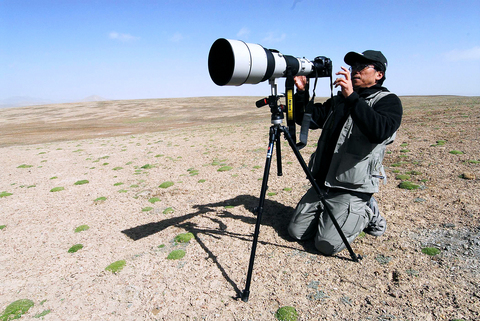
PHOTO COURTESY OF WANG CHIH-HONG
Young and fearless, Wang ventured deep into Tibet in 1990, an isolated region that was closed to foreigners, and began his decade-long journalistic project on the land and its people. As a volunteer for the China Exploration and Research Society, Wang had also thrown himself into conservation work in the remoter regions of China, spending his days counting yaks and endangered birds, or joining the society’s expeditionary survey on the ancient silk road in collaboration with the National Aeronautics and Space Administration.
Like a sponge absorbing everything he had seen along the way, Wang began to plan a project of his own. Even though five years of traveling in Tibet had given him enough material for a planned publication, the traveler felt there was something seriously lacking in his work. “The land had given me so much, and I felt it was my duty to give something back in return... . The nature of a journalist’s job is to get what is needed for his or her story and leave. But to me, that’s a form of exploitation,” Wang said.
Seeing how the lives of Tibetans on the remote Tibetan Plateau were seriously plagued by the lack of access to even the most basic medical treatment, Wang sought out professional support from doctor Chiu Jen-hui (邱仁輝). Together, they set up a medical training camp in 1995, funded by bank loans and donations from friends and family members. The pair trained Tibetans who were interested in becoming village doctors in remote mountain regions.
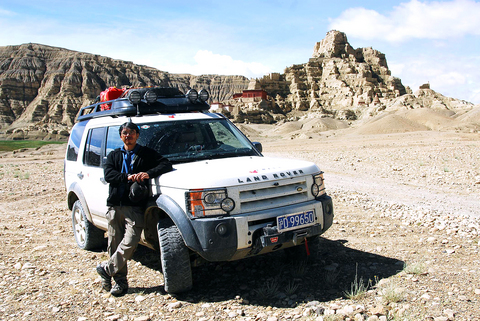
PHOTO COURTESY OF WANG CHIH-HONG
“The hardship the locals endure is unimaginable to people used to modern conveniences... . Take transportation for example, it often takes two days for a village doctor to reach his patients,” said Wang.
Now funded by the Friends of Tibet Society (財團法人中華藏友會), the project has trained over 200 village doctors who can provide medical aid and health services to isolated nomadic tribes.
The humanitarian returned to Taiwan in 1998 and established the award-winning Rhythms Monthly, a magazine funded by the Tzu Chi Cultural and Communication Foundation (慈濟傳播文化志業基金會). His return to the media seemed a natural move to Wang as he was always drawn to the idea of creating high-quality publications.
Hailed as Taiwan’s National Geographic, the monthly magazine positioned itself from the beginning as a pioneering medium that explores the world from a local perspective. “With backing from the nonprofit Tzu Chi foundation, we are free to do what the profit-driven media can’t; [that is] help to cultivate global viewpoints in the minds of our journalists and readers,” Wang said.
Years of preparation, researching and reporting need to go into the magazine’s annual reports on selected topics such as the epic sea voyage of Zheng He (鄭和) (1371-1435 AD) and the 19-year Silk Road voyage of the Tang Dynasty Buddhist monk Xuanzang (玄奘).
Following the routes taken by the two greatest explorers in Chinese history, the troupe of journalists and photographers were dispatched in small numbers across Asia and Africa. From China, India, Nepal to Central and Southern Asian countries, their lauded accomplishment not only served as an inspiration for the Discovery channel’s documentary on Zheng He’s sea voyage but led to several international touring exhibitions and picture-filled tomes.
“I have done it all myself so I also expect my colleges to meet high demands,” Wang said, adding that the most important rule of the game is to play it safe, even though the most experienced reporter can run into danger every now and then. “An editor-in-chief’s worst nightmare is to get a phone call in the middle of the night. And it happens,” Wang said.
The magazine has also conducted a comprehensive study on Taiwan’s history starting from the Austronesian culture dating as far back as 10,000 years. Large amounts of documents and publications in Europe from the 16th century to 18th century were examined to shed light on the island’s relation with Western world powers and China.
The magazines’ adventurers are also among the first ones to arrive in disaster zones and spend months doing follow-up reports on the regions. Taiwanese readers gained a better under-standing of humanitarian problems with first-hand reports on tsunami-ravaged Indonesia and Sri Lanka, earthquake-shaken Pakistan or hurricane-plagued New Orleans. Following the Tzu Chi Foundation’s international aid teams, journalists are able to enter countries and regions normally closed to the outside world, such as North Korea and Afghanistan under the Taliban.
“At Rhythms Monthly, I can feel more comfortable with my job as a journalist. Going to places with aid teams, we can be of some help and not just build our stories around other people’s suffering,” Wang said.
An explorer by nature, Wang never fails to find time in his busy schedule to answer requests from his life-long friend Wong How-man (黃效文) for expeditions. The magazine was the first medium in the world to call global attention to the dwindling numbers of endangered species in Tibet, particularly the Tibetan antelope, which inhabits the Tibetan Plateau.
Encountering untold misery and injustice during his travels, Wang certainly has had moments of despair but finds solace in the contributions he can make. “You can’t change the system but you can do small things to help,” Wand said. “And even if you fail, at least you can face yourself with a clear conscience. I know I will never become a good journalist, because whenever I see a person suffering, my first reaction is to put down the camera and help that person.”
It is a heartfelt reflection on the world from a humble humanitarian who has seen it all.

Last week Joseph Nye, the well-known China scholar, wrote on the Australian Strategic Policy Institute’s website about how war over Taiwan might be averted. He noted that years ago he was on a team that met with then-president Chen Shui-bian (陳水扁), “whose previous ‘unofficial’ visit to the US had caused a crisis in which China fired missiles into the sea and the US deployed carriers off the coast of Taiwan.” Yes, that’s right, mighty Chen caused that crisis all by himself. Neither the US nor the People’s Republic of China (PRC) exercised any agency. Nye then nostalgically invoked the comical specter

April 15 to April 21 Yang Kui (楊逵) was horrified as he drove past trucks, oxcarts and trolleys loaded with coffins on his way to Tuntzechiao (屯子腳), which he heard had been completely destroyed. The friend he came to check on was safe, but most residents were suffering in the town hit the hardest by the 7.1-magnitude Hsinchu-Taichung Earthquake on April 21, 1935. It remains the deadliest in Taiwan’s recorded history, claiming around 3,300 lives and injuring nearly 12,000. The disaster completely flattened roughly 18,000 houses and damaged countless more. The social activist and

Over the course of former President Ma Ying-jeou’s (馬英九) 11-day trip to China that included a meeting with Chinese Communist Party (CCP) leader Xi Jinping (習近平) a surprising number of people commented that the former president was now “irrelevant.” Upon reflection, it became apparent that these comments were coming from pro-Taiwan, pan-green supporters and they were expressing what they hoped was the case, rather than the reality. Ma’s ideology is so pro-China (read: deep blue) and controversial that many in his own Chinese Nationalist Party (KMT) hope he retires quickly, or at least refrains from speaking on some subjects. Regardless

Approaching her mid-30s, Xiong Yidan reckons that most of her friends are on to their second or even third babies. But Xiong has more than a dozen. There is Lucky, the street dog from Bangkok who jumped into a taxi with her and never left. There is Sophie and Ben, sibling geese, who honk from morning to night. Boop and Pan, both goats, are romantically involved. Dumpling the hedgehog enjoys a belly rub from time to time. The list goes on. Xiong nurtures her brood from her 8,000 square meter farm in Chiang Dao, a mountainous district in northern Thailand’s


 RSS
RSS