


If the title appears grandiloquent, it is meant to be. This is not so much a history as a call to arms. Andrew Roberts has clothed himself in the mantle of Winston Churchill and picks up where Churchill left off. The united phalanx of the US, Britain, Canada, Australia and New Zealand, he declaims, has saved the world in “one overall, century-long struggle between the English-speaking people’s democratic pluralism and fascist intolerance of different varieties”: Prussian imperialism, Nazism, Soviet communism and now the “feudal, theocratic, tribal, obscurantist” challenge of Islamic fundamentalism.
The English-speaking peoples are invoked against the unreliability of everybody else. This is the sort of history that makes Arthur Bryant read like an academic monograph. Roberts’s message is simple: when the English-speaking peoples stand side by side, history has a happy ending; when they do not, civilization is threatened. The greatest threat has always been the rot within — liberals, churchmen, intellectuals, whose introspection tempts right-minded people to doubt their own moral worth.
This is an exasperating book. Roberts writes with all the popular verve of the best narrative historian. His account is peppered with arresting might-have-beens; if the Treaty of Versailles had dismembered Germany in 1919, would Nazism have taken root? If the Ottoman Empire had not been similarly dismembered, would the Middle East be the mess it is today?

Roberts is eloquent on the great moments of courage and defiance by presidents and prime ministers and by many other now forgotten men — except for Margaret Thatcher, there is scarcely a woman mentioned — in the desperate circumstances of his grand narrative.
He has gathered a wealth of surprising detail: Winston Churchill never visited Australia; in 1945, a B25 bomber flew into the Empire State Building, but it did not collapse. This could have been a fascinating history analyzing the strengths, tensions and ambiguities in the relationships between the cultures of the English-speaking world. However, Roberts has overlaid his narrative with a relentless, coarse polemic that diminishes the argument he seeks to make.
In his pantheon, the only English virtues that count are those that march to the colors of the full-blooded, neoconservative global nationalism of US Secretary of Defense Donald Rumsfeld and US President George W. Bush. Liberal and social democratic values, and much of the US democratic tradition, are swept up into a mocking condemnation of all that has weakened the virility of the Anglosphere’s destiny. Hence the Beveridge Report, published as El Alamein turned the tide of war, introduced the bacillus of the welfare state and Clement Attlee, in victory, destroyed Britain’s hopes of recovery by implementing it. Roberts rightly lampoons those who claim a moral equivalence between the terrors of Mao and Stalin and the abuses of the West. He then uses this argument perversely to shrug off Guantanamo Bay and Abu Ghraib. He remains blind to the damage they have caused to the moral credibility of the very values he espouses. At no point does he consider whether the Bush presidency may in itself be an aberration threatening a political culture that has secured the links between liberal democracies across the Atlantic and Pacific.
At times, Roberts reads like 1066 and All That, without the jokes. People are either “disgraceful” or “noble.” Good things include Teddy Roosevelt, Kipling, Reagan, General Pinochet, Nixon, Blair, Thatcher, Eisenhower, Ulstermen generally and the inventiveness of the English-speaking people in creating penicillin and lethal weapons systems. Bad things are Lloyd George (good at war, bad at peace), Wilfred Owen, the French, the Irish (in the First World War, with justification), Keynes, Heath, Wilson, Carter, Clinton, the UN, the EU, Hollywood, Gandhi, Princess Diana and Mountbatten.
This is a dreadful pity because, when Roberts seriously thinks through the dilemmas facing the last generation of British imperialists as they came to terms with their need for American support and the inevitable ceding of power that entailed, his history comes to life. His portrait of Lord Lansdowne, the great Whig grandee who, in 1917, decided that there should be a negotiated peace with Germany to stop the slaughter, captures the central dilemma of the war. Roberts accords Neville Chamberlain the seriousness he deserves. He picks open Churchill’s private conflicting feelings about the US.
Roberts’ other great enemy is Europe. Britain, acting as “an abusive parent” to the Common-wealth, entered the former European Economic Community in 1972, under the “moral cowardice” of Heath, in “the dour, drab defeatist Seventies.” His subtext seems to be that British foreign policy should return to a version of the “splendid isolation” of 1900, but in partnership with American global isolationism.
In many ways, Roberts has written a most unEnglish book. Its rhetorical insistence — “In the last century, the Union Jack has flown on Everest and the Stars and Stripes on the Moon” — drowns out the reasoned and discriminating judgments, the measured understanding of the other sides’ perspective, that are the best of English virtues.
For those of us who believe that the Enlightenment values that have held Europe and America together for 400 years remain our best defense in the struggle with Islamic terrorist unreason, Roberts should not be permitted so crudely to limit the debate to either signing up to the Bush crusade or accepting the white feather.
The challenge ahead for the English-speaking peoples, and for many others, is too serious for that.
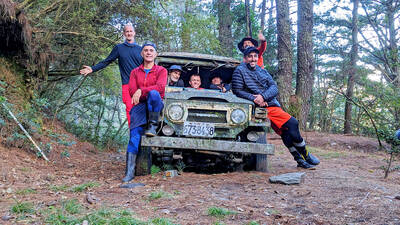
The year was 1991. A Toyota Land Cruiser set out on a 67km journey up the Junda Forest Road (郡大林道) toward an old loggers’ camp, at which point the hikers inside would get out and begin their ascent of Jade Mountain (玉山). Little did they know, they would be the last group of hikers to ever enjoy this shortcut into the mountains. An approaching typhoon soon wiped out the road behind them, trapping the vehicle on the mountain and forever changing the approach to Jade Mountain. THE CONTEMPORARY ROUTE Nowadays, the approach to Jade Mountain from the north side takes an

Last week Joseph Nye, the well-known China scholar, wrote on the Australian Strategic Policy Institute’s website about how war over Taiwan might be averted. He noted that years ago he was on a team that met with then-president Chen Shui-bian (陳水扁), “whose previous ‘unofficial’ visit to the US had caused a crisis in which China fired missiles into the sea and the US deployed carriers off the coast of Taiwan.” Yes, that’s right, mighty Chen caused that crisis all by himself. Neither the US nor the People’s Republic of China (PRC) exercised any agency. Nye then nostalgically invoked the comical specter

Relations between Taiwan and the Czech Republic have flourished in recent years. However, not everyone is pleased about the growing friendship between the two countries. Last month, an incident involving a Chinese diplomat tailing the car of vice president-elect Hsiao Bi-khim (蕭美琴) in Prague, drew public attention to the People’s Republic of China’s (PRC) operations to undermine Taiwan overseas. The trip was not Hsiao’s first visit to the Central European country. It was meant to be low-key, a chance to meet with local academics and politicians, until her police escort noticed a car was tailing her through the Czech capital. The
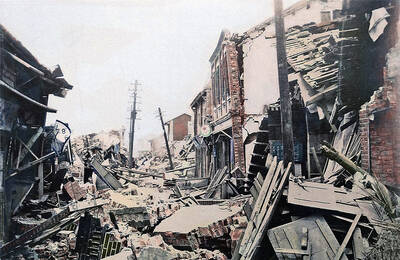
April 15 to April 21 Yang Kui (楊逵) was horrified as he drove past trucks, oxcarts and trolleys loaded with coffins on his way to Tuntzechiao (屯子腳), which he heard had been completely destroyed. The friend he came to check on was safe, but most residents were suffering in the town hit the hardest by the 7.1-magnitude Hsinchu-Taichung Earthquake on April 21, 1935. It remains the deadliest in Taiwan’s recorded history, claiming around 3,300 lives and injuring nearly 12,000. The disaster completely flattened roughly 18,000 houses and damaged countless more. The social activist and


 RSS
RSS