


The fragmentation that has characterized Italy’s politics since its late-19th-century unification has characterized its cuisine for much longer. Travel around the country and it’s hard not to be floored by the incredible differences in food from one area — sometimes one town — to another. This is especially true in regions as diverse as Emilia-Romagna — home of parmigiano, prosciutto and aceto balsamico, and blessed with good soil, a favorable climate and flat topography — or Sicily, starkly Mediterranean but a place where the strong influences of North Africa and the Middle East created a cuisine that isn’t seen anywhere else in the world.
Talk of subtle gradations in Italian food is even something of a sport among obsessive-compulsive travelers, who might spend hours engaged in friendly one-upmanship over exactly where to find exactly which near-perfect dish. They might have stumbled on the quintessential Neapolitan pizza, or an extraordinary linguine with clams at a hole in the wall in Rome, or the best farinata in Genoa.
Curiously, it’s the country’s most popular tourist region — Tuscany — where the food can be least interesting. Most of the region is landlocked, more extreme in its climate than much of the country, suitable for growing grapes and certainly olives, but not great for extensive agriculture. Historically, the mountainous terrain made trade and communication between villages difficult, limiting the spread of ingredients and of ideas about cooking. So visitors to glorious Firenze eat steak and wonder what’s next.
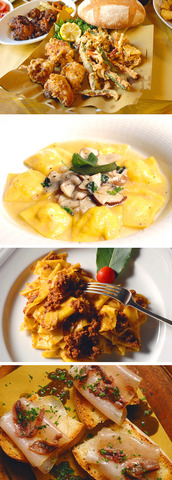
PHOTO: NY TIMES NEWS SERVICE
What’s next is Lucca. Its food is among Italy’s most compelling — almost certainly the best in Tuscany — and the town is a draw in its own right. Enclosed by walls whose broad tops look out over the town’s lovely towers and broad, calm piazzas on one side and park grounds on the other, Lucca may not have the perfectly medieval feeling of Siena, but neither does it have the crowds. Although it gets its share of tourists, it almost never feels overrun.
The difference between food in Lucca and the rest of the region is perhaps best epitomized by one of the town’s most representative dishes, tortelli lucchese. In Italy, you can determine a region’s historical affluence by the dominant type of pasta. Flour and water, perhaps with some oil, produced a bleak-colored pasta made by poor people. Flour with a few eggs, yielding a pale yellow pasta, was the pasta of the not-so-poor. Flour with a lot of eggs — creating a brilliant yellow — was for the wealthy.
Tuscan pasta was almost never made with eggs, which made it closer in spirit to Italy’s south than its north. But Lucca, with banking and a robust silk trade, had money, which explains why its food is better than that in the rest of Tuscany. Not surprisingly, tortelli lucchese is bright yellow pasta, stuffed with seasoned meat and topped with a heavily meat-laden ragu. Talk about rich!
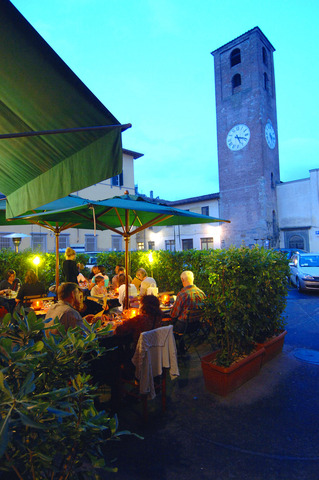
PHOTO: NY TIMES NEWS SERVICE
Most restaurants in Lucca offer not only tortelli lucchese but also the other local specialties: a soup of farro (a barleylike grain) with beans; fried everything; rabbit in many forms; and baccala (salt cod). Things have not changed much; the Lucchese remain set in their ways. For the most part, the bread is still unsalted. (If you have never eaten unsalted bread, consider yourself blessed; it’s dull and flat-tasting. Fortunately, many places serve salted focaccia along with it.) And some foods are eaten only one way: My friend Ed Schneider, dining at Ristorante Giglio, started to put lemon on a piece of grilled baccala, and a waiter swooped down on him, grabbed the lemon, and explained that it was there only “for idiots.” Schneider was instructed to eat his salt cod with lots of oil and lots of black pepper, as the locals do.
Culinary tour
In an attempt to give an overview of Luccan fare, I’ve chosen restaurants that I believe execute local specialties best, but they’re not the only options.
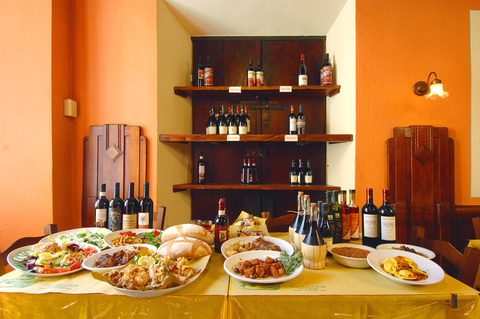
PHOTO: NY TIMES NEWS SERVICE
Nor are restaurants the only places to eat: Santini, in the Piazza Citadella, is a world-class gelateria (and a better bet than the dessert offerings in most restaurants). You can buy torta con becchi (bird’s beaks, because of the peaked shape of the crusts), in many bakeries; these can be made with almost anything, though they’re usually seen with either chard or chocolate (sometimes both). Buccellato, the raisiny, eggy sweet bread, is also good for a snack.
But though tradition is important here, it isn’t everything, as La Mora demonstrates nicely. This is clearly a Luccan restaurant, but the chef — who worked in New York at Osteria del Circo and Le Cirque in 1999 and 2000 — carefully takes a few liberties, and they work. In a city where every restaurant offers essentially the same dishes, I found it delightful that one played around a bit.
This is probably not, however, the reason La Mora is widely considered the best restaurant in the area of Lucca. The explanation for that probably lies with its precise execution, more formal (and generally efficient) service, and fancy linens and tableware. Though there’s a certain stiffness that comes with all of this, there is little pretension, and it feels luxurious to get away from the plastic tablecloths that so often accompany authenticity in Italy. Furthermore, there are other features about La Mora that I like: the little garden and the open back room (which is where almost everyone sits, avoiding the more formal internal dining room).
The food, however, is the focus, and it’s quite terrific. I was inclined to enjoy it at once, because the bread contains salt, a heretical act that makes everyone except true Tuscans ecstatic. But in an area where frying is a sacred act, La Mora does it exceptionally well, as evidenced by the delicate zucchini flowers and baccal fritters. Fritto misto of lamb, rabbit and vegetables employed three frying techniques, one resembling tempura (used for the vegetables), one with bread crumbs (the lamb, whose flavor was exceptional) and one that used a heavier batter (for the mild rabbit), all to good effect. A more traditional fritto misto of tiny squid, large shrimp, fresh sardines and rouget was also nearly perfect.
La Mora’s pasta dishes reach back into local traditions and also explore those of what might be called greater Tuscany. It’s not unusual to see Luccan menus that eschew seafood entirely, but La Mora not only offers (in season) an ancient dish of fresh taglietelle with baby eels, tomato and pepolino (a variety of thyme), but pasta with a tomato-octopus sauce, too. Ravioli stuffed with spinach and cheese were served with a delicious marjoram sauce, and maltagliate (badly cut) pasta was served with a tomato sauce with rabbit and plenty of Parmesan. All of these were carefully prepared and wonderfully seasoned.
Other dishes were almost uniformly appealing: simply grilled squid on arugula was doused with an olive oil so good I would gladly have downed a glass; fresh shrimp, barely steamed, were given the same treatment. A plate of pork had the unmistakable taste of boar (many local breeds are half-and-half). It was fatty and salty to very good effect, and served with cavalo nero (black cabbage, a true delicacy) and some wild fennel. Squab with spinach, pine nuts and raisins was topped, as squab almost always is, with a too-sweet demi-glace, but the spinach itself was incredible.
Back in the city proper, Ristorante Giglio offers the best combination of authentic food, pleasant surroundings and professional service I’ve found. The inside room — which is where the locals seem to prefer to sit, perhaps the better to avoid us tourists — is formal, with a look that’s a hundred years old. I suppose it has a certain charm, and the linens are finer and chandeliers sparkle, but it feels like faded splendor to me.
The outside scene, in contrast, is gorgeous. The piazza (del Giglio) is one of Lucca’s most open and lovely, and the covered patio boasts tables set with real linens. There’s a decent wine list, and the service is professional but not wooden; in fact, as my friend Ed’s anecdote indicates, it’s quite personal.
Of the three pasta dishes I sampled, all were worth recommending, but especially the ultrayellow pasta with fresh porcini, a real treat, and the unusual farro-based pasta with rabbit.
The grilled salt cod with pepper (no lemon was even offered) was delicious, though the accompanying chickpeas were flat and unexciting. Simply grilled cuttlefish with a side of lavishly buttered spinach was better. Beef tenderloin, a cut that is frequently dull and flavorless, was exceptional, no less so for the big fat porcini mushroom served on top and the accompanying dish of roasted potatoes, omnipresent in this city but better here than elsewhere.
Since it is a “ristorante,” I wasn’t surprised by the quality of Giglio’s service; the next three places are all trattorias, which means, essentially, that they’re inexpensive (or should be), the service may be friendly, but it’s as casual as that at your local diner, and the appointments are minimal.
Still, the food at trattorias can be terrific, and it is here that you find the nearly unadulterated soul of local food, just as you do at their cousins throughout Italy. Figure, on average, 25 euros (about US$33) a person for three or four courses, with local wine and bottled water.
Da Francesco and Gigi are both reliable favorites located in pleasant little piazzas. Gigi is on Piazza del Carmine — near the ancient amphitheater and a beautiful clock tower (making it easy to find) — where there’s barely any traffic at night, either vehicular or foot, so the exterior seating is delightful. Though it’s completely simple, Gigi’s interior is better lighted and in general better looking than those of the other restaurants here.
The trattoria itself has become a little younger, hipper and less working-class than it once was; I fondly remember watching the World Cup matches on its outdoor television four years ago, but the TV has been removed. The food may be a little less compelling than it once was, too, though it’s still pretty good. Crostini with lardo and anchovies — a kind of Tuscan version of surf and turf — was super, the anchovies piercing right through the fat; other crostini were good as well. Some pasta dishes are unexciting, but others, especially the inspired little dishes like macaroni with zucchini and pine nuts, and a couple variations on the classics, like orecchiette with sausage and Gorgonzola, really work. Papa al pomodoro, a bread-thickened tomato soup (or tomato-thinned bread soup), is soothing and, in summer, when it is offered, flavorful.
Gigi’s pollo al mattone — chicken under a brick, a split, flattened, perfectly browned and crisped chicken, barely seasoned — can be just average or exemplary; it’s worth a shot. Their fried food is usually excellent, so if nothing else you should order a plate of fried vegetables on the side.
Simplicity with style
Other than the fact that it’s less good-looking, I have fewer qualifications about Da Francesco, where the food is just plain great. The tortelli lucchese here were the best I have had (and I have eaten them all over town); you should sample them once to understand the relative opulence of Lucca’s cuisine. The farro soup with beans is also classic and neatly executed. Even simple roasted meats are worth trying here, and though the presentation is not elegant, when you get a plate of baby lamb containing a piece of leg, breast and loin, all lightly seasoned with salt, pepper, thyme, garlic and olive oil, for about US$15, and you think of paying US$40 for the same thing in Manhattan, you’ll glow. Rabbit roasted with hot peppers — again, with pieces from all parts of the animal — was also delicious.
Another plus here: the staff members were, on my last two visits, incredibly friendly, patient with broken Italian or willing to speak English and eager to explain the various dishes on the menu.
Finally, there is Da Leo, a great-looking place featuring a carved wood interior (there is no outside seating here), lovely wainscoting and an eclectic assortment of art including wood block prints and some older black-and-white photographs, all in a very chummy atmosphere, the kind where everyone claps when a birthday cake is brought out from the kitchen.
Of these three trattorias, this is the one with the most uneven cooking. Bean soup with farro and olive oil, farfalle with Gorgonzola and arugula, and pork ribs (or shank) with roasted potatoes were all good examples of the straightforward home-style cooking for which people love this place. If you hit it right, Da Leo can be a lot of fun, but I’d save it for last on this list: Elsewhere in Tuscany, I’d be pushing you to go there. In Lucca, it’s an also-ran.

In late October of 1873 the government of Japan decided against sending a military expedition to Korea to force that nation to open trade relations. Across the government supporters of the expedition resigned immediately. The spectacle of revolt by disaffected samurai began to loom over Japanese politics. In January of 1874 disaffected samurai attacked a senior minister in Tokyo. A month later, a group of pro-Korea expedition and anti-foreign elements from Saga prefecture in Kyushu revolted, driven in part by high food prices stemming from poor harvests. Their leader, according to Edward Drea’s classic Japan’s Imperial Army, was a samurai

Located down a sideroad in old Wanhua District (萬華區), Waley Art (水谷藝術) has an established reputation for curating some of the more provocative indie art exhibitions in Taipei. And this month is no exception. Beyond the innocuous facade of a shophouse, the full three stories of the gallery space (including the basement) have been taken over by photographs, installation videos and abstract images courtesy of two creatives who hail from the opposite ends of the earth, Taiwan’s Hsu Yi-ting (許懿婷) and Germany’s Benjamin Janzen. “In 2019, I had an art residency in Europe,” Hsu says. “I met Benjamin in the lobby
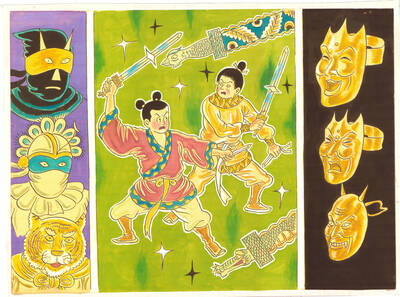
April 22 to April 28 The true identity of the mastermind behind the Demon Gang (魔鬼黨) was undoubtedly on the minds of countless schoolchildren in late 1958. In the days leading up to the big reveal, more than 10,000 guesses were sent to Ta Hwa Publishing Co (大華文化社) for a chance to win prizes. The smash success of the comic series Great Battle Against the Demon Gang (大戰魔鬼黨) came as a surprise to author Yeh Hung-chia (葉宏甲), who had long given up on his dream after being jailed for 10 months in 1947 over political cartoons. Protagonist

A fossil jawbone found by a British girl and her father on a beach in Somerset, England belongs to a gigantic marine reptile dating to 202 million years ago that appears to have been among the largest animals ever on Earth. Researchers said on Wednesday the bone, called a surangular, was from a type of ocean-going reptile called an ichthyosaur. Based on its dimensions compared to the same bone in closely related ichthyosaurs, the researchers estimated that the Triassic Period creature, which they named Ichthyotitan severnensis, was between 22-26 meters long. That would make it perhaps the largest-known marine reptile and would


 RSS
RSS