


The most original and thought-provoking insights in The Greatest Story Ever Sold: The Decline and Fall of Truth from 9/11 to Katrina, Frank Rich’s meticulously researched chronicle of the Bush administration’s exploits, come in his searing analysis of the role that the “new mediathon” has played in the demise of fact-driven public discourse.
In a lengthy examination of the jingoistic, pro-Pentagon reporting on the early days of the Iraq war, Rich notes that “about the only discouraging words to be found in the American mass media about America’s instant victory in Iraq was on a basic cable channel, Comedy Central.”
Jon Stewart, the host of Comedy Central’s Daily Show, wins Rich’s praise for finding laughs by “taking the facts of a news story more seriously than real TV journalists did,” as when he called the list of US allies the “Coalition of the Piddling” while conventional news media “mindlessly parroted” the Pentagon’s preferred tags, “coalition forces” or “Coalition of the Willing.” “What we do, I almost think, is adorable in its realism,” Rich quotes Stewart as saying. “It’s quaint.”
In his book, Rich, an op-ed columnist for the New York Times and a liberal icon whose writings enthuse Bush bashers everywhere, indicts this presidency for a slew of public relations hat tricks he calls “fictional realities” designed to “accomplish a variety of ends, the most unambiguous of which was to amass power and hold on to it.”
But while US President George W. Bush’s political gurus will likely quibble with certain items in Rich’s bill of particulars — notably, his “wag the dog” theory of the 2003 invasion of Iraq as mostly a scheme for Bush to run for re-election as a “vainglorious ‘war president”’ — they have every reason to gloat in response to this recitation of their tactical maneuvers. After all, so much of what Rich details — and deplores — worked well for the Bush White House, at least in winning the short-term gains they were seeking in each of the episodes presented.
The truly cynical political operator, whether Republican or Democrat, could read this book as a manual for how to use deception, misinformation and propaganda to emasculate your enemies, subdue the news media and befuddle the public, and not as the call to arms for truth that Rich seeks to provide.
When he sets his jeweler’s eye upon the so-called Swift-boating of the 2004 Democratic presidential nominee John Kerry, for instance, future candidates for office get point-by-point instruction on how to turn a campaign liability into an asset: In this case, how someone with no combat experience can successfully run on national security issues against someone who was actually shot on the battlefield.
Rich asserts that the Bush camp, “so brilliant at creating fictional stories for their own man,” managed to “create a fictional biography for Kerry” that offset the stories of his heroism as captain of a Swift boat in Vietnam, leaving the war hero “stripped of his medals — so that he would be on the same footing as a president whose Vietnam service consisted of sporadic participation in the Texas ‘cham-pagne unit’ stateside.”
The gambit, of course, worked. The president won re-election in 2004, thanks in no small measure to the seeding of doubts about one of Kerry’s major assets in that wartime campaign: his own combat record.
This book is destined to enjoy a healthy shelf life for anyone ever needing a reference or citation to the dates, names and places for the Bush presidency’s many triumphs in marketing itself and the war in Iraq. Rich’s criticism of the legitimacy of those achievements is harsh, which will please the president’s critics.
He writes in his introduction that the book is “not intended to be a harangue” against Bush. But he provides ample fodder for anti-Bush haranguers and a steady supply of personal put-downs, like his claim that “the only really daring move in Bush’s entire adult life was to fire Bobby Valentine as manager of the Texas Rangers.”
The occasional ad hominem asides — referring to Bush as a “glad-handing salesman,” a “spoiled brat” and a “rich kid who used his father’s connections to escape Vietnam” — will delight the Bush haters among Rich’s fan base, but tend to undermine the often eloquent conclusions that he draws from his own raw material.
That’s too bad. The reader could more willingly go along with Rich’s conclusions that Bush has “lost the public” and “lost the war of ideas” in the struggle against radical Islam if Rich’s disdain for the president as a person were less obvious, and if he occasionally gave Bush credit for some of his initiatives.
Of all those he skewers for contributing to the “decline and fall of truth” in the selling of the war in Iraq, Rich goes easiest on the American people, writing that they had “a better excuse than the smart guys within the Beltway” because “Americans always love a good story.” He says that after the Sept. 11, 2001, attacks on American soil it was “not all that easy to resist” an administration willing to sell a scary story “with brilliant stagecraft and relentless pacing.”
Still, Rich ends his book by urging Americans to reject the pervasive culture of blurred lines between truth and fiction, or to risk being “exploited by another master manipulator from either political party.” If the public does not heed Rich’s warnings, perhaps the news media will answer his call for coverage that more aggressively separates fiction from reality as a step toward a more truthful civic life.

Last week Joseph Nye, the well-known China scholar, wrote on the Australian Strategic Policy Institute’s website about how war over Taiwan might be averted. He noted that years ago he was on a team that met with then-president Chen Shui-bian (陳水扁), “whose previous ‘unofficial’ visit to the US had caused a crisis in which China fired missiles into the sea and the US deployed carriers off the coast of Taiwan.” Yes, that’s right, mighty Chen caused that crisis all by himself. Neither the US nor the People’s Republic of China (PRC) exercised any agency. Nye then nostalgically invoked the comical specter
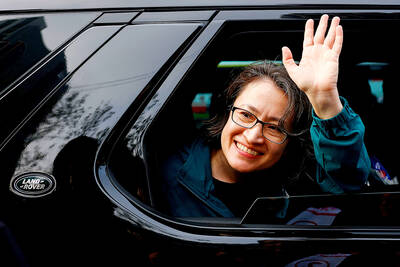
Relations between Taiwan and the Czech Republic have flourished in recent years. However, not everyone is pleased about the growing friendship between the two countries. Last month, an incident involving a Chinese diplomat tailing the car of vice president-elect Hsiao Bi-khim (蕭美琴) in Prague, drew public attention to the People’s Republic of China’s (PRC) operations to undermine Taiwan overseas. The trip was not Hsiao’s first visit to the Central European country. It was meant to be low-key, a chance to meet with local academics and politicians, until her police escort noticed a car was tailing her through the Czech capital. The
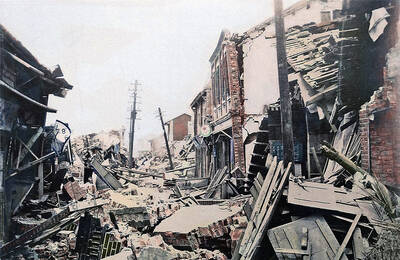
April 15 to April 21 Yang Kui (楊逵) was horrified as he drove past trucks, oxcarts and trolleys loaded with coffins on his way to Tuntzechiao (屯子腳), which he heard had been completely destroyed. The friend he came to check on was safe, but most residents were suffering in the town hit the hardest by the 7.1-magnitude Hsinchu-Taichung Earthquake on April 21, 1935. It remains the deadliest in Taiwan’s recorded history, claiming around 3,300 lives and injuring nearly 12,000. The disaster completely flattened roughly 18,000 houses and damaged countless more. The social activist and

Over the course of former President Ma Ying-jeou’s (馬英九) 11-day trip to China that included a meeting with Chinese Communist Party (CCP) leader Xi Jinping (習近平) a surprising number of people commented that the former president was now “irrelevant.” Upon reflection, it became apparent that these comments were coming from pro-Taiwan, pan-green supporters and they were expressing what they hoped was the case, rather than the reality. Ma’s ideology is so pro-China (read: deep blue) and controversial that many in his own Chinese Nationalist Party (KMT) hope he retires quickly, or at least refrains from speaking on some subjects. Regardless


 RSS
RSS