


Latin America, as the late Venezuelan author Carlos Rangel once wrote, has always had a “love-hate relationship” with the US. The love is expressed in its purest form: imitation. The hate, more akin to resentment, boils down to a frustrated desire to get the Yanquis’ attention.
Fidel Castro pulled it off in the 1960s, torturing the Kennedy brothers with his cigar and his Marxism, and now, in Venezuela, Hugo Chavez is giving us a rerun. At least, this is the refrain of Nikolas Kozloff, a British-educated American who has written Hugo Chavez: Oil, Politics, and the Emerging Challenge to the United States.
Kozloff apparently believes that Americans have much to fear from Venezuela. His admiring study of Chavez, an up-by-the-bootstraps lieutenant colonel who tried and failed to take power in a coup and subsequently succeeded at the ballot box, is peppered with phrases like “in an alarming warning sign for George Bush,” and, “in an ominous development for American policymakers.”
Why does Kozloff think, as stated on the book jacket, that Venezuela represents a “potentially dangerous enemy to the United States?” Caracas is our fourth-biggest oil exporter, so maybe some day, the implication is, it could cut us off.
And Chavez, with his friend you-know-who in Cuba, has taken to taunting America and lobbying other Latin American countries against the brand of free-trade liberalism that Washington has advocated. Chavez has even been trying to form an energy alliance with Argentina and Brazil, for the ostensible purpose of using oil as a “weapon” against the gringos, and he has refused to permit US overflights in the war against cocaine.
Is this really worth getting all steamed up about? I lived in Venezuela during the 1970s, also a period of high oil prices and, not coincidentally, a time when the government was strutting its stuff as a regional (and vaguely anti-capitalist) power. Getting America to worry, or at least to care, was a high priority, as I realized when a friendly Venezuelan reporter eagerly asked me which of two left-wing political parties Americans “feared the most.”
One of these parties was known by the acronym MIR and the other as MAS. The truth was that no Americans I knew had heard of either. My own relatives could barely distinguish Venezuela from Colombia or Peru. I didn’t say that, of course. The local journalists were unfailingly kind to me, and I had no wish to hurt their feelings. I allowed, “I guess we fear each of them about the same.” Anyway, in a few years, the price of oil collapsed, and the posturing from Caracas went with it.
Kozloff will perhaps appreciate the personal anecdote because his book is replete with the same. He lets us in on his travels, Jack Kerouac-style, so we are with him when he is hiking in the Andes, observing rural poverty, or acquainting himself with indigenous tribes. Then the author is back in England, where he joins an “anti-capitalist May Day protest,” at which one of his confreres deface a statue of Winston Churchill. Then he is watching Chavez on TV, then protesting against globalism, then, in 2000, doing research for his dissertation in Caracas. He watches Al Gore and US President George W. Bush on the tube, cannot see much difference between them and casts his lot with Ralph Nader.
As for Chavez, the author portrays him, convincingly, as a soldier indignant about the moral flabbiness and corrupt ways of the career politicians he replaced. We learn that Chavez’s antipathy toward American culture stems, in some measure, from his partly Indian blood lines. So it is that Chavez has rechristened Columbus Day “Indigenous Resistance Day.” Resistance to what? He is no fan of liberal economics, free trade, cross-border investment, the prescriptions of the International Monetary Fund nor, indeed, of capitalism itself.
This is all well and good with Kozloff. His analysis is essentially Marxist, ie., he sees trade as a one-way street that helps the rich and hurts the poor. His book is filled with the sort of new-lefty rhetoric I had thought went out in the 1970s. He applauds the Venezuelan president’s idea for an alternative trade association — meaning one not aligned with the US — that, in Chavez’s tedious phraseology, would be a “socially oriented trade bloc rather than one strictly based on the logic of deregulated profit maximization.”
But neither Kozloff nor Chavez can escape the fact that the 1970s are over. Socialism hasn’t worked; it’s kaput. Free-market medicine (which Kozloff refers to by the more sinister-sounding “neo-liberalism”) hasn’t always worked, but it’s worked better than anything else.
And in fact, Kozloff’s fantasy of an America threatened by left-wing Latins is a vestige of a world that was dominated by a Moscow-Washington rivalry — a world that no longer exists. The only way Venezuela could truly stop supplying the US with oil (which trades in a global market) would be to stop selling it to everyone, which isn’t in the cards.
The right question is not what America has to fear from Chavez, but what Venezuelans have to fear from Chavez. The answer would seem to be plenty. He has militarized the government, emasculated the country’s courts, intimidated the media, eroded confidence in the economy and hollowed out Venezuela’s once-democratic institutions.
Chavez’s rhetoric has provided a pleasing distraction to the country’s poor, but it has not eradicated poverty. The real riddle of Venezuela today, as it was a generation ago, is why, despite its bountiful oil reserves, its fertile plains and its democratic traditions, it has been persistently unable to make an economic leap similar to that of Chile or of the various success stories in Asia. And writers who serve as cheerleaders for the failed idea of blaming America are anything but Venezuela’s friends.
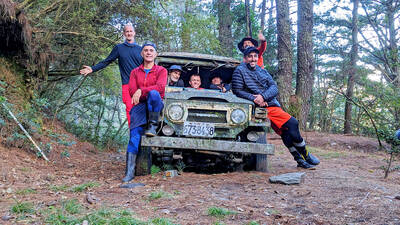
The year was 1991. A Toyota Land Cruiser set out on a 67km journey up the Junda Forest Road (郡大林道) toward an old loggers’ camp, at which point the hikers inside would get out and begin their ascent of Jade Mountain (玉山). Little did they know, they would be the last group of hikers to ever enjoy this shortcut into the mountains. An approaching typhoon soon wiped out the road behind them, trapping the vehicle on the mountain and forever changing the approach to Jade Mountain. THE CONTEMPORARY ROUTE Nowadays, the approach to Jade Mountain from the north side takes an

Last week Joseph Nye, the well-known China scholar, wrote on the Australian Strategic Policy Institute’s website about how war over Taiwan might be averted. He noted that years ago he was on a team that met with then-president Chen Shui-bian (陳水扁), “whose previous ‘unofficial’ visit to the US had caused a crisis in which China fired missiles into the sea and the US deployed carriers off the coast of Taiwan.” Yes, that’s right, mighty Chen caused that crisis all by himself. Neither the US nor the People’s Republic of China (PRC) exercised any agency. Nye then nostalgically invoked the comical specter
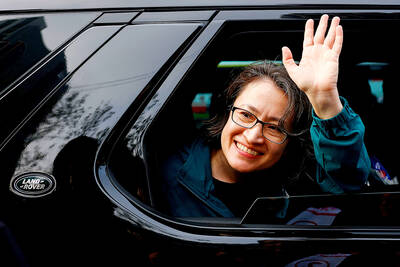
Relations between Taiwan and the Czech Republic have flourished in recent years. However, not everyone is pleased about the growing friendship between the two countries. Last month, an incident involving a Chinese diplomat tailing the car of vice president-elect Hsiao Bi-khim (蕭美琴) in Prague, drew public attention to the People’s Republic of China’s (PRC) operations to undermine Taiwan overseas. The trip was not Hsiao’s first visit to the Central European country. It was meant to be low-key, a chance to meet with local academics and politicians, until her police escort noticed a car was tailing her through the Czech capital. The
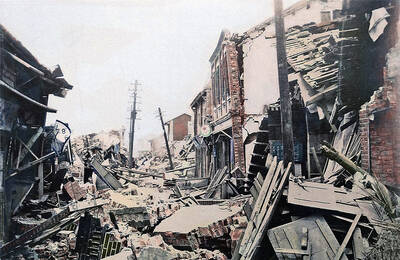
April 15 to April 21 Yang Kui (楊逵) was horrified as he drove past trucks, oxcarts and trolleys loaded with coffins on his way to Tuntzechiao (屯子腳), which he heard had been completely destroyed. The friend he came to check on was safe, but most residents were suffering in the town hit the hardest by the 7.1-magnitude Hsinchu-Taichung Earthquake on April 21, 1935. It remains the deadliest in Taiwan’s recorded history, claiming around 3,300 lives and injuring nearly 12,000. The disaster completely flattened roughly 18,000 houses and damaged countless more. The social activist and


 RSS
RSS