


Against all expectations, the elephant was not in the room. Come Friday evening, at the end of its first full day as an art object, the elephant had probably gone for a lie down, drained by all the attention it had received.
The previous night, at the glamorous opening in the decidedly un-Beverly Hills setting of a disused warehouse at the end of a cul de sac nestled close to a downtown freeway interchange, the elephant had upstaged some of Hollywood’s finest. Painted red, adorned with gold fleur-de-lis, the elephant merged into the wallpaper behind it. There was nothing that Brad Pitt and Angelina Jolie could do other than gawp.
The stars, who also included Jude Law and Keanu Reeves, had gathered for the first LA show by the British prankster, provocateur, graffiti artist and general meddler, Banksy. Known for his street art and interventions in Britain, his show in LA, Barely Legal, was his first large-scale exhibition in the US. Complete with valet parking and a retinue of publicists, it is by far the most high profile of Banksy’s foreign jaunts, which have also taken him to Paris, New York and Israel.
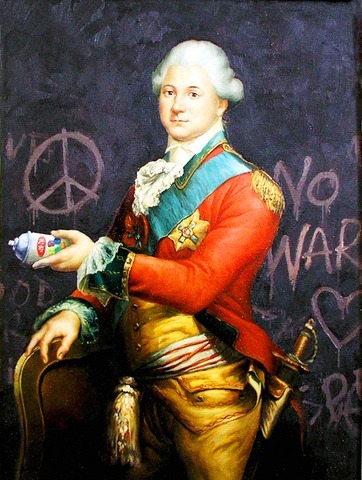
PHOTO: NY TIMES NEWS SERVICE
The show includes pieces of British iconography, such as a Guardsman on Horse Guards Parade atop a pantomime horse, in addition to work aimed specifically at the local audience. A police van dominates the entrance to the exhibition, decorated with a picture of Dorothy from The Wizard of Oz carrying a noose. Occupying an entire wall next to it is a painting reinterpreting an American icon, the raising of the flag at Iwo Jima. In Banksy’s interpretation, the scene is given an urban setting with a group of protesters raising the flag on top of a car.
The world of Brad, Angelina, Jude and Keanu is a long way from Banksy’s origins as a 14-year-old schoolboy in Bristol, England, dabbling in graffiti when it was considered an aggressive form of counterculture. The images that followed, daubed illegally on London’s walls, paved the way for the trend of appropriating public space by graffiti artists. His chutzpah rose to a higher plane earlier this year when he sprayed nine paintings on the 684km barrier that separates Israel from Palestinian territories. A stencil on a Bristol building was allowed to remain in place by the city council after the public voiced overwhelming support.
Yet somehow, despite his mainstream appeal, Banksy has lost none of the respect of his more “underground” British peers. “People have been doing graffiti [in the UK] for about 30 years, and it’s time it was taken seriously,” said “Tizer,” a south London graffiti artist who works on public murals and on education projects with young offenders. “When people talk about graffiti they talk about Banksy. Famous people have always come to his exhibitions because his stuff is easy to read.” A week before the Los Angeles exhibition, Banksy visited Disneyland, somehow managing to place an inflatable figure dressed as a Guantanamo detainee alongside a railroad ride. A short film of the escapade runs inside the LA show. In the same darkened screening room a glass case displays another of his recent interventions: the Paris Hilton CD doctored by Banksy, which he carried out with the help of Los Angeles-based producer Danger Mouse. Enormous cockroaches had been placed inside the display case. Like much of Banksy’s work, it is an overt statement. But of what, precisely?
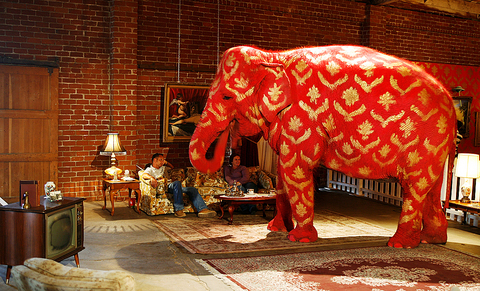
PHOTO: NY TIMES NEWS SERVICE
“There’s more than one thing going on in every picture,” said Tarik, a chef who had seen Banksy’s work in a magazine and decided he had to see it for himself. “There’s a lot of tension in the pictures.”
Tarik gestures at a large painting showing a group of cavemen carrying spears approaching some shopping trolleys. “European artists are a lot more bold and willing to fight,” he says. “The concept of opposing your government is full of bullshit here.”
Banksy himself had displayed a fine sense of bullshit in an interview he gave to Roger Gastman published in the LA Weekly. “Some of the paintings have taken literally days to make,” he confided. “Essentially, it’s about what a horrible place the world is, how unjust and cruel and pointless life is, and ways to avoid thinking about all that. One of the best ways turned out to be sitting in a warehouse making paintings about cruelty, pain and pointlessness.”
Gastman, who edits a magazine called Swindle that features a longer interview with Banksy, thinks that the humor will not be lost on the LA audience. “His work is fun and witty when you see it in the street,” he said. “No matter what serious questions I asked his answers are very reflective of the humor in his work.”
In keeping with his secretive persona — there are no pictures of Banksy and his identity remains in doubt — the artist himself was probably not present at the opening. But that didn’t stop people asking. “Is the artist here,” asked J Mitchell, a singer. “Are you the artist?”
Josh, a computer programmer and stencil artist was impressed by the scale of the work. “He doesn’t do discreet like other stencil artists,” he said. “These are supposed to be here, in a gallery. He does it big, which is what graffiti artists have been doing for a long time.”
But in a town that takes its animal welfare very seriously, some took exception to the presence of the elephant. On entering, visitors were presented with a flyer reading: “There’s an elephant in the room. There’s a problem we never talk about. The fact is that life isn’t getting any fairer. 1.7 billion people have no access to clean drinking water... . Every day hundreds of people are made to physically be sick by morons at art shows telling them how bad the world is but never actually doing something about it. Anybody want a free glass of wine?”
Some of the money from the show will have come from the numbered prints on sale for US$500 each on the glitzy opening night. The rest will have come from the current market for his work, with Banksy’s pictures selling for upwards of US$75,000, according to his London agent Steve Lazarides.
Tai, the 38-year-old painted pachyderm was scrubbed down on Sunday on the orders of the Los Angeles department of animal services.
Last week Joseph Nye, the well-known China scholar, wrote on the Australian Strategic Policy Institute’s website about how war over Taiwan might be averted. He noted that years ago he was on a team that met with then-president Chen Shui-bian (陳水扁), “whose previous ‘unofficial’ visit to the US had caused a crisis in which China fired missiles into the sea and the US deployed carriers off the coast of Taiwan.” Yes, that’s right, mighty Chen caused that crisis all by himself. Neither the US nor the People’s Republic of China (PRC) exercised any agency. Nye then nostalgically invoked the comical specter
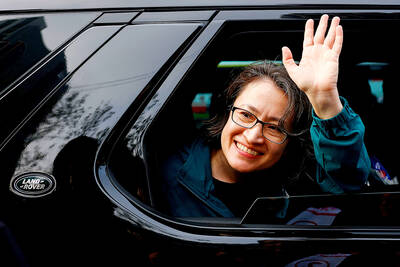
Relations between Taiwan and the Czech Republic have flourished in recent years. However, not everyone is pleased about the growing friendship between the two countries. Last month, an incident involving a Chinese diplomat tailing the car of vice president-elect Hsiao Bi-khim (蕭美琴) in Prague, drew public attention to the People’s Republic of China’s (PRC) operations to undermine Taiwan overseas. The trip was not Hsiao’s first visit to the Central European country. It was meant to be low-key, a chance to meet with local academics and politicians, until her police escort noticed a car was tailing her through the Czech capital. The
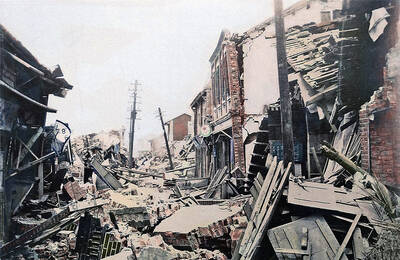
April 15 to April 21 Yang Kui (楊逵) was horrified as he drove past trucks, oxcarts and trolleys loaded with coffins on his way to Tuntzechiao (屯子腳), which he heard had been completely destroyed. The friend he came to check on was safe, but most residents were suffering in the town hit the hardest by the 7.1-magnitude Hsinchu-Taichung Earthquake on April 21, 1935. It remains the deadliest in Taiwan’s recorded history, claiming around 3,300 lives and injuring nearly 12,000. The disaster completely flattened roughly 18,000 houses and damaged countless more. The social activist and

Over the course of former President Ma Ying-jeou’s (馬英九) 11-day trip to China that included a meeting with Chinese Communist Party (CCP) leader Xi Jinping (習近平) a surprising number of people commented that the former president was now “irrelevant.” Upon reflection, it became apparent that these comments were coming from pro-Taiwan, pan-green supporters and they were expressing what they hoped was the case, rather than the reality. Ma’s ideology is so pro-China (read: deep blue) and controversial that many in his own Chinese Nationalist Party (KMT) hope he retires quickly, or at least refrains from speaking on some subjects. Regardless


 RSS
RSS