


Al-Qaeda has become a virtual phenomenon. We know something exists, though what is continually debated. The evidence of its existence is limited to Internet sites, intermittent statements and bomb attacks which are linked, with varying degrees of justification, to “al-Qaeda” by the perpetrators, by the victims or by a variety of other actors. Where once you could interview members of al-Qaeda or associated militant groups, you now risk far more than gastroenteritis when you travel through the badlands of southern Afghanistan. The sole sources of information are selected leaks from ‘intelligence sources’ of dubious reliability. The result is a wash of information, most of it barely worth the few pulses of electronic energy that its dissemination requires.
This means that every writer working on the subject has to undertake a triage of information. Some do this conscientiously, checking sources insofar as is possible, attempting to get out on the ground where they can. Many don't, unquestioningly repeating the handouts of security services or governments, or selecting facts to match prefabricated analyses.
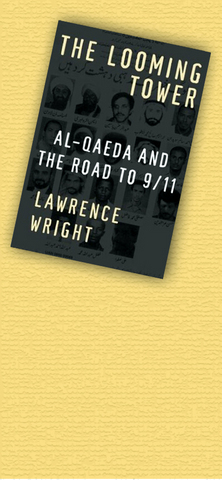
Lawrence Wright, as the long list of interviewees for The Looming Tower makes obvious, falls into the former category. Though much of what he recounts is well known, the authority with which he describes “al-Qaeda's road to 9/11” is uncommon. There is sufficient new material or, at least, sufficient additional detail on episodes that were not previously properly understood to make the book well worth reading.
Wright dispels a number of myths. The relatively tiny number of Arab fighters in Afghanistan during the war against the Soviet Union received no aid from the US. Thus, Osama bin Laden is not the creation of the CIA. He was not responsible for the attacks of the early 1990s in Somalia and New York. The recruits in the al-Qaeda camps in the late 1990s were well-educated, intelligent men with no evidence of mental instability. The 9/11 hijackers were not “recruited” in Germany, but traveled to Afghanistan under their own steam to seek jihad.
His otherwise impressively thorough system of notes breaks down on the vexed question of al-Qaeda's relation with Iraq. Bizarrely, Wright repeats still-unproven allegations of visits by key al-Qaeda figures to Baghdad. Sketchy references tell us that at least one of the sources is badly-flawed American magazine articles. And when Wright says that Ayman al-Zawahiri, bin Laden's closest collaborator, and Abu al-Zarqawi, the Jordanian militant recently killed in Iraq, set up Ansar ul-Islam, he is in error. Interviews with Ansar members in Iraq in 2002 told me that the group was, in various forms, extant from the mid- to late-1990s. And when Wright says al-Zawahiri and al-Zarqawi may have set up the group with the aid of Iraqi intelligence, he is repeating something that is dangerous, very probably false and certainly unsubstantiated.
Wright is so unhappy with this apparent “fact” that he adds a rare asterisked footnote on the page, saying this “supposition” is based on information from Ayad Allawi, a leader of the Iraqi opposition before the 2003 war who was a conduit for many of the least accurate elements of the prewar claims about WMD. If the statement is so flaky, why publish it?
He is very strong on the role of al-Zawahiri. An increasing number of al-Qaeda communications now put the square, bearded face of the 54-year-old, Egyptian-born, former pediatrician in the foreground. If bin Laden is the poster boy of al-Qaeda, al-Zawahiri is the thinker. Without al-Zawahiri's strategic decision to shift from attacking apostate Middle Eastern governments to targeting the West, the attacks of Sept. 11, 2001 would not have happened. Without his experience as a militant in the tough environment of Egypt, the “agitation and propaganda” tactics that typify al-Qaeda would never have been developed.
Al-Zawahiri's thinking owes as much to contemporary left-wing thought as to the holy texts, their exegetes and the works of Islamic thinkers. He cut his activist teeth battling socialists on Egyptian campuses, and the language of Marxism heavily informs his influential book, Knights Under the Banner of the Prophet.
This attributes the lack of active sympathy among “the Muslim masses” for al-Qaeda's radical views to “false consciousness.” What is needed, he says, is a “vanguard” to lead by example. Again, religious tradition is fused with modern secular revolutionary theory to create uniquely powerful, attractive and convincing ideas. “We must mobilize the nation in the battle of Islam against infidelity,” al-Zawahiri says. “We caution against the risk of Muslim vanguards getting killed in silence.”
The “silence” refers to modern communications to be used by the vanguard — in a self-imposed and secure exile up a mountain in Afghanistan — to reach the population at large without having to create a grassroots organization. And the more spectacular the attack, the better. As French social theorist Jean Baudrillard pointed out after 9/11: “We are far beyond ideology and politics; now the aim is to radicalize the world by sacrifice.”
The question now, five years after the atrocious day of the attacks, has al-Zawahiri succeeded? It is tempting to point to the bombs in London and elsewhere, to the hideous mess in Iraq, to recent victories of Islamists, to the violent and polarized rhetoric and answer yes. But though a growing number may be answering the call of al-Zawahiri and others, the total remains minimal and the great uprising of the Muslim masses that he hoped to spark has not occurred. His most recent interventions have had a defensive, almost peevish and frustrated air. Yet he and Bin Laden are still in Afghanistan — or just over the border in Pakistan — apparently easily evading the clumsy attempts to catch or kill them.
Jason Burke is the London-based Observer newsaper's Europe Editor and the author of Al-Qaeda: The True Story of Radical Islam published by Penguin.

In late October of 1873 the government of Japan decided against sending a military expedition to Korea to force that nation to open trade relations. Across the government supporters of the expedition resigned immediately. The spectacle of revolt by disaffected samurai began to loom over Japanese politics. In January of 1874 disaffected samurai attacked a senior minister in Tokyo. A month later, a group of pro-Korea expedition and anti-foreign elements from Saga prefecture in Kyushu revolted, driven in part by high food prices stemming from poor harvests. Their leader, according to Edward Drea’s classic Japan’s Imperial Army, was a samurai

Approaching her mid-30s, Xiong Yidan reckons that most of her friends are on to their second or even third babies. But Xiong has more than a dozen. There is Lucky, the street dog from Bangkok who jumped into a taxi with her and never left. There is Sophie and Ben, sibling geese, who honk from morning to night. Boop and Pan, both goats, are romantically involved. Dumpling the hedgehog enjoys a belly rub from time to time. The list goes on. Xiong nurtures her brood from her 8,000 square meter farm in Chiang Dao, a mountainous district in northern Thailand’s

Located down a sideroad in old Wanhua District (萬華區), Waley Art (水谷藝術) has an established reputation for curating some of the more provocative indie art exhibitions in Taipei. And this month is no exception. Beyond the innocuous facade of a shophouse, the full three stories of the gallery space (including the basement) have been taken over by photographs, installation videos and abstract images courtesy of two creatives who hail from the opposite ends of the earth, Taiwan’s Hsu Yi-ting (許懿婷) and Germany’s Benjamin Janzen. “In 2019, I had an art residency in Europe,” Hsu says. “I met Benjamin in the lobby
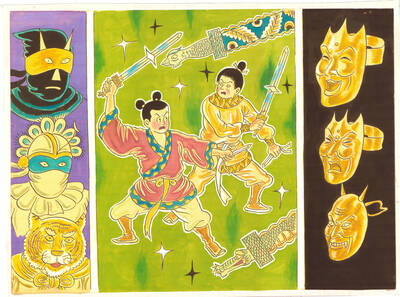
April 22 to April 28 The true identity of the mastermind behind the Demon Gang (魔鬼黨) was undoubtedly on the minds of countless schoolchildren in late 1958. In the days leading up to the big reveal, more than 10,000 guesses were sent to Ta Hwa Publishing Co (大華文化社) for a chance to win prizes. The smash success of the comic series Great Battle Against the Demon Gang (大戰魔鬼黨) came as a surprise to author Yeh Hung-chia (葉宏甲), who had long given up on his dream after being jailed for 10 months in 1947 over political cartoons. Protagonist


 RSS
RSS