


It is hard indeed to know what to expect of the Bulgarian production of Puccini's opera Turandot, due to play in Taipei and Kaohsiung over the next two weeks.
First there is the question of Eastern European opera companies. Some of them are starved of cash and forced to offer 30-year old productions sung by soloists who themselves are also a little past their sell-by dates. But others, such as the State Opera Poland who visited Taipei in 2002, and inexplicably attracted such tiny audiences, were outstanding, certainly in their two leading soloists. You never, in other words, know quite what you're going to get.
Then there's the opera itself. It's both a great classic and potential landmine. After enormous success in his early years, Puccini lapsed into silence and near-failure in middle-age, suddenly coming up, however, with this extraordinary work as he lay dying. He never finished it, but it was completed by a colleague and many listeners believe it's his masterpiece.
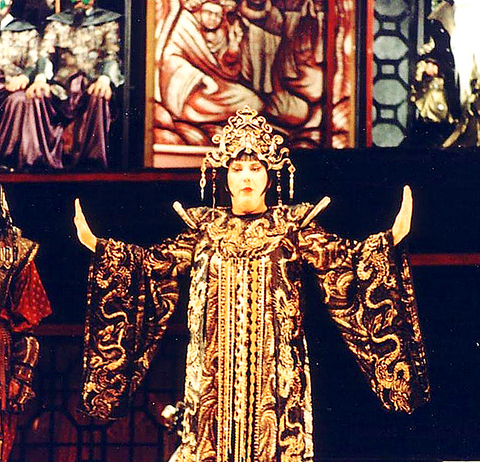
PHOTO COURTESY OF KHAM
It tells a tale of a sexually frigid Chinese princess who decapitates all suitors who fail to answer her three riddles. But herein lies the problem. Bringing European Chinoiserie dating from 1926 to a real Chinese society 80 years on — the whole project bristles with difficulties and occasions for the acutest embarrassment.
Reading about the Sofia National Opera isn't an experience that decides you one way or the other. This production, for instance, has recently been seen in the Johnson County Community College, Kansas, at the Zeiterion Theater in New Bedford, Massachusetts, and courtesy of the Concert Association of Wilmington (population 60,000) in Delaware. That it's showing in Taipei at the less than state-of-the-art Sun Yat-sen Memorial Hall theater isn't ultimately encouraging either.
But then you never know. A country that produced a soprano like Anna Tomowa-Sintow can't by any means be written off. Opera needs scenery, however drab, and costumes, however dowdy, if its curious magic is to stand a chance of coming off. With the NSO Ring set to be largely in a concert version (though with the supremely magnificent and not-to-be-missed Linda Watson in the leading female role), opera buffs eager for the whiff of peeling sets and threadbare wigs may just be in for a bonanza with this possibly Ruritanian, but equally possibly enthralling, Turandot.
It's four years since any agent brought a fully-staged foreign opera production to Taiwan. Previously the practice was rather common, but then with the economic down-turn they all got cold feet. This time there will be 150 people involved — instrumentalists, chorus-members, stage-hands and soloists — with the scenery arriving in separate consignments on two cargo ships. This, then, is hardly imported opera on the cheap. However much the show may lack celebrity international names, it will in some sense be the real thing. It's only coming to Taiwan, incidentally, and as a cultural exchange is likely to have a rather particular Taiwanese flavor.
The production is double-cast — two sets of soloists will alternate in the main roles. On Sept. 20, Sept. 22, Sept. 23 and Sept. 24 at 7.30pm in Taipei, and on Sept. 29 and Sept. 30 at 7.30pm in Kaohsiung it will be as follows: Turandot — Bayasgalan Dashnyam; Timur — Svetozar Rangelov; Calaf — Kostadin Andreev; Liu — Sofia Ivanova. On Sept. 21 at 7.30pm and on Sept. 23 and Sept. 24 at 2.30pm in Taipei, and on Sept. 28 at 7.30pm and Sept. 30 at 2.30pm in Kaohsiung it will be as follows: Turandot — Elena Baramova; Timur — Dimitar Stantchev; Calaf — Kamen Chanev; Liu — Tsvetana Bandalovska.
Being Puccini, and being Turandot in particular, tickets, even at these rather high prices, are likely to sell briskly. Will it be a genuinely moving experience, good for a laugh, or a little bit of both? In the final analysis, this remains just about anybody's guess.
Performance Notes:
The Sofia State Opera's production of Puccini's Turandot plays at Taipei's Sun Yat-sen Theater on Sept. 20, Sept. 21, Sept. 22, Sept. 23 and Sept. 24 at 7.30pm, and on Sept. 23 and Sept. 24 at 2.30pm. In Kaohsiung it plays at the Chiang Kai-shek Cultural Center on Sept. 28, Sept. 29 and Sept. 30 at 7.30pm, and on Sept. 30 at 2.30pm.
Ticket prices in Taipei are from NT$1,200 to NT$4,800, and in Kaohsiung from NT$800 to NT$3,600. Seats can be reserved by calling (07) 7403-466, or by visiting www.ticket.com.tw, or applying in person at any Kingstone bookstore.

Last week Joseph Nye, the well-known China scholar, wrote on the Australian Strategic Policy Institute’s website about how war over Taiwan might be averted. He noted that years ago he was on a team that met with then-president Chen Shui-bian (陳水扁), “whose previous ‘unofficial’ visit to the US had caused a crisis in which China fired missiles into the sea and the US deployed carriers off the coast of Taiwan.” Yes, that’s right, mighty Chen caused that crisis all by himself. Neither the US nor the People’s Republic of China (PRC) exercised any agency. Nye then nostalgically invoked the comical specter

Over the course of former President Ma Ying-jeou’s (馬英九) 11-day trip to China that included a meeting with Chinese Communist Party (CCP) leader Xi Jinping (習近平) a surprising number of people commented that the former president was now “irrelevant.” Upon reflection, it became apparent that these comments were coming from pro-Taiwan, pan-green supporters and they were expressing what they hoped was the case, rather than the reality. Ma’s ideology is so pro-China (read: deep blue) and controversial that many in his own Chinese Nationalist Party (KMT) hope he retires quickly, or at least refrains from speaking on some subjects. Regardless

Approaching her mid-30s, Xiong Yidan reckons that most of her friends are on to their second or even third babies. But Xiong has more than a dozen. There is Lucky, the street dog from Bangkok who jumped into a taxi with her and never left. There is Sophie and Ben, sibling geese, who honk from morning to night. Boop and Pan, both goats, are romantically involved. Dumpling the hedgehog enjoys a belly rub from time to time. The list goes on. Xiong nurtures her brood from her 8,000 square meter farm in Chiang Dao, a mountainous district in northern Thailand’s

Peter Brighton was amazed when he found the giant jackfruit. He had been watching it grow on his farm in far north Queensland, and when it came time to pick it from the tree, it was so heavy it needed two people to do the job. “I was surprised when we cut it off and felt how heavy it was,” he says. “I grabbed it and my wife cut it — couldn’t do it by myself, it took two of us.” Weighing in at 45 kilograms, it is the heaviest jackfruit that Brighton has ever grown on his tropical fruit farm, located


 RSS
RSS