


The jury at the Venice Film Festival left critics and journalists perplexed and in some cases vexed when it awarded top prize to China's Still Life.
Jia Zhangke's (賈樟柯) picture, about two people searching for their partners as villages and towns are submerged by the giant Three Gorges Dam project in China, was introduced as a surprise entry at a point when the main competition was already nearly over.
Many journalists at the 11-day movie marathon had not seen the film when the prizes were announced, and after a screening of the Golden Lion winner following the awards ceremony late on Saturday the response of the packed theater was muted.

PHOTO: AFP
“This verdict leaves people perplexed (and with Rome looming),” said the headline in the Corriere della Sera newspaper, suggesting the jury had damaged Venice's reputation at a time when Rome is launching a rival festival.
The article by Tullio Kezich goes on to question several decisions of a jury headed by French actress Catherine Deneuve.
“Apart from the award for Helen Mirren ... there is not much to agree on in the list of prizes,” he wrote.
Mirren won the best actress award for her portrayal of the British monarch in Stephen Frears' The Queen, one of the few popular decisions alongside French veteran Alain Resnais' best director award for Private Fears in Public Places.
Eyebrows were raised over the choice of Ben Affleck as best actor for his role in Hollywoodland.
The Golden Lion for Still Life came days after Chinese director Lou Ye (婁燁) was banned from making movies for five years for submitting Summer Palace, a romance set against the backdrop of the 1989 Tiananmen Square protests, in Cannes without official approval.
Still Life was also screened this week at the 31st Toronto International Film Festival. But, for some, the day began with the British film Death of a President. Critics fretted whether they should show up two hours before the screening, or three. One hour was plenty. A fictitious documentary about the assassination of US President George W. Bush, the would-be provocation had already been snapped up for American distribution; we were just here to see what the noise was about.
Like the work of the Taiwanese transplant Tsai Ming-liang (蔡明亮), Jia's films have everything going for them except a robust commercial future in America. That is a shame both for these great directors and for an audience that no longer seems interested in looking at film images from beyond its borders.
One of six features commissioned for the New Crowned Hope festival that takes place in Vienna in November, which are all meant to be inspired by themes in Mozart's work, Tsai's most recent film, I Don't Want to Sleep Alone, sounds a requiem for the common man amid the squalor of Kuala Lumpur, Malaysia. Despite an absence of powdered wigs or the naked French women who sometimes entice American audiences into theaters, and who were of course in attendance at this year's festival, the film should speak to anyone with a conscience.
In other film festival news, organizers of Asia's largest film festival are hoping this year's event will power the development of Asian cinema over the next 10 years.
Next month's Pusan International Film Festival (PIFF) in South Korea will be the biggest since it was launched in 1996, but organizers are hoping for a new focus on the business side of the movie industry.
“We hope this year's festival will be a springboard for the development of Asia's film industry in the next decade,” festival director Kim Dong-ho told a press conference late Tuesday.
It will provide Asia's “first total film market” at which the movie industry can discuss financing, production, post-production, technology and sales, and will attract some 2,000 people from the global film industry, he added.
This year the festival in the southern city of Busan will show 245 films from 63 countries including 64 world premieres, the largest number in its history, to celebrate its 11th anniversary.
In addition, some 130 exhibition and sales booths will be set up by 156 companies from more than 40 countries, Kim said.

In late October of 1873 the government of Japan decided against sending a military expedition to Korea to force that nation to open trade relations. Across the government supporters of the expedition resigned immediately. The spectacle of revolt by disaffected samurai began to loom over Japanese politics. In January of 1874 disaffected samurai attacked a senior minister in Tokyo. A month later, a group of pro-Korea expedition and anti-foreign elements from Saga prefecture in Kyushu revolted, driven in part by high food prices stemming from poor harvests. Their leader, according to Edward Drea’s classic Japan’s Imperial Army, was a samurai

The following three paragraphs are just some of what the local Chinese-language press is reporting on breathlessly and following every twist and turn with the eagerness of a soap opera fan. For many English-language readers, it probably comes across as incomprehensibly opaque, so bear with me briefly dear reader: To the surprise of many, former pop singer and Democratic Progressive Party (DPP) ex-lawmaker Yu Tien (余天) of the Taiwan Normal Country Promotion Association (TNCPA) at the last minute dropped out of the running for committee chair of the DPP’s New Taipei City chapter, paving the way for DPP legislator Su

Located down a sideroad in old Wanhua District (萬華區), Waley Art (水谷藝術) has an established reputation for curating some of the more provocative indie art exhibitions in Taipei. And this month is no exception. Beyond the innocuous facade of a shophouse, the full three stories of the gallery space (including the basement) have been taken over by photographs, installation videos and abstract images courtesy of two creatives who hail from the opposite ends of the earth, Taiwan’s Hsu Yi-ting (許懿婷) and Germany’s Benjamin Janzen. “In 2019, I had an art residency in Europe,” Hsu says. “I met Benjamin in the lobby
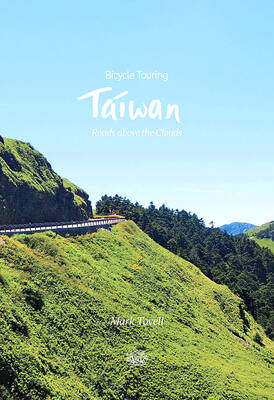
It’s hard to know where to begin with Mark Tovell’s Taiwan: Roads Above the Clouds. Having published a travelogue myself, as well as having contributed to several guidebooks, at first glance Tovell’s book appears to inhabit a middle ground — the kind of hard-to-sell nowheresville publishers detest. Leaf through the pages and you’ll find them suffuse with the purple prose best associated with travel literature: “When the sun is low on a warm, clear morning, and with the heat already rising, we stand at the riverside bike path leading south from Sanxia’s old cobble streets.” Hardly the stuff of your


 RSS
RSS