


Jeff Wu (吳德朗), founder of the Indian Music and Culture Organization (台北印度音樂文化中心), began his life-long love affair with the subcontinent when he bought an Indian drum in Spain. He found himself a percussion teacher, an American living in New Zealand, and was immediately drawn into the kaleidoscopic culture of the ancient civilization.
In 2001, Wu returned to Taiwan with the aim of disseminating his love of Indian culture, and with the help of friends and the Indian Taipei Association started the annual Indian music and dance festival two years ago.
As well as fostering cultural exchanges between artists in Taiwan and India, Wu lectures, writes books and maintains a Web site (www.indianandworldmusic.net) devoted to Indian music.
Wu's undertaking has not been an easy task. “People in Taiwan still have a very limited understanding of Indian culture. The majority either see the region from as an economic angel or stereotype it as a poverty-stricken, third-world country,” Wu said.
As part of his efforts to foster a greater appreciation of Indian culture, Wu teamed up with Tandoor Indian Restaurant (坦都印度餐廳) this year, and has opened a new branch of the eatery on Zhongxiao E Rd. The restaurant-cum-performance space hosts exhibitions and cultural activities.
This weekend, the restaurant will present two classical Indian dances: Kathak from northern Indian and Bharatha Natyam from southern India.
“Indian music and dance are commonly divided into two types, from north and south India. Classical dances differ greatly from region to region. They are mainly performed in god worshipping rituals and depict mythological stories, so the performers need to have a deep understanding of the dances' religious and mythological origins,” Wu said.
According to Wu, Kathak consists of whirling movements that were influenced by Sufism. And unlike other classical dances that could only be performed at shrines and temples in ancient times, Kathak was performed for entertainment, at royal banquets for example, and can be seen in contemporary Bollywood movies.
The Bharatha Natyam is performed as a worship ritual. As Wu points out, sangeet, the Indian word for dance, refers to a combination of dance, singing and theater, and as such is a story-telling art form. The performers are trained in exaggerated facial expressions and over 600 hand gestures that mimic animals and plants and convey abstract emotions such as the joy of love and the hatred of enemies.
Performers are deemed able to perform the elegant and sophisticated dances only after years of training. “Indian music and dance training follows the oral-aural tradition. Performers are required to absorb the arts into their bodies and minds,” Wu said.
The performances will take place at 7:30pm tomorrow night. The restaurant is located at 7, Alley 6, Ln 170, Zhong-xiao E Rd Sec 4, Taipei (台北市忠孝東路四段170巷6弄7號). Admission is NT$500 which includes the two dance performances and a buffet. A workshop will be held by an experienced dancer and instructor on Sunday morning at 10am to introduce participants to the spiritual world of Bharatha Natyam. For more information, call (02) 8773-3248.

In late October of 1873 the government of Japan decided against sending a military expedition to Korea to force that nation to open trade relations. Across the government supporters of the expedition resigned immediately. The spectacle of revolt by disaffected samurai began to loom over Japanese politics. In January of 1874 disaffected samurai attacked a senior minister in Tokyo. A month later, a group of pro-Korea expedition and anti-foreign elements from Saga prefecture in Kyushu revolted, driven in part by high food prices stemming from poor harvests. Their leader, according to Edward Drea’s classic Japan’s Imperial Army, was a samurai

Approaching her mid-30s, Xiong Yidan reckons that most of her friends are on to their second or even third babies. But Xiong has more than a dozen. There is Lucky, the street dog from Bangkok who jumped into a taxi with her and never left. There is Sophie and Ben, sibling geese, who honk from morning to night. Boop and Pan, both goats, are romantically involved. Dumpling the hedgehog enjoys a belly rub from time to time. The list goes on. Xiong nurtures her brood from her 8,000 square meter farm in Chiang Dao, a mountainous district in northern Thailand’s
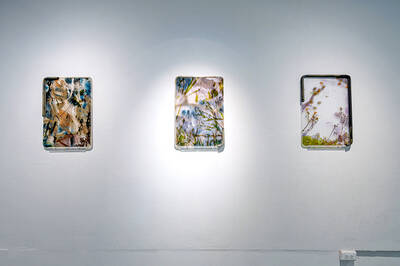
Located down a sideroad in old Wanhua District (萬華區), Waley Art (水谷藝術) has an established reputation for curating some of the more provocative indie art exhibitions in Taipei. And this month is no exception. Beyond the innocuous facade of a shophouse, the full three stories of the gallery space (including the basement) have been taken over by photographs, installation videos and abstract images courtesy of two creatives who hail from the opposite ends of the earth, Taiwan’s Hsu Yi-ting (許懿婷) and Germany’s Benjamin Janzen. “In 2019, I had an art residency in Europe,” Hsu says. “I met Benjamin in the lobby
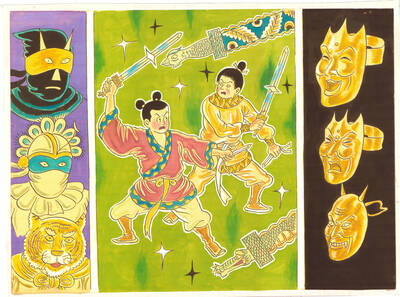
April 22 to April 28 The true identity of the mastermind behind the Demon Gang (魔鬼黨) was undoubtedly on the minds of countless schoolchildren in late 1958. In the days leading up to the big reveal, more than 10,000 guesses were sent to Ta Hwa Publishing Co (大華文化社) for a chance to win prizes. The smash success of the comic series Great Battle Against the Demon Gang (大戰魔鬼黨) came as a surprise to author Yeh Hung-chia (葉宏甲), who had long given up on his dream after being jailed for 10 months in 1947 over political cartoons. Protagonist


 RSS
RSS