


Mountain climbing has long provided a seductive metaphor for spiritual quests, ever since Moses went up Mount Sinai and came down with the Ten Commandments.
We may no longer expect explicit spiritual guidance in our mountain movies, but a film like Kevin Macdonald’s disappointing Touching the Void, a British semi-documentary, is still very much concerned with notions of purification and transcendence, of slipping the bonds of ordinary material existence and entering a new, elevated realm of stark simplicity, elemental forces and moral clarity.
The mountain movies that were popular in Germany in the late 1920s and early 1930s, many starring Leni Riefenstahl and Luis Trenker, pointed a clear way out of the messy conflicts and confusions of the Weimar era. Unfortunately, however, they pointed to Hitler, who quickly appropriated the mountain imagery for his own propaganda ends.
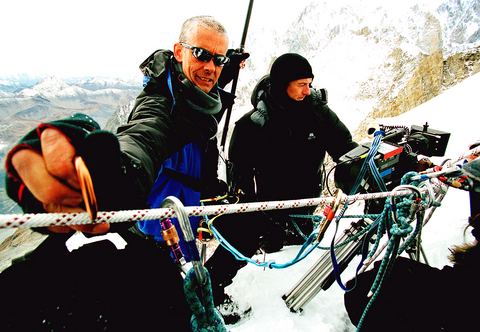
PHOTO COURTESY OF CINEPLEX
In keeping with our current ideologies, the climb in Touching the Void is treated less like a religious retreat than a psychological encounter session, a high-altitude group-therapy meeting that allows its two real-life protagonists, the British climbers Joe Simpson and Simon Yates, to learn important lessons about themselves and their inter-personal relationships.
With the use of staged, pseudo-documentary sequences, the film reconstructs the disastrous 1985 attempt that Simpson and Yates made on the 6,400m Siula Grande in the Peruvian Andes. All went well for three days until Simpson fell and drove his lower leg into his kneecap, leaving him crippled. Yates tried to lower Simpson down the mountainside with a climbing rope, but accidentally lowered him into a deep crevasse. Receiving no response from his partner, Yates was faced with a terrible choice: either to stay and hold on to the rope, at the risk of being eventually pulled into the ravine by Simpson’s body weight, or to cut the rope and try to save himself.
While the actors Brendan Mackey (as Simpson) and Nicholas Aaron (as Yates) recreate the climb on camera (with the help of climbing doubles), clambering through locations that range from the actual Peruvian mountain to Mount Blanc in the Alps, the genuine Simpson and Yates narrate their adventures from an unidentified cozy, warm place just off screen. Because we already know the two men will survive, suspense is at a minimum; the film is more concerned with the awful suffering they endured, tortures both mental (as Yates struggles with the decision to cut the cord) and physical (as Simpson finds himself in the pit of an ice cave, barely able to crawl and with no obvious way out).
This is compelling stuff, but there is something deeply distracting in the use of recreated material. MacDonald, the director, imitates a raw, video-based cinema verite style, but fairly often places the camera in locations that would be inaccessible to a cameraman on the actual expedition (for example, when Simpson falls into the crevasse, the camera crew is already there to meet him).
Just as Simpson falls into the physical hell of the mountain’s cavernous innards, so does Yates confront the moral hell of being forced — or so he believes — to sacrifice his partner in order to save himself. The lesson of Touching the Void is that both experiences not only can be survived, but also can be an occasion for what the daytime talk shows call ‘’personal growth.’’ Having come through, having touched the void and been touched by it, Simpson and Yates are shown as elevated spirits, with a new sense of what is important in their lives and what is not. It is apparently not only the church that now produces saints but also extreme sports as well.

In late October of 1873 the government of Japan decided against sending a military expedition to Korea to force that nation to open trade relations. Across the government supporters of the expedition resigned immediately. The spectacle of revolt by disaffected samurai began to loom over Japanese politics. In January of 1874 disaffected samurai attacked a senior minister in Tokyo. A month later, a group of pro-Korea expedition and anti-foreign elements from Saga prefecture in Kyushu revolted, driven in part by high food prices stemming from poor harvests. Their leader, according to Edward Drea’s classic Japan’s Imperial Army, was a samurai

The following three paragraphs are just some of what the local Chinese-language press is reporting on breathlessly and following every twist and turn with the eagerness of a soap opera fan. For many English-language readers, it probably comes across as incomprehensibly opaque, so bear with me briefly dear reader: To the surprise of many, former pop singer and Democratic Progressive Party (DPP) ex-lawmaker Yu Tien (余天) of the Taiwan Normal Country Promotion Association (TNCPA) at the last minute dropped out of the running for committee chair of the DPP’s New Taipei City chapter, paving the way for DPP legislator Su

Located down a sideroad in old Wanhua District (萬華區), Waley Art (水谷藝術) has an established reputation for curating some of the more provocative indie art exhibitions in Taipei. And this month is no exception. Beyond the innocuous facade of a shophouse, the full three stories of the gallery space (including the basement) have been taken over by photographs, installation videos and abstract images courtesy of two creatives who hail from the opposite ends of the earth, Taiwan’s Hsu Yi-ting (許懿婷) and Germany’s Benjamin Janzen. “In 2019, I had an art residency in Europe,” Hsu says. “I met Benjamin in the lobby

April 22 to April 28 The true identity of the mastermind behind the Demon Gang (魔鬼黨) was undoubtedly on the minds of countless schoolchildren in late 1958. In the days leading up to the big reveal, more than 10,000 guesses were sent to Ta Hwa Publishing Co (大華文化社) for a chance to win prizes. The smash success of the comic series Great Battle Against the Demon Gang (大戰魔鬼黨) came as a surprise to author Yeh Hung-chia (葉宏甲), who had long given up on his dream after being jailed for 10 months in 1947 over political cartoons. Protagonist


 RSS
RSS