


It’s six years since Da Chen’s literary debut. Colors of the Mountain [reviewed in Taipei Times August 6, 2000] was a slice of exceptionally good-humored autobiography, even though it featured the hard times almost everyone of his generation in China experienced. Set in a small village near the city of Fuzhou in Fujian Province, the book told the story of a school student from an educated family background during, and then after, the Cultural Revolution. The boy could play table tennis, the flute and the violin, but was still refused a school place because of his quasi-elite background. Things changed after Mao’s death, however, and he became a scholar and the first person from his village ever to enroll in Amoy University. Da Chen emigrated to the US at the age of 23 with a bamboo flute and US$30 in his pocket (or so we were led to believe by the publishers) and is today a lawyer in New York.
Brothers is Da Chen’s first book in six years, apart from another piece of autobiography covering much the same ground as Colors of the Mountain. I said in 2000 that, at his best, he read like Mark Twain. How, then, does this new venture read?
A highly ambitious novel, it features the conflicting aspirations, capitalist and communist, of two half-brothers. Tan is the rightful heir to the Long family fortunes, while Shento is the illegitimate product of a casual liaison of his father’s.
Neither brother is aware of the other’s existence until towards the end of the novel. In addition, we’re presented with a tragic love story that threatens to bring disaster, not only to the parties involved, but also to China’s ruling elite. The novel, clearly as part of its essential design, also directs a searchlight onto China’s struggle to re-assert its communist traditions in the wake of Mao’s demise and the resurgence of capitalism.
Tan Long is born into the loving embrace of his family, with the privileges that come from having two prosperous grandfathers, one in the military, the other in banking. Shento’s circumstances are very different. He’s the product of a broken umbilical cord after his mother’s suicide bid, and is left dangling from a branch until he’s rescued and adopted by an aged medicine man.
Following frontier skirmishes between China and Vietnam, Shento is impressed by conversations he has with General Ding Long. Struck by the physical resemblance between Shento and his own son, Ding Long offers him a silver medallion — as if in intuitive half-acknowledgement of Shento’s natural birthright. But once his adoptive parents’ compound is torched by the Vietnamese, Shento becomes an orphan with, as they say, loneliness his only company.
Worse is to follow. At military school in Fujian his assigned roommate, Black Dog, turns out to be a psychopath. In self-defense Shento attacks him with a chair, blinding him in one eye. His sanity comes under threat when he’s assigned the task of decapitating live tuna, and he’s only saved when he meets Sumi, a talented writer who’s as much an outcast as he is.
Following Mao’s death, the news of General Ding Long’s promotion to commander-in-chief of the Garrison Force inspires Shento to write to him. In a letter that stresses too heavily his links with the general, he asks him for help and promotion. The general rejects him, threatening to have him tried by the Supreme Court.
This cuts Shento to the quick. “I was but an accident in life,” he writes (in tones reminiscent of a Samuel Beckett novel), “not intended, not needed.” When he learns of Black Dog’s return and rape of Sumi, Shento hangs him from a tree before fleeing the scene.
Tan, meanwhile, is unsurprisingly making progress in his very different life. He forms an attachment to his teacher, Miss Lu, until she is shipped off to Siberia, possibly at his parents’ instigation. Citing his family connections, Tan demands her release. Instead he’s arrested, charged with her murder, and tortured. With the father and grandfather now under official suspicion, the family decides to relocate to Fujian, his grandfather’s (and Da Chen’s) home province. Here they find hospitality, plus a more or less happy compromise between Communism and Buddhism.
When Tan meets Sumi, the classic “two brothers loving the same girl” theme takes the novel over. They are equals in literary excellence and, believing Shento to be dead, Sumi’s feelings for the other brother grow fast.
Tan, it turns out, has a talent for finance. He’s fuelled by a desire to promote Sumi’s writing gifts and so sets up his own publishing company. Fifty-thousand copies of a book of hers are sold at first printing, even as the two tie with top grades, and together set off for Beijing University.
Tan’s dreaming up an ambitious scheme to build a Chinese Rockefeller Center on Tiananmen Square, and Shento’s rising to unexpected eminence in the presidential security contingent, destine them to confront each other in the pro-democracy events of 1989, where the novel reaches its strong, if somewhat formulaic, climax. When Shento discovers that Sumi is the brightest star in Tan’s publishing business, he abducts her on New Year’s Eve, just before the celebration to launch Tan’s new project. When she discovers her first love is not dead but alive and in a position of authority, Sumi decides to commit herself to neither brother in the optimistic hope that they can thereafter live in peace.
The Long family eventually decamps to the US where Tan learns that his banker grandfather has placed a deposit in his name of US$20 million. When Shento receives the identical sum from the same source, the healing forces of generosity — plus, you might think, American values — are finally seen to prevail.
Da Chen’s style, if not exactly Twain-like, nonetheless remains taut and muscular. He’s capable of describing barbarity, neglect, passion and kindness with equal success. But you must be warned of one thing. As your reviewer knows to his cost, this is a very long novel.
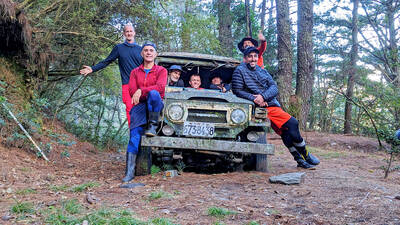
The year was 1991. A Toyota Land Cruiser set out on a 67km journey up the Junda Forest Road (郡大林道) toward an old loggers’ camp, at which point the hikers inside would get out and begin their ascent of Jade Mountain (玉山). Little did they know, they would be the last group of hikers to ever enjoy this shortcut into the mountains. An approaching typhoon soon wiped out the road behind them, trapping the vehicle on the mountain and forever changing the approach to Jade Mountain. THE CONTEMPORARY ROUTE Nowadays, the approach to Jade Mountain from the north side takes an

Last week Joseph Nye, the well-known China scholar, wrote on the Australian Strategic Policy Institute’s website about how war over Taiwan might be averted. He noted that years ago he was on a team that met with then-president Chen Shui-bian (陳水扁), “whose previous ‘unofficial’ visit to the US had caused a crisis in which China fired missiles into the sea and the US deployed carriers off the coast of Taiwan.” Yes, that’s right, mighty Chen caused that crisis all by himself. Neither the US nor the People’s Republic of China (PRC) exercised any agency. Nye then nostalgically invoked the comical specter

Relations between Taiwan and the Czech Republic have flourished in recent years. However, not everyone is pleased about the growing friendship between the two countries. Last month, an incident involving a Chinese diplomat tailing the car of vice president-elect Hsiao Bi-khim (蕭美琴) in Prague, drew public attention to the People’s Republic of China’s (PRC) operations to undermine Taiwan overseas. The trip was not Hsiao’s first visit to the Central European country. It was meant to be low-key, a chance to meet with local academics and politicians, until her police escort noticed a car was tailing her through the Czech capital. The
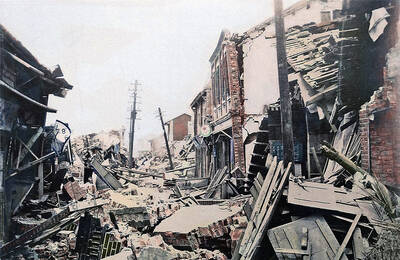
April 15 to April 21 Yang Kui (楊逵) was horrified as he drove past trucks, oxcarts and trolleys loaded with coffins on his way to Tuntzechiao (屯子腳), which he heard had been completely destroyed. The friend he came to check on was safe, but most residents were suffering in the town hit the hardest by the 7.1-magnitude Hsinchu-Taichung Earthquake on April 21, 1935. It remains the deadliest in Taiwan’s recorded history, claiming around 3,300 lives and injuring nearly 12,000. The disaster completely flattened roughly 18,000 houses and damaged countless more. The social activist and


 RSS
RSS