


Considering how many historic recordings bear his name, it’s a little surprising that it has taken until now, almost 20 years after his death, for someone to write a biography of John Hammond. But maybe it’s not all that surprising.
After all, Hammond spent his career out of the spotlight. While helping to steer artists from Billie Holiday to Bruce Springsteen into the public eye as a talent scout, record producer and overall mover and shaker, he remained the benevolent (some would say paternalistic) man behind the curtain.
And it’s not as if Hammond has never been written about. He’s a prominent supporting character in the biographies and autobiographies of his most famous so-called discoveries, a list that also includes Bob Dylan, Count Basie, Benny Goodman and Aretha Franklin. He told his own story in 1977 in John Hammond on Record, a memoir that was more than a little self-serving and selective, but entertaining nonetheless.

So while it could be said that Dunstan Prial is staking out virgin territory with his Hammond biography, The Producer, it could also be said that he is simply taking all the good Hammond anecdotes that have been out there for years and putting them in one place, creating the literary equivalent of a greatest-hits collection.
But he has done more. He has conducted some solid research, and while his book is sometimes a little light on context (among other things, it lacks a thorough discography), he has fashioned the diverse strands of Hammond’s life into a very readable narrative. It helps that he has a fascinating protagonist.
If John Hammond didn’t exist, a novelist might have had to invent him. A child of privilege (his mother was a Vanderbilt), he was drawn to jazz and blues at an early age and went on to dedicate his life, and fortune, to American vernacular music, and also to racial equality. With his flattop haircut and perpetual grin, he cut a strange figure. With his sharp ear, infectious enthusiasm and deep pockets, he helped change the course of 20th-century music.
Prial, a journalist (and the son of Frank Prial, who was a reporter), clearly admires Hammond’s accomplishments, as both musical catalyst and social activist, but this book is not hagiography. Prial acknowledges that Hammond could be arrogant and imperious; that he could be vindictive toward musicians, among them Duke Ellington, who did not follow his career advice; and that he could take a rather cavalier attitude toward conflicts of interest.
In the 1930s, when he was producing records by Goodman, Holiday and Basie, Hammond was also an influential critic. He wrote about music, primarily for Down Beat and the British magazine Melody Maker, and he often raved about musicians he worked with, without disclosing his involvement. (“I was in the studio at the time,” he would write about a record he was praising. What he wouldn’t say is that he was there because he was supervising the session.) As Prial notes, Hammond defended such apparent ethical lapses by explaining that it was all for the greater good of the music, and that anyway he was not benefiting financially. Call it the jazz version of noblesse oblige.
Prial tells us that he first learned about Hammond through the music of Stevie Ray Vaughan, the dynamic blues-rock guitarist who in the early 1980s became Hammond’s last significant protege, and that he was a fan of Dylan and Springsteen before he knew anything about the man credited with discovering them. So it’s not surprising that once his narrative enters the 1960s — shortly after Hammond rejoined Columbia Records, where he had first made his mark as a producer, and began shifting his focus from jazz — Prial seems much more engaged than when writing about the musicians Hammond recorded in the 1930s. He understands that these earlier artists were important but has a hard time explaining why.
For example, he writes of Lionel Hampton: “His music alone was enough to startle even virtuoso musicians of Benny Goodman’s caliber. When Hampton’s mallets struck the metallic bars of the vibraharp, a spray of notes burst forth. And each one made perfect sense, one note following another impossibly fast but never forced.” A spray of notes? This is colorful writing, but it doesn’t shed very much light.
Some passages are apt to make even the casual jazz fan wince. Take Prial’s observation that in Kansas City, in the days when Count Basie was a local hero, “improvisational jamming was the preferred style.” One word would have done it: jamming is improvisation.
But the author’s musical expertise is beside the point when he writes, eloquently, about what was perhaps Hammond’s greatest accomplishment: persuading an initially reluctant Benny Goodman to hire two black sidemen, Hampton and the pianist Teddy Wilson.
By bringing a racially mixed quartet on tour with his very successful all-white big band, Goodman made a powerful statement, if not quite as powerful as he would have made by integrating the big band, which he did not do until some years later. (Frustratingly, Prial sometimes acknowledges that the quartet and the orchestra were separate entities but at times seems to forget, as when he praises Goodman for “allowing two black men into his band.”)
Two decades before civil rights marchers shined a harsh light on the reality of segregation, John Hammond, via Benny Goodman, took a brave stand that almost no one else, in or out of the music business, was taking. That, Prial suggests, meant more to him than having a hit record ever could. It meant more to the world too.
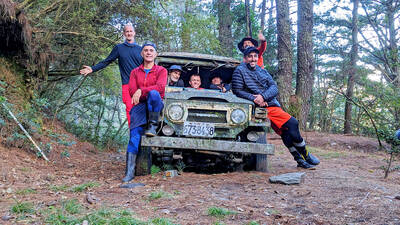
The year was 1991. A Toyota Land Cruiser set out on a 67km journey up the Junda Forest Road (郡大林道) toward an old loggers’ camp, at which point the hikers inside would get out and begin their ascent of Jade Mountain (玉山). Little did they know, they would be the last group of hikers to ever enjoy this shortcut into the mountains. An approaching typhoon soon wiped out the road behind them, trapping the vehicle on the mountain and forever changing the approach to Jade Mountain. THE CONTEMPORARY ROUTE Nowadays, the approach to Jade Mountain from the north side takes an

Last week Joseph Nye, the well-known China scholar, wrote on the Australian Strategic Policy Institute’s website about how war over Taiwan might be averted. He noted that years ago he was on a team that met with then-president Chen Shui-bian (陳水扁), “whose previous ‘unofficial’ visit to the US had caused a crisis in which China fired missiles into the sea and the US deployed carriers off the coast of Taiwan.” Yes, that’s right, mighty Chen caused that crisis all by himself. Neither the US nor the People’s Republic of China (PRC) exercised any agency. Nye then nostalgically invoked the comical specter

Relations between Taiwan and the Czech Republic have flourished in recent years. However, not everyone is pleased about the growing friendship between the two countries. Last month, an incident involving a Chinese diplomat tailing the car of vice president-elect Hsiao Bi-khim (蕭美琴) in Prague, drew public attention to the People’s Republic of China’s (PRC) operations to undermine Taiwan overseas. The trip was not Hsiao’s first visit to the Central European country. It was meant to be low-key, a chance to meet with local academics and politicians, until her police escort noticed a car was tailing her through the Czech capital. The
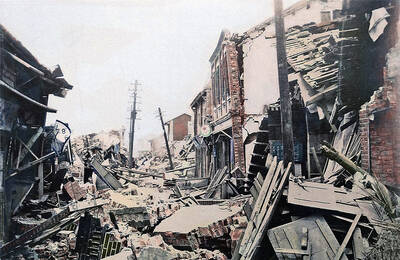
April 15 to April 21 Yang Kui (楊逵) was horrified as he drove past trucks, oxcarts and trolleys loaded with coffins on his way to Tuntzechiao (屯子腳), which he heard had been completely destroyed. The friend he came to check on was safe, but most residents were suffering in the town hit the hardest by the 7.1-magnitude Hsinchu-Taichung Earthquake on April 21, 1935. It remains the deadliest in Taiwan’s recorded history, claiming around 3,300 lives and injuring nearly 12,000. The disaster completely flattened roughly 18,000 houses and damaged countless more. The social activist and


 RSS
RSS