


Fountain is a new “arts and living” magazine from the National Cultural Association, and comes complete with enthusiastic introductory remarks from its chairman, President Chen Shui-bian (陳水扁). Its Vice-Chairman is Vice-President Annette Lu (呂秀蓮). With such prestigious backing, hopes must ride high for new insights into Taiwan's arts scene, even if acerbic criticism or radical invective seems unlikely. What, then, do we find?
This first issue is devoted to Taiwan's film scene, hardly a success story, you might think, if viewed in terms of its current moneymaking capabilities. But then Taiwanese movies have met with critical success on the international arts scene, so if Fountain is going to follow the path of art-for-art's-sake, disdaining all commercial considerations, then film would clearly be an appropriate topic to get the ball rolling.
And anyway there's always Ang Lee (李安), a Taiwanese success story if ever there was one, with former president Lee Teng-hui (李登輝) taking his whole family to see Wedding Banquet (喜宴) all those years ago, and now Chen saying he'd like the relationship between Taiwan and the US to be comparable to that depicted in Brokeback Mountain — and both movies gay-centered products to boot. Any director capable of having that much influence must be worthy of continued celebration.
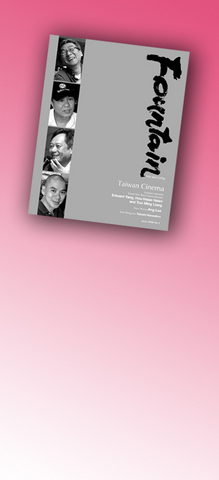
And so it appears here. The magazine carries an absorbing phone-interview with Lee, conducted by David Monson, in which the director has the following to say about local film-makers: “I hope they don't get into self-pity and feel lonely for the sake of being artistic ... . Ninety-nine percent of people watch mainstream movies ... . They can be as lonely as they want to be, they can feel noble, but if they're not good enough they are just not good enough.”
I could hardly believe my eyes when I read this. If it doesn't mean they should all up and go and make movies in the US like Lee, I don't know what it does mean. He qualifies this statement, however, by adding immediately afterwards, “But without the healthy development of the film industry” — by which he can only mean Taiwan's film industry — “they will never know if they're good enough or not.”
Even so, local directors are not without their international contacts. Hou Hsiao-hsien (侯孝賢), for instance, is currently working in France at the invitation of the Musee d'Orsay. In an interview here (with Sophie Wood) he describes how he evolved his own script for a film there, and selected Juliette Binoche for the leading role. He also expresses his belief that Taiwan's film industry will rebound in the next five years because “the China Motion Picture Company (CMPC),” which 10 years ago was “Taiwan's most important film production company,” is “being bought by Gou Tai-chiang (郭台強) [brother of Terry Gou (郭台銘), Chairman of Hon Hai Precision Industrial (鴻海科技) and the richest man in Taiwan].”
In addition, he states the following: “The big reason why Taiwan's film industry is set to take off in that four or five years ago CMC Magnetic, a company that makes optical discs, established CMC Movie Corporation for the sole purpose of investing in film production. They currently own Warner Brother's Village and they have a home video rental company called Asia 1.
Now they've begun making their own movies and are working on several big projects.” Taiwan's film directors, in other words, may not be remaining lonely and artistic for that much longer.
Tsai Ming-liang (蔡明亮) also talks here about his next film, set among the poorest of the poor in Kuala Lumpur and to be entitled Black Eye, after the black eye Malaysia's former deputy prime minister Anwar Ibrahim was given by an assailant as he left a courtroom in 1999. “I think good movies, whether they're Eastern or Western, are simply very brave creations,” Tsai remarks. “They're not an effort to cater to the market or to common views or ideas.”
There are interviews, too, with Edward Yang (楊德昌), currently working on a feature-length animation film “aimed ... to compete for the top-level global market.” And indeed the whole thrust of Fountain is up-beat, as well as being intelligent and seemingly aimed at increasing Taiwan's international stature generally. One hopes that there won't be too much emphasis on less probing “lifestyle” topics in future issues. Currently the magazine is twice-yearly, with the possibility of its coming out more frequently later on.
Another cultural periodical relating to Taiwan that has come our way is from Lyons, France. Entitled Transtext(e)s Transcultures (www.transcultures.net), it's unusual in being a trilingual cultural production in French, English and Chinese. It's more academic than Fountain, but arguably equally interesting.
Taiwan is prominently featured in an article on Tsai by the Italian critic Corrado Neri, a frequent visitor to Taipei. The argument is developed from his Italian book on Tsai (Cafoscarina, Venice, 2004) and is in essence that Tsai, most notably in What Time Is It There? (你那邊幾點?), is the Taiwanese equivalent of the French New wave directors of the 1950s, especially Truffaut, in representing a “resistance in the face of the American invasion of the Hollywood movies.” Hollywood was “commercial, mechanical and standardized,” whereas the French (and Taiwanese) New Wave stood for “freedom of expression and creation, fantasy, diversity, research and exploration.” Ang Lee, perhaps, wouldn't entirely agree.
Not all the journal is in all three languages. Sometimes a summary of the main drift of an article is in all three, then the main body of the text is in just one of them. But sometimes entire articles are translated in full. There's even some Greek in an article on the poet Constantin Cavafy — there the main text is in French, with a summary of the argument in English and Chinese.
Even so, the admirable intention of the publication as a whole to present itself in all three languages is maintained. Its general editor is Gregory Lee (whose Chinas Unlimited was reviewed in Taipei Times on June 20, 2004). Lee himself is an Englishman of partially Chinese extraction teaching in France, so the logic of the magazine's linguistic approach may be partially rooted there. More information, anyway, can be accessed on the journal's Web site.

Last week Joseph Nye, the well-known China scholar, wrote on the Australian Strategic Policy Institute’s website about how war over Taiwan might be averted. He noted that years ago he was on a team that met with then-president Chen Shui-bian (陳水扁), “whose previous ‘unofficial’ visit to the US had caused a crisis in which China fired missiles into the sea and the US deployed carriers off the coast of Taiwan.” Yes, that’s right, mighty Chen caused that crisis all by himself. Neither the US nor the People’s Republic of China (PRC) exercised any agency. Nye then nostalgically invoked the comical specter
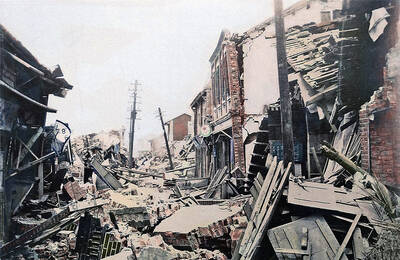
April 15 to April 21 Yang Kui (楊逵) was horrified as he drove past trucks, oxcarts and trolleys loaded with coffins on his way to Tuntzechiao (屯子腳), which he heard had been completely destroyed. The friend he came to check on was safe, but most residents were suffering in the town hit the hardest by the 7.1-magnitude Hsinchu-Taichung Earthquake on April 21, 1935. It remains the deadliest in Taiwan’s recorded history, claiming around 3,300 lives and injuring nearly 12,000. The disaster completely flattened roughly 18,000 houses and damaged countless more. The social activist and

Over the course of former President Ma Ying-jeou’s (馬英九) 11-day trip to China that included a meeting with Chinese Communist Party (CCP) leader Xi Jinping (習近平) a surprising number of people commented that the former president was now “irrelevant.” Upon reflection, it became apparent that these comments were coming from pro-Taiwan, pan-green supporters and they were expressing what they hoped was the case, rather than the reality. Ma’s ideology is so pro-China (read: deep blue) and controversial that many in his own Chinese Nationalist Party (KMT) hope he retires quickly, or at least refrains from speaking on some subjects. Regardless

Approaching her mid-30s, Xiong Yidan reckons that most of her friends are on to their second or even third babies. But Xiong has more than a dozen. There is Lucky, the street dog from Bangkok who jumped into a taxi with her and never left. There is Sophie and Ben, sibling geese, who honk from morning to night. Boop and Pan, both goats, are romantically involved. Dumpling the hedgehog enjoys a belly rub from time to time. The list goes on. Xiong nurtures her brood from her 8,000 square meter farm in Chiang Dao, a mountainous district in northern Thailand’s


 RSS
RSS