


Four of five paintings by Gustav Klimt that were at the center of a much-publicized restitution battle will be heading to Christie's for sale this fall, Marc Porter, president of Christie's, confirmed this week. Whether the works will be auctioned or sold privately has yet to be determined, he said.
Experts say the four paintings — three landscapes and a portrait executed between 1903 and 1916 — are worth about US$100 million.
The five Klimts were handed over by Austria in January to Maria Altmann of Los Angeles, the niece of the original owners in Vienna, and other family members. The paintings came from the collection of the Jewish sugar industrialist Ferdinand Bloch-Bauer and his wife, Adele. An arbitration court had ruled that they were improperly seized when the Nazis took over the country.
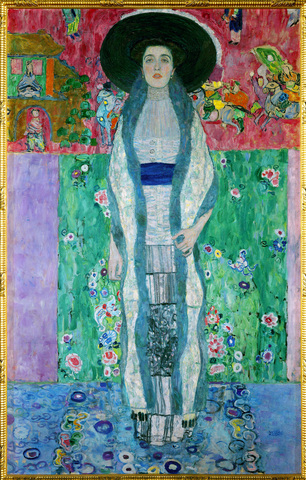
PHOTO: NY TIMES NEWS SERVICE
In June the cosmetics executive Ronald Lauder purchased the most renowned of the five, a gold-flecked portrait of Adele Bloch-Bauer from 1907, for the Neue Galerie in Manhattan for US$135 million. It is the highest price known to have been paid for a painting, eclipsing the US$104.1 million paid for Picasso's 1905 Boy With a Pipe (The Young Apprentice) in an auction at Sotheby's in 2004.
All five Klimts are currently on view at the Neue and have been attracting large crowds. “None of us is in a position to keep them,” Altmann said in a telephone interview from her home in Los Angeles.
For months now, said Steven Thomas, the lawyer representing the Bloch-Bauer heirs, both Christie's and its archrival Sotheby's have been making overtures to Altmann and her relatives about selling the paintings. But it was only in the last few weeks that the negotiations really heated up.
“It was actually competitive to the end,” Thomas said. The final decision was based primarily on relationships, he added: Stephen Lash, chairman of Christie's in America, grew up in Fall River, Massachusetts, where Altmann and husband lived in the early 1940s. Lash has been in constant touch with Altmann since she initiated the efforts to recover the paintings. And Christie's had been enlisted by Lauder to help him negotiate the purchase of Adele Bloch-Bauer I.
For most of the last 60 years the paintings had hung in the Austrian Gallery of the Belvedere Palace in Vienna near The Kiss, another lustrous gold-flecked Klimt masterpiece of the Art Nouveau era.
The Nazis seized them from one of the Bloch-Bauers' palaces in Vienna. They had been hanging in a bedroom that Ferdinand Bloch-Bauer had turned into a kind of shrine to his wife after she died of meningitis in 1925. “He took the bed out, and there were always fresh flowers,” Altmann recalled.
She said she traveled to Vienna this summer to see the house, where she had spent much time in her youth. “It was not recognizable,” she said. “It no longer had the look of a palace, now it's just a house of business. I went in and tried to find the bedroom, but I couldn't find anything that reminded me of a bedroom.”
Since Lauder announced he had bought Adele Bloch-Bauer I for the Neue Galerie, which he helped to found five years ago, there has been speculation that he might buy the other paintings. On Friday he said in a telephone interview that he would consider purchasing one or more “if the price is right.”
“They're all great pictures,” Lauder added. “Each one would have something to add to the Neue Galerie's collection. But if the buyer is not the Neue Galerie, I hope they will end up in other museums.”
Asked which he would most like to buy, Lauder replied, Adele Bloch-Bauer II, a later (1912) and far different portrait of the Viennese salon hostess. In Adele Bloch-Bauer I she is depicted in a regal setting, clad in an exotic richly patterned gold gown and posed against a tapestry of gold decorations.
In the 1912 portrait she wears fashionable street clothes, including a wide-brimmed hat, and stands before a brightly colored floral background. Japanese motifs like warrior horses appear in the rear top portion of the canvas.
Art historians and chroniclers of Vienna society in the early 20th century have long suspected that Klimt and Adele Bloch-Bauer were lovers. This theory is shared by Altmann, who remembers her aunt well, although she was just nine when Bloch-Bauer died. Klimt made hundreds of preparatory drawings of Bloch-Bauer for the portraits.
Altmann said she doubted that the brightly colored dress in the 1912 portrait was really her aunt's. “She never dressed loudly,” she said. “I always remember her wearing long, simple white dresses and holding a gold cigarette holder. I don't remember anything like the dress in the picture.”
Altmann said she had no particular favorite among the Klimt paintings. “When you grow up with something, you are so used to it,” she said. “There were so many other beautiful things in the house, like porcelains, furniture and other paintings. I personally love the landscapes.”
The earliest, Birch Forest from 1903, is an Austrian landscape rendered in rich autumnal colors. “It's quite an intense picture,” said Guy Bennett, head of Impressionist and modern paintings at Christie's in New York, “and one of the few woods scenes Klimt painted.” He added that it is “comparable in quality to another of his landscapes,” hanging in the Moderne Galerie in Dresden.
Another landscape, Apple Tree I (circa 1912), shows the tree in full flower in shimmering pinks and reds, its branches spread wide: for Klimt, a symbol of the tree of life.
The remaining landscape, Houses at Unterach on the Attersee, was painted around 1916 on the south shore of a resort town on a lake in the countryside east of Salzburg where Klimt spent the summers of 1914, 1915 and 1916. A portion of the town is shown from across the lake, in a style influenced by Cezanne's geometric renderings of Mont Sainte-Victoire.
Altmann said it did not matter to her whether Christie's arranges an auction or private sales of the Klimts, which remain on view at the Neue Galerie through Sept. 18. “I've never been to an auction, so I think it would be exciting,” she said.
“I'm simply hoping for the best,” she added.
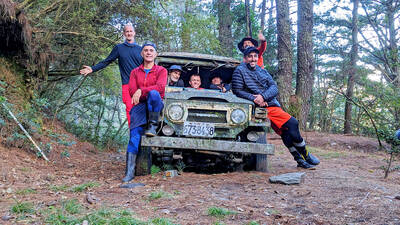
The year was 1991. A Toyota Land Cruiser set out on a 67km journey up the Junda Forest Road (郡大林道) toward an old loggers’ camp, at which point the hikers inside would get out and begin their ascent of Jade Mountain (玉山). Little did they know, they would be the last group of hikers to ever enjoy this shortcut into the mountains. An approaching typhoon soon wiped out the road behind them, trapping the vehicle on the mountain and forever changing the approach to Jade Mountain. THE CONTEMPORARY ROUTE Nowadays, the approach to Jade Mountain from the north side takes an

Last week Joseph Nye, the well-known China scholar, wrote on the Australian Strategic Policy Institute’s website about how war over Taiwan might be averted. He noted that years ago he was on a team that met with then-president Chen Shui-bian (陳水扁), “whose previous ‘unofficial’ visit to the US had caused a crisis in which China fired missiles into the sea and the US deployed carriers off the coast of Taiwan.” Yes, that’s right, mighty Chen caused that crisis all by himself. Neither the US nor the People’s Republic of China (PRC) exercised any agency. Nye then nostalgically invoked the comical specter

Relations between Taiwan and the Czech Republic have flourished in recent years. However, not everyone is pleased about the growing friendship between the two countries. Last month, an incident involving a Chinese diplomat tailing the car of vice president-elect Hsiao Bi-khim (蕭美琴) in Prague, drew public attention to the People’s Republic of China’s (PRC) operations to undermine Taiwan overseas. The trip was not Hsiao’s first visit to the Central European country. It was meant to be low-key, a chance to meet with local academics and politicians, until her police escort noticed a car was tailing her through the Czech capital. The
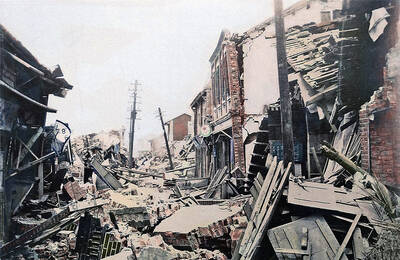
April 15 to April 21 Yang Kui (楊逵) was horrified as he drove past trucks, oxcarts and trolleys loaded with coffins on his way to Tuntzechiao (屯子腳), which he heard had been completely destroyed. The friend he came to check on was safe, but most residents were suffering in the town hit the hardest by the 7.1-magnitude Hsinchu-Taichung Earthquake on April 21, 1935. It remains the deadliest in Taiwan’s recorded history, claiming around 3,300 lives and injuring nearly 12,000. The disaster completely flattened roughly 18,000 houses and damaged countless more. The social activist and


 RSS
RSS