


I began having second thoughts about riding a horse through northern Mongolia right around the moment I slammed into the tree trunk.
Without warning, my horse had bolted toward it, and I had no idea how to regain control. The impact flung me through the air. I landed hard on the forest floor as my horse scampered into the bush.
Then a crashing sound came from behind — Chuka, the Mongolian guide who had been bringing up the rear of our group of four travelers, had been thrown off his horse too. A short, round man, he picked himself up and shook his head to bring himself back to his senses, or maybe just to blow off the cobwebs of a bad hangover from a vodka binge the previous night.
PHOTO: NY TIMES NEWS SERVICE
So even Mongolians get tossed off horses, I thought, somewhat comforted.
Once we had rounded up the prickly horses with the help of two local guides, we figured out that our seemingly irrational mounts had stumbled into a beehive in the middle of the forest.
It was an inauspicious start to what was to be a three-day horse trek last September in a wilderness area around Khovsgol Lake, a 1,713km2 patch of pristine blue water that lies just south of the border with Russia in the Siberian plain. My Lonely Planet guidebook said it was the deepest lake in Central Asia and the world's 14th-largest source of fresh water. Surrounding the lake are pine forests, subalpine meadows and undulating mountain ranges, scenery with more than a passing resemblance to the Pacific Northwest. It had taken three days of hard driving across bone-jarring roads (and sometimes no roads at all) just to get here from Ulan Bator, the country's capital and only real urban center.
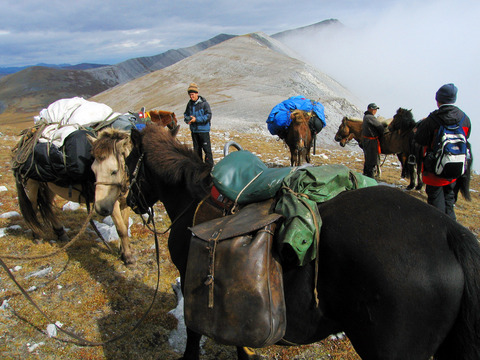
PHOTO: NY TIMES NEWS SERVICE
There are few countries in the world where it is as easy to get lost, to be completely drawn away from civilization, as Mongolia. I had planned to spend a month exploring the corners of the desolate land from which Genghis Khan and his kin once rode forth to conquer much of Asia, and which remains one of the world's least populated countries, with many of its people still leading nomadic lives. I was accompanied by my friend Tini and two backpackers we had met in Ulan Bator.
The most efficient way for travelers to go cross-country is by car, so we paid Khoyga, a laconic driver with a Russian van, and Chuka, a talkative cook, to take us from the capital into the wild.
The plan was to rent horses and hire local guides after reaching Khovsgol Lake and strike out toward the Darkhad Depression, a mysterious plain of 300 lakes settled by the Tsaatan people, reindeer herders who still practiced shamanism. What could be more evocative than riding across the steppes of Central Asia, following the ghosts of the great Khans and meeting reclusive tribes? Horseback riding seemed to be the definitive way to see the countryside; even in the 21st century, this is the favored mode of transport in rural Mongolia, with nomads corralling sheep and other livestock while galloping beneath the endless blue sky.
PHOTO: AP
Our original plan, though, was thrown off track as soon as we reached the lake. We were told that recent snowfall and resulting high waters in the rivers would make it impossible for inexperienced riders like us to traverse some of the mountains.
The campsite owner, Ganbaa, suggested taking the horses through a protected forest area called the Khoridol Saridag Nuruu, to the west of the lake. He arranged for horses and two guides to start with us the next morning. That night, after a day of hiking around the lake, we sat around a campfire and properly kicked off the journey in true Mongolian fashion, by feasting on mutton cooked using hot rocks, then downing shots of vodka. The Mongolians insisted that each of us sing a song before drinking. We all managed to belt out a tune, but none of us could compete with a Mongolian horseman who astounded us with traditional throat-singing.
That night, we unrolled our sleeping bags in one of Ganbaa's gers, the round felt tents that Mongolian nomads erect and disassemble as they move their animals from pasture to pasture as seasons change. Mongolia has some of the coldest winters on earth, but people stay warm in these gers, with the help of a central stove, thick blankets and the company of family and friends.
We drove up the lakeshore the next morning to meet our horses and guides at a small settlement called Toilogt. Though nursing a painful hangover, Chuka managed to help the guides, Tsenggel and his 19-year-old son Boggi, pack the food into saddlebags and strap the tents and other camping gear to the horses. We were all relieved when we saw that the saddles on our horses were leather and not wooden, the kind usually used by the Mongolians.
The guides paired me with a light-brown stallion with a long, flowing mane. He seemed calm in temperament, exactly the kind of steed I wanted. It had been six years since I had last ridden, in a Tibetan region of China, and I did not want to deal with a hothead. Little did I know the abuse my body would endure just hours later.
We were surprised by just how short and stubby Mongolian horses were compared with those in the American West. Given the legends surrounding Mongolian cavalrymen, it seemed paradoxical that these horses should appear to be of inferior breeding. But I learned from history books that it was the relatively small size of these animals that had given the Mongols a tactical advantage in Genghis Khan's time: The warriors could quickly leap on and off the horses in the middle of battle.
We saddled up after lunch and began sauntering north. The autumnal winds had picked up, bringing a chill, and rain clouds began moving over the lake. We veered west to climb up into a valley that led toward the protected forest area. The leaves had begun changing, and patches of ground were colored red and gold.
Controlling a horse is not an instinctual matter, at least not for me. The guides had shown us some basic techniques — for example, snap the loose end of the reins against the horse's rump to get it moving. Gently pull back on the reins to get it to stop. Kick your feet against its flanks if it refuses to go. The guides made it all look effortless, but when I tried spurring my horse, it continued plodding along about as quickly as a bicycle with two flats.
The horses simply fell in line with one another, not showing much imagination or initiative, and stubbornly refused to obey our efforts to direct them.
We were still trying to figure out the proper way to handle them when the first raindrops began to fall. It soon turned into a steady drizzle, and we had to dismount in a clearing to throw plastic covers over our bags. As our guides cinched the bags tight, I noticed a white tepee in a grove of trees.
A tepee in the middle of Mongolia? Then we saw the two large animals tethered to ropes. One was white, the other half-gray and half-white, and both had enormous racks of horns that sprouted from their heads in fantastic shapes. It was the first time I had ever seen reindeer.
A woman in a thick black robe stood at the door of the tepee alongside her husband, who was dressed in a dirty smock. They were Tsaatan, also known as Dukha, the nomadic herders who used reindeer for every necessity in their lives, from milk to the leather that formed the walls of their tents. My guidebook said there were only 200 of them left in northern Mongolia, and only a handful wandered this close to Khovsgol Lake, away from the Darkhad Depression.
Their tepees and shamanistic practices suggested a connection with American Indians, whose ancestors had crossed over from Asia in prehistoric times. We edged closer to the couple standing by their tepee, but our horses kept their distance because of a snarling guard dog.
We decided to steer wide of the encampment and return to the trail leading up the valley. Two reindeer stared at us from the bushes, then dashed off.
The rain came and went throughout the afternoon. It was during a sunny patch that our horses ran into the beehive along the path. Chaos ensued for a few minutes, as Chuka and I both found ourselves knocked flat onto our backs. I stared up at the sky, shaken and disoriented.
We made camp farther up the valley, setting up tents in the cold rain. Chuka boiled soup for dinner. The next morning, we climbed over a low pass and descended through a windswept bog, a wall of mountains in the distance.
On our third and final day, we came across a small Mongolian camp in a green pasture. A smiling, fresh-faced couple invited us into their new ger. They had just married, and for the summer they lived alone in this ger, affording them some privacy, while other family members stayed in a log cabin next door. The wife, Ulaanaa, made fresh mutton dumplings for us, her belly swollen with their first child.
In the coming months, the entire family would move into the ger, finding warmth together. That was the key to survival here in Mongolia — taking refuge in the goodwill of family, friends and even strangers.
As Ulaanaa ladled out steaming bowls of milk tea and dumplings for us, the wind began to howl outside. Winter was not far off.

Last week Joseph Nye, the well-known China scholar, wrote on the Australian Strategic Policy Institute’s website about how war over Taiwan might be averted. He noted that years ago he was on a team that met with then-president Chen Shui-bian (陳水扁), “whose previous ‘unofficial’ visit to the US had caused a crisis in which China fired missiles into the sea and the US deployed carriers off the coast of Taiwan.” Yes, that’s right, mighty Chen caused that crisis all by himself. Neither the US nor the People’s Republic of China (PRC) exercised any agency. Nye then nostalgically invoked the comical specter
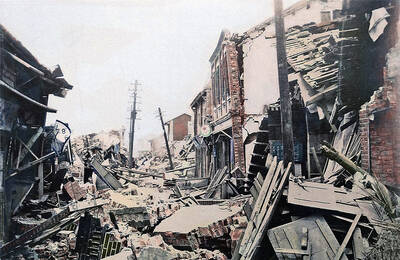
April 15 to April 21 Yang Kui (楊逵) was horrified as he drove past trucks, oxcarts and trolleys loaded with coffins on his way to Tuntzechiao (屯子腳), which he heard had been completely destroyed. The friend he came to check on was safe, but most residents were suffering in the town hit the hardest by the 7.1-magnitude Hsinchu-Taichung Earthquake on April 21, 1935. It remains the deadliest in Taiwan’s recorded history, claiming around 3,300 lives and injuring nearly 12,000. The disaster completely flattened roughly 18,000 houses and damaged countless more. The social activist and

Over the course of former President Ma Ying-jeou’s (馬英九) 11-day trip to China that included a meeting with Chinese Communist Party (CCP) leader Xi Jinping (習近平) a surprising number of people commented that the former president was now “irrelevant.” Upon reflection, it became apparent that these comments were coming from pro-Taiwan, pan-green supporters and they were expressing what they hoped was the case, rather than the reality. Ma’s ideology is so pro-China (read: deep blue) and controversial that many in his own Chinese Nationalist Party (KMT) hope he retires quickly, or at least refrains from speaking on some subjects. Regardless

Approaching her mid-30s, Xiong Yidan reckons that most of her friends are on to their second or even third babies. But Xiong has more than a dozen. There is Lucky, the street dog from Bangkok who jumped into a taxi with her and never left. There is Sophie and Ben, sibling geese, who honk from morning to night. Boop and Pan, both goats, are romantically involved. Dumpling the hedgehog enjoys a belly rub from time to time. The list goes on. Xiong nurtures her brood from her 8,000 square meter farm in Chiang Dao, a mountainous district in northern Thailand’s


 RSS
RSS