


Agroup of 20-somethings work intensively in their Tianmu (天母) flat preparing the first play to be put out by the theater company Lee Qingzhao the Private (李清照私人劇團). The self-funded theater commune has residents proficient in dancing, script writing, directing and costume design, and the members have all set out to impress with unrestrained vitality and creativity.
Founded half a year ago by two young poets Yuguo (魚果) and Liu Liang-yen (劉亮延), the company takes its name from the female poet of the Sung Dynasty. Its first play takes as its point of departure the serpent figure of Bai Suzhen (白素貞) from the Tale of the White Snake(白蛇傳). The style it has chosen is that of kabuki.
A traditional Japanese form of theater originating in the Edo period, kabuki has its roots in the popular culture of the townspeople. The choice of the form echoes the spirit of the young group, which portrays the lives of ordinary folk drawn from classical Chinese literature.
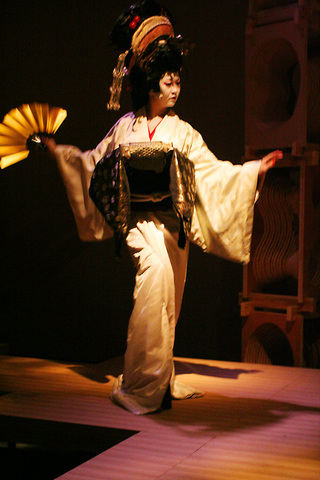
PHOTO COURTESY OF THEATER COMPANY OF LEE QING ZHAO THE PRIVATE
“We are named after Lee Qingzhao because she is the representative figure in classical Chinese literature who roams freely between folk art and the refined. As readers, we find Zhao's language full of surprises. She takes us to different realms and offers alternative ways of sensing and feeling. We hope that our plays are encounters that surprise the audience,” Liu said.
Using the disguise of kabuki dance, Liu's Bai Suzhen is a stunning mix-and-match dance piece. It is performed by young yet experienced Jasmine Wang (王世緯) accompanied by live piano and percussion sounds and erotic chanting by Yuguo. Wang spent three months learning kabuki dance and is also a professionally trained Butoh dancer. In this performance, she had to overcome the challenge of dancing in many layers of costumes weighing more than 10kg.
The off-stage chanting is worth an independent introduction of its own. Mixing traditional Japanese dance music and the Frensh impressionism of Debussy, gifted young poet Yuguo puts his creative input into Liu's modern poetry and transforms it into a sultry psalm of the serpent, using the sounds of various Taiwanese dialects. When asked how he defines his music, Yuguo said, “let's just say it's a form of personal expression.”
Like Liu's most recent acclaimed play about Cao Chi-chiao (曹七巧), a melancholic rereading of Eileen Chang's (張愛玲) The Golden Cangue (金鎖記) in the form of Peking opera, Bai Suzhen is a monologue from a twisted female character whose craziness is magnified through layers of repetitions.
Making references to the Chinese classic and a kabuki theater piece called Dojiji, both of which share similar imagery of snakes, women, shrines and hatred, the play is not a faithful adaptation of the classic but is intended to raise the question of “who is reading it.”
“Our use of the text doesn't make this an adaptation. Take The Golden Cangue, for example. To present such a sensual novel, you can't simply retell the story. You need to bring out what you think is the essence of the text. The return is to the reader who has something to say,” Yuguo said.
What Liu and Yuguo try to say about the literary revision is that it is in the nature of a constant becoming: a snake trying to become a women and vice versa — a figure caught in between two contexts and the authenticity of identity.
The play also mirrors the formation of the company. “[The character] Bai Suzhen cannot be defined in words. She is always on the road but does not know where to go. We are like her. We are not theater professionals but still want to put on a play because there is a possibility of becoming,” Liu said.

In late October of 1873 the government of Japan decided against sending a military expedition to Korea to force that nation to open trade relations. Across the government supporters of the expedition resigned immediately. The spectacle of revolt by disaffected samurai began to loom over Japanese politics. In January of 1874 disaffected samurai attacked a senior minister in Tokyo. A month later, a group of pro-Korea expedition and anti-foreign elements from Saga prefecture in Kyushu revolted, driven in part by high food prices stemming from poor harvests. Their leader, according to Edward Drea’s classic Japan’s Imperial Army, was a samurai
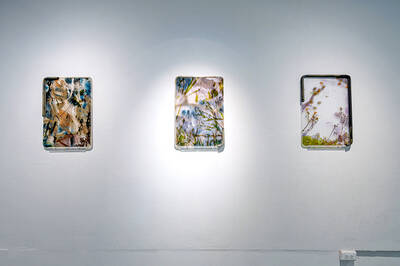
Located down a sideroad in old Wanhua District (萬華區), Waley Art (水谷藝術) has an established reputation for curating some of the more provocative indie art exhibitions in Taipei. And this month is no exception. Beyond the innocuous facade of a shophouse, the full three stories of the gallery space (including the basement) have been taken over by photographs, installation videos and abstract images courtesy of two creatives who hail from the opposite ends of the earth, Taiwan’s Hsu Yi-ting (許懿婷) and Germany’s Benjamin Janzen. “In 2019, I had an art residency in Europe,” Hsu says. “I met Benjamin in the lobby
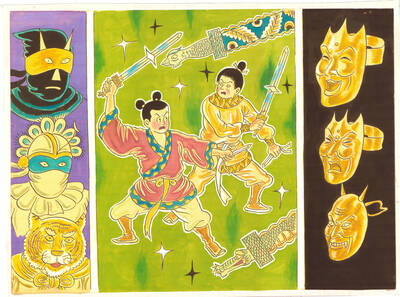
April 22 to April 28 The true identity of the mastermind behind the Demon Gang (魔鬼黨) was undoubtedly on the minds of countless schoolchildren in late 1958. In the days leading up to the big reveal, more than 10,000 guesses were sent to Ta Hwa Publishing Co (大華文化社) for a chance to win prizes. The smash success of the comic series Great Battle Against the Demon Gang (大戰魔鬼黨) came as a surprise to author Yeh Hung-chia (葉宏甲), who had long given up on his dream after being jailed for 10 months in 1947 over political cartoons. Protagonist

A fossil jawbone found by a British girl and her father on a beach in Somerset, England belongs to a gigantic marine reptile dating to 202 million years ago that appears to have been among the largest animals ever on Earth. Researchers said on Wednesday the bone, called a surangular, was from a type of ocean-going reptile called an ichthyosaur. Based on its dimensions compared to the same bone in closely related ichthyosaurs, the researchers estimated that the Triassic Period creature, which they named Ichthyotitan severnensis, was between 22-26 meters long. That would make it perhaps the largest-known marine reptile and would


 RSS
RSS