


Li Guilian proudly shows off the intricate stone carving under the eaves of the entrance to her dilapidated traditional courtyard house in China's capital.
“Look at the wonderful artwork, this is the mythological crane, this is a pen holder and brush, indicating the house owner was an intellectual,” says Li, 56, pointing at details of the house her grandparents bought a century ago.
Then an air of despondency clouds her face. The local area where she grew up and lives — rows of courtyard houses criss-crossed with alleyways called hutongs — has been slated for demolition.
“No one has consulted us. They just force people to move when they want,” she says, lamenting the fate of the historical area at the hands of district authorities and developers.
Like Li, tens of thousands of residents in Beijing's charming but run-down old city districts are facing the fate of being forced to move out of the homes they have lived in for decades and effectively driven out of town.
Some of these houses are several hundred years old, but Beijing is now going through the biggest wave of destruction since the Cultural Revolution (1966-1976), with swathes of old buildings being razed at a rapid pace.
Whereas precious relics were destroyed due to anti-feudal ideologies in the Cultural Revolution, the current transformation is due to the pull of power and money as land prices rocket in the run-up to the Olympic Games in 2008.
The government's decision to prioritize economic development over heritage protection and its monopoly over land rights have led to the current situation, experts say.
Despite the government announcing several policies in recent years to preserve certain parts of old Beijing from urban development, mass-scale demolition goes on unabated in protected zones, often under the name of “renovation” projects.
Collusion between property developers and officials is common, residents claim, as officials often get a share of property developers' lucrative profits.
For example, in 2002, the Beijing municipal government approved a protection plan for 25 historical districts, yet a few years on, many residents in these areas were told their houses were “hazardous” and had to be demolished.
Residents say they are simply helpless in the face of political and financial power.
Ding Ai, who lives just on the edge of the Forbidden City, says her neighbors were beaten by thugs because they refused to move for a property development project.
“They have this robber mentality,” says Ding, a campaigner for the protection of historical houses. “Many houses are not unsafe, why should they have to move?”
“It's all motivated by profits,” sighs Zhang Jinian, another campaigner. “Their priority is not to preserve our heritage.”
The Olympic Games, seen by the government as an opportunity to showcase a modern and glitzy China, has provided the perfect excuse to get rid of anything perceived as old and decaying, they say.
“They just want to chase out poor people and let the rich people in,” Zhang says.
Ordinary hutong residents are paid compensation for their homes, but the amount is often only adequate for an apartment 25km or further outside the central city.
Architect and urban planner Wu Hwa believes that, in the process of trying to buff up its image by “renovating” the old districts of Beijing, authorities are actually destroying the natural charm and life of the historical capital.
“Things are often better off when they are left alone, they have their own charm. Why do we have to make changes, just to get the opposite result?” Wu says.
Residents living in the hutongs, who know the stories behind the historical buildings, have their own ideas of how to rejuvenate the streets they are familiar with.
In the western district of Xuanwu, where numerous former homes of famous revolutionaries and intellectuals are located, residents say renovating the century-old houses and creating a heritage trail could bring in tourism incomes.
“We should make the most of our historical roots,” says hutong resident Hu Jinhua.
The Beijing Cultural Relics Bureau, while expressing hopes to protect the historical residential areas, says its hands are often tied because it can only protect individual buildings that are officially designated historical relics.
“Ordinary courtyard houses and hutong's come under the jurisdiction of the ministries of construction and planning ... . If they were under the Cultural Relics Bureau, demolition would be prohibited,” says Deputy Director Kong Fanzhi.
But as it is, the residents can only lament the demise of the heritage that they are so proud of but will soon have to sacrifice to make way for new property development.
“I feel this is part of the blood that flows in my body — it is not just a property, but the elixir of China's culture and the pride of our country's wisdom,” says the despondent Li.
“Now we're just like a floating leaf in the sea — completely helpless,” she says, sitting next to an aged carved wooden door frame, a poignant reminder of the house's glorious past.

In late October of 1873 the government of Japan decided against sending a military expedition to Korea to force that nation to open trade relations. Across the government supporters of the expedition resigned immediately. The spectacle of revolt by disaffected samurai began to loom over Japanese politics. In January of 1874 disaffected samurai attacked a senior minister in Tokyo. A month later, a group of pro-Korea expedition and anti-foreign elements from Saga prefecture in Kyushu revolted, driven in part by high food prices stemming from poor harvests. Their leader, according to Edward Drea’s classic Japan’s Imperial Army, was a samurai

Approaching her mid-30s, Xiong Yidan reckons that most of her friends are on to their second or even third babies. But Xiong has more than a dozen. There is Lucky, the street dog from Bangkok who jumped into a taxi with her and never left. There is Sophie and Ben, sibling geese, who honk from morning to night. Boop and Pan, both goats, are romantically involved. Dumpling the hedgehog enjoys a belly rub from time to time. The list goes on. Xiong nurtures her brood from her 8,000 square meter farm in Chiang Dao, a mountainous district in northern Thailand’s

Located down a sideroad in old Wanhua District (萬華區), Waley Art (水谷藝術) has an established reputation for curating some of the more provocative indie art exhibitions in Taipei. And this month is no exception. Beyond the innocuous facade of a shophouse, the full three stories of the gallery space (including the basement) have been taken over by photographs, installation videos and abstract images courtesy of two creatives who hail from the opposite ends of the earth, Taiwan’s Hsu Yi-ting (許懿婷) and Germany’s Benjamin Janzen. “In 2019, I had an art residency in Europe,” Hsu says. “I met Benjamin in the lobby
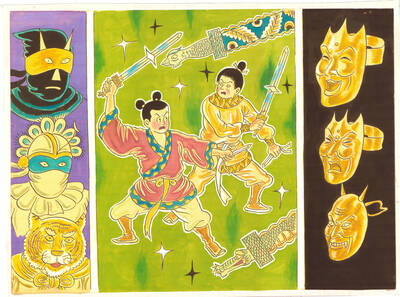
April 22 to April 28 The true identity of the mastermind behind the Demon Gang (魔鬼黨) was undoubtedly on the minds of countless schoolchildren in late 1958. In the days leading up to the big reveal, more than 10,000 guesses were sent to Ta Hwa Publishing Co (大華文化社) for a chance to win prizes. The smash success of the comic series Great Battle Against the Demon Gang (大戰魔鬼黨) came as a surprise to author Yeh Hung-chia (葉宏甲), who had long given up on his dream after being jailed for 10 months in 1947 over political cartoons. Protagonist


 RSS
RSS