


One day in October 1989, in the reading room of London’s Imperial War Museum, the Keeper of Documents handed two boxes to Robert Bickers, a Chinese-speaker, historian, and author of Britain in China. “I think you’ll enjoy these,” he said.
The boxes contained documents relating to the life of Maurice Tinkler, a Briton born in Grange-over-Sands, Lancashire, close to the English Lake District, in 1898. At the age of 21 he took a job in the Shanghai Municipal Police, a post he held for 11 years, resigning in circumstances Bickers is unable to explain. He ended life as supervisor of labor in the Shanghai subsidiary of a UK cotton-printing firm, the China Printing and Finishing Company. During a strike in 1939, partly anti-British in nature, he was beaten up by occupying Japanese troops (who were encouraging the strikers) and died in a Japanese hospital in Pudong the following day.
In opting to write the life of a perhaps representative but nonetheless largely undistinguished servant of empire, Bickers is following a trend to study ordinary people caught up in world events rather than famous political figures. The life of a single such individual will clearly make for good reading, but such an enterprise is only possible if detailed biographical information is available. In Maurice Tinkler’s case just enough of it was.
But there’s more to it than this. Bickers adds a chapter at the end of the book pointing out that he himself, the son of an air force sergeant, was sent to Hong Kong in 1971 and lived there for three years. “I too am a creature of the empire world,” he writes, along with millions of other near-anonymous Britons. It’s their experience he wants to understand, and in this book Maurice Tinkler is made to stand, slightly artificially, as their representative. And because Bickers writes in a notably accessible style, the book has become a popular success, and here appears as a Penguin paperback.
Bickers is no idealizer of empire, and you can’t help feeling Tinkler’s stridently racist opinions and frequently violent outbursts suit his underlying purposes. “His comments were mainstream even if his violence wasn’t,” he remarks. The British Empire, like all empires, depended on force, he insists, both for its establishment and its continuation. “It shattered the societies it subjugated, but it also shattered and disoriented British society.” After their expatriate lives men frequently found they couldn’t return home, unable to face re-integrating themselves into life back in a country from which they had grown distant, and frequently moved on to places even further away.
Tinkler was a policeman in Shanghai’s tiny International Settlement, the extra-territorial district where foreigners enjoyed immunity from Chinese law. He was thus a member of a group more than usually concerned with the enforcement of foreign rule. And as George Orwell wrote (in The Road to Wigan Pier, but referring to his own life in uniform in Burma), in the police “you see the dirty side of Empire at close quarters.”
In attempting the biography of an ordinary man, Empire Made Me inevitably encounters the problem of missing dates. Bickers has no idea what Tinkler did between 1931 and February 1934, for instance, and can only guess, and his speculations are included in a chapter entitled “What We Can’t Know.” Any historian understands that, when looking at the lives of ordinary people, this is often almost everything.
The book naturally has much to say on the Shanghai of the period. The British dominated the International Settlement, though it was never a colony. The police, as elsewhere in the British Empire, felt themselves to be a good deal less than “pukka.” Drinking while on duty was common, and this may have been the reason for Tinkler’s demotion and subsequent resignation in 1930. Corruption (“graft”) was common too, though Bickers thinks it unlikely Tinkler fell into that trap as he never accumulated any savings, having only ?48 (US$89) in the bank just before he died.
Even so, he managed a trip, sailing First Class, to Taiwan and Japan in 1921, visiting Taipei, Tainan and Alishan, calling in on Japanese police stations en route and being well-received.
This is in many ways a rather melancholy book, as well as being a meticulous one. Its subtitle “An Englishman Adrift in Shanghai” sets the tone. Empire, in Bickers’s view, was a seductive illusion, drawing men who had few other options into the soft life it offered, then quietly bleeding them and leaving them in effect unable to go home. Injustice permitted this state of affairs, he says, but the expatriates rarely thought in this way, maintaining instead societies that reminded them of home, though usually a home that was out-of-date by a generation, or even two.
On the other hand, Bickers’s is also a vision that offers several poetic possibilities, and it’s certainly preferable to earnest statistical analyses and tables of trade figures. That his interest verges on the imaginative is confirmed by his discussion of many novels dealing with the British Empire, including books by Paul Scott, Anthony Burgess and J.G.Ballard.
Maurice Tinkler’s dramatic end put him onto the front pages of British newspapers. Enoch Powell, later to become a prominent UK politician, even wrote a poem on him at the age of 27, seeing him as a loyal servant of empire abandoned to his fate by his country. And it was probably this last-minute celebrity that brought his file onto Bickers’ library desk in the first place. Historians feed off death, he remarks, but mulling over this evocative book, with its faded photographs and interviews with surviving relatives, you feel that it tells truths about the allure as well as the pitfalls of displacement. Its title, incidentally, probably refers back to Graham Greene’s early novel England Made Me, confirming that Bickers is a keen reader of fiction, and disposed to a similarly evocative treatment of history.

Last week Joseph Nye, the well-known China scholar, wrote on the Australian Strategic Policy Institute’s website about how war over Taiwan might be averted. He noted that years ago he was on a team that met with then-president Chen Shui-bian (陳水扁), “whose previous ‘unofficial’ visit to the US had caused a crisis in which China fired missiles into the sea and the US deployed carriers off the coast of Taiwan.” Yes, that’s right, mighty Chen caused that crisis all by himself. Neither the US nor the People’s Republic of China (PRC) exercised any agency. Nye then nostalgically invoked the comical specter

Relations between Taiwan and the Czech Republic have flourished in recent years. However, not everyone is pleased about the growing friendship between the two countries. Last month, an incident involving a Chinese diplomat tailing the car of vice president-elect Hsiao Bi-khim (蕭美琴) in Prague, drew public attention to the People’s Republic of China’s (PRC) operations to undermine Taiwan overseas. The trip was not Hsiao’s first visit to the Central European country. It was meant to be low-key, a chance to meet with local academics and politicians, until her police escort noticed a car was tailing her through the Czech capital. The
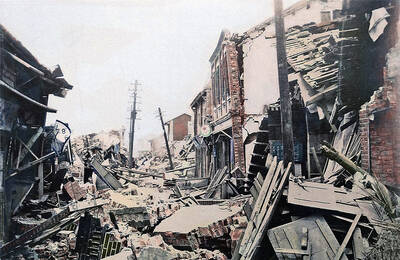
April 15 to April 21 Yang Kui (楊逵) was horrified as he drove past trucks, oxcarts and trolleys loaded with coffins on his way to Tuntzechiao (屯子腳), which he heard had been completely destroyed. The friend he came to check on was safe, but most residents were suffering in the town hit the hardest by the 7.1-magnitude Hsinchu-Taichung Earthquake on April 21, 1935. It remains the deadliest in Taiwan’s recorded history, claiming around 3,300 lives and injuring nearly 12,000. The disaster completely flattened roughly 18,000 houses and damaged countless more. The social activist and

Over the course of former President Ma Ying-jeou’s (馬英九) 11-day trip to China that included a meeting with Chinese Communist Party (CCP) leader Xi Jinping (習近平) a surprising number of people commented that the former president was now “irrelevant.” Upon reflection, it became apparent that these comments were coming from pro-Taiwan, pan-green supporters and they were expressing what they hoped was the case, rather than the reality. Ma’s ideology is so pro-China (read: deep blue) and controversial that many in his own Chinese Nationalist Party (KMT) hope he retires quickly, or at least refrains from speaking on some subjects. Regardless


 RSS
RSS