


The Lake House, a wondrously illogical time-travel romance directed by Alejandro Agresti, is notable mainly for reuniting Keanu Reeves and Sandra Bullock, who together survived a harrowing bus ride in Speed. That was 12 years ago — how time flies! — and since then they have gone their separate movie-star ways, into the Miss Congeniality and Matrix franchises, as well as into a startlingly long list of bad movies, of which I will mention only Hope Floats and Sweet November.
But these two stars have a habit of being more appealing than their material. This is not just a matter of excellent facial bone structure, but also of a sly ability to play simultaneously in and against type. Because Bullock and Reeves have become such familiar screen presences, their performances turn out, more often than not, to be genuinely surprising. Bullock likes to be difficult, to temper her radiance with grouchiness, while Reeves, when the mood strikes, can inflect his mild, baffled affect with meanness, moodiness and even a hint of thorny intelligence.
So while the general public has not, as far as I can tell, been clamoring for a reunion, The Lake House nonetheless functions as a fascinating experiment. Is the chemistry — or, given that Speed was all about the velocity of bodies in motion, the physics — still there? It is, although in this case the viewer will also have to grapple with a heavy dose of Hollywood metaphysics, which keeps the leads apart for most of the movie.

PHOTOS COURTESY OF WARNER BROS
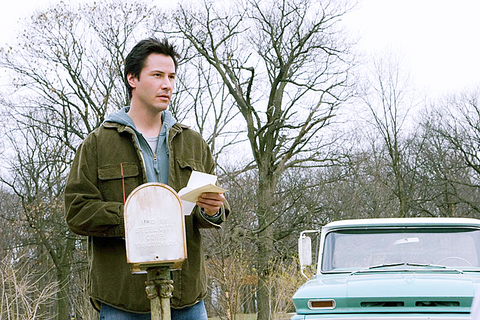
At the start, Bullock's character, Kate, a stressed-out physician who has just completed her residency, moves out of the architectural curiosity that gives the picture its title, leaving a note in the mailbox for the next tenant. That would be Reeves's Alex, a soulful real estate developer who turns out actually to be the previous tenant. Some unexplained wrinkle in the space-time continuum — or a serious glitch at the postal service — has made it possible for Kate, in 2006, to correspond with Alex, who is still making his way through 2004.
“Not much has changed,” Kate writes to him at one point, when he asks what things are like in the future. His general lack of curiosity — he doesn't ask who won the presidential election or the World Series, or pester her for stock market tips — is in keeping with the fuzziness of the film's conceit. If you approach it with a rational, skeptical mind, The Lake House will fall apart almost immediately. But where is the fun in that? You'll just have to accept that a book can travel through the mail to a date earlier than the one printed on its copyright page, and that a fancy Chicago restaurant will hold an unconfirmed reservation for two years.
The Lake House, while completely preposterous, is not without charm. Both Kate and Alex drive well-preserved old cars — hers is a copper-colored Mustang that appears to be of late-1960s vintage, while his pickup truck looks even older — and the movie they inhabit, based on a Korean film called Il Mare, is an unapologetic throwback to a classic studio genre, the melodrama of impossible love. The social obstacles that used to exist — in the real world and, more intensely, in Production Code-governed Hollywood — have lost their forbidding power, which may be why supernatural and science fiction touches are required to keep the idea of romantic longing alive.

Kate and Alex, by means of handwritten letters placed in that mailbox (and read in back-and-forth voice-over to simulate real-time conversations), fall deeply and achingly in love. There is some competition for their affection. Alex is coolly, almost sadistically indifferent to a co-worker (Lynn Collins) who all but throws herself at his feet, while Kate has recently broken up with a perfectly decent but manifestly inadequate fiance (Dylan Walsh), who keeps showing up no matter what year it is. She also has a gentle mother (Willeke van Ammelrooy) and a wise boss (Shohreh Aghdashloo), who serve as confidantes, while Alex is burdened with an imperious, narcissistic father (Christopher Plummer), a famous architect who designed that strange, impractical house by the lake.
The contrivances of the plot, which may require occasional glance s at a multiyear date book, are smoothly handled by David Auburn's script and by Agresti's direction. Visually, The Lake House is elegant without being terribly showy, with a connoisseur's eye for Chicago's architectural glories. But the movie is, above all, a showcase for its stars, who seem gratifyingly comfortable in their own skin and delighted to be in each other's company again, in another deeply silly, effortlessly entertaining movie.

In late October of 1873 the government of Japan decided against sending a military expedition to Korea to force that nation to open trade relations. Across the government supporters of the expedition resigned immediately. The spectacle of revolt by disaffected samurai began to loom over Japanese politics. In January of 1874 disaffected samurai attacked a senior minister in Tokyo. A month later, a group of pro-Korea expedition and anti-foreign elements from Saga prefecture in Kyushu revolted, driven in part by high food prices stemming from poor harvests. Their leader, according to Edward Drea’s classic Japan’s Imperial Army, was a samurai

Located down a sideroad in old Wanhua District (萬華區), Waley Art (水谷藝術) has an established reputation for curating some of the more provocative indie art exhibitions in Taipei. And this month is no exception. Beyond the innocuous facade of a shophouse, the full three stories of the gallery space (including the basement) have been taken over by photographs, installation videos and abstract images courtesy of two creatives who hail from the opposite ends of the earth, Taiwan’s Hsu Yi-ting (許懿婷) and Germany’s Benjamin Janzen. “In 2019, I had an art residency in Europe,” Hsu says. “I met Benjamin in the lobby

April 22 to April 28 The true identity of the mastermind behind the Demon Gang (魔鬼黨) was undoubtedly on the minds of countless schoolchildren in late 1958. In the days leading up to the big reveal, more than 10,000 guesses were sent to Ta Hwa Publishing Co (大華文化社) for a chance to win prizes. The smash success of the comic series Great Battle Against the Demon Gang (大戰魔鬼黨) came as a surprise to author Yeh Hung-chia (葉宏甲), who had long given up on his dream after being jailed for 10 months in 1947 over political cartoons. Protagonist

A fossil jawbone found by a British girl and her father on a beach in Somerset, England belongs to a gigantic marine reptile dating to 202 million years ago that appears to have been among the largest animals ever on Earth. Researchers said on Wednesday the bone, called a surangular, was from a type of ocean-going reptile called an ichthyosaur. Based on its dimensions compared to the same bone in closely related ichthyosaurs, the researchers estimated that the Triassic Period creature, which they named Ichthyotitan severnensis, was between 22-26 meters long. That would make it perhaps the largest-known marine reptile and would


 RSS
RSS