


Last Friday afternoon at the Museum of Contemporary Art Taipei (MOCA台北當代藝術館), 27-year-old street artist Mickeyman (米其鰻), co-founder of the design brand Taipei Bremen, was having a ball with a bunch of college kids as he worked with them on a project to realize their wild imaginations in creatively designed items. This new program is run by the museum to offer members of the general public hands-on workshops so that they can engage in art both with their bodies and minds.
"The education programs are part of the agenda of the museum's new operating team. We will periodically invite creative persons, not necessarily established artists, from different fields to hold art camps," Lin Hsiao-yun (林小雲), the assistant curator of the museum's education department said.
Besides the art camps, a series of weekend workshops will also take place starting tomorrow in conjunction with the SlowTech exhibition, which, through artists' reflections on time, space, distance, speed and the interplay between physical senses and technology aims to explore the social and cultural significance of a slower pace of life in a post dot.com era.
"The workshops evolved from the key elements presented at the exhibit. We figure since lots of works deal with time, such as Bill Viola's video installation piece Dissolution, Edition 6, we will do a course on time first," Lin said.
Guided by Hsia Hsia (夏夏), a young artist with a passion for poetry, tomorrow's workshop is inspired by Miwa Yanagi's photographic series My Grandmothers, which is on display at the SlowTech exhibition.
The series of photographs explores models' ideal lives 50 years from now through the surreal images of elderly women. Class participants will be encouraged to experience differing perceptions of time through poetry.
Hsia Hsia uses capsule toys, stamps and matchboxes to illustrate the poetry to be read at the workshop. "I invited the poets I love to come up with poetry and I did the designs and handicrafts myself ... . At first I just did it for fun, making about 50 capsule toys and hoping they could be sold within a year," the artist said.
Now she has her own capsule toy vending machine that tours the island, and pieces from her stamp and matchbox series have become a collector item among college students and art lovers.
The second workshop will be led by veteran artist Hsu Jui-hsien (徐瑞憲), who specializes in mechanical art, a marginalized art form on the contemporary art scene. The two classes will mirror the mechanical art works of Mary Ziegler from the US and local artist Tao Ya-lun (陶亞倫), which are currently on display in SlowTech. Hsu will illustrate the hidden mechanisms and kinetic principles that bring to life the visual presentations of the art works.
Working with the mechanical art form for 10 years, Hsu believes the reason why few artists choose to work with his chosen genre is that it requires a high degree of technical knowledge to obtain a good command of the media. "I spent several years getting familiar with the basics of mechanical gears and principles of dynamics; the challenges are greater. You need to face and solve seemingly insurmountable difficulties through intense physical involvement and constant learning from professionals," Hsu said.
For Hsu, the demanding physical contact with the raw materials is the key part of the creations themselves. "As an artist, I am never satisfied with being a mere concept provider," Hsu said.
His delicate mechanical wonders sometimes require years to complete. Even before the actual producing process begins, Hsu needs to put several months of work into drawing drafts and detailed blueprints of the art work's mechanical structures.
As all the components and machinery in his works are self-made, Hsu has built up his collections of mechanical apparatuses into a small factory. "My studio in Taoyuan (桃園) is filled with professional equipment of industrial standards … . Once my brother came to visit my studio and said to me 'you don't have much left in your bank account, do you?'" Hsu said.
The mechanics specialist will bring his self-made gears and simple equipment to the workshops help participants make their own mechanical art works. "It will be a lot of fun to see the MOCA studio turned into a small factory," Lin said.
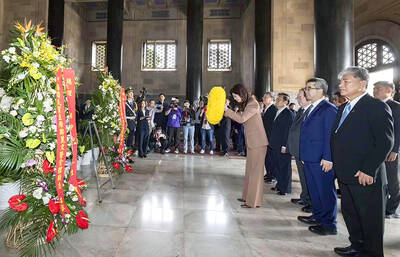
The problem with Marx’s famous remark that history repeats itself, first as tragedy, the second time as farce, is that the first time is usually farce as well. This week Chinese Nationalist Party (KMT) Chair Cheng Li-wun (鄭麗文) made a pilgrimage to the People’s Republic of China (PRC) “to confer, converse and otherwise hob-nob” with Chinese Communist Party (CCP) officials. The visit was an instant international media hit, with major media reporting almost entirely shorn of context. “Taiwan’s main opposition leader landed in China Tuesday for a rare visit aimed at cross-strait ‘peace’”, crowed Agence-France Presse (AFP) from Shanghai. Rare!

What is the importance within the Chinese Nationalist Party (KMT) of the meeting between Xi Jinping (習近平), the leader Chinese Communist Party (CCP), and Cheng Li-wun (鄭麗文), the leader of the KMT? Local media is an excellent guide to determine how important — or unimportant — a news event is to the public. Taiwan has a vast online media ecosystem, and if a news item is gaining traction among readers, editors shift resources in near real time to boost coverage to meet the demand and drive up traffic. Cheng’s China trip is among the top headlines, but by no means
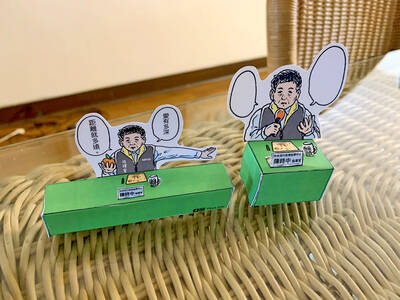
Sunflower movement superstar Lin Fei-fan (林飛帆) once quipped that the Democratic Progressive Party (DPP) could nominate a watermelon to run for Tainan mayor and win. Conversely, the DPP could run a living saint for mayor in Taipei and still lose. In 2022, the DPP ran with the closest thing to a living saint they could find: former Minister of Health and Welfare Chen Shih-chung (陳時中). During the pandemic, his polling was astronomically high, with the approval of his performance reaching as high as 91 percent in one TVBS poll. He was such a phenomenon that people printed out pop-up cartoon

The town of Jhihben (知本) in Taitung County is most well-known for its hot springs, but if you’re looking for an interesting nearby daytime excursion to complement an evening soak at your hotel, don’t miss the Jhihben National Forest Recreation Area (知本國家森林遊樂區). From the resort area, simply take Bus 8129 down to the last stop at the end of the main road and then walk across the bridge and turn left for the ticket gate. This bus can also be taken right from the Taitung Bus Station or from the Zhiben TR station, and runs approximately once an hour all day


 RSS
RSS