


The internal combustion engine contributes massively to global warming, kills around 1.2 million people a year in road accidents and, scientists now warn, is costing billions of US dollars in crop damage each year.
The villain is a molecule of oxygen called ozone.
Way up in the stratosphere, the wafer-thin ozone layer exists naturally as a protector of life, filtering out ultra-violet sunlight that would otherwise slice and corrupt human DNA.
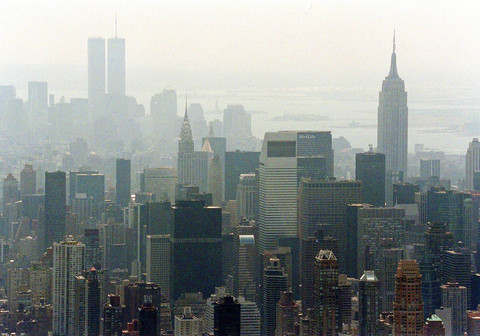
PHOTO: NY TIMES NEWS SERVICE
At ground level, though, ozone can be dangerous. Formed by a reaction between nitrogen oxides and volatile organic compounds emitted by road traffic, ozone smog can be a life-shortening problem for people with bad respiratory problems.
Another fast-emerging picture is that this pollution is also inflicting a rising bill in damage to food plants, especially in regions where hot, sunny, windless conditions favor ozone formation.
Frank Raes, a Dutch scientist at the Joint Research Centre in Ispra, a unit funded by the EU's executive Commission, estimates that each year India loses US$5 billion in crops because of ozone, followed by China, with US$2.5 billion.
They are followed by Iran, Pakistan, Turkey and the east and west coasts of North America.
By 2030, says Raes, India will lose 20 percent of its crops through damage, compared with less than 5 percent through man-made global warming.
An assessment of 45 countries made in 2002 for the UN Economic Commission for Europe found that ozone is already costing farmers in Europe and countries of the former Soviet Union more than US$7.5 billion a year.
Ozone enters plants through respiratory pores in the leaves. It then produces byproducts that crimp efficiency in photosynthesis, leaving a plant that is weak and undersized — and with a crop size and quality to match.
Before industrialization, annual mean ozone concentrations were between 10 parts per billion (ppb) and 15ppb.
In industrialized countries, levels have been rising annually by between 0.5 percent to 2.5 percent; in Britain, this average can reach 30ppb today on hot and sunny days, according to a 2004 study by University of York scientists in northern England.
Such averages may not seem much, given that, depending on the crop, ozone levels need to hit 40ppb or 50ppb to start affecting the plant.
The problem is that there can be high peaks, depending on the season, local topography and type of weather.
For one thing, ozone levels are highest in summer, when crops are growing.
And, ironically, they are often highest in the countryside. Ozone smog originates in the city but it takes several hours to form through local atmospheric chemical reactions, and then drifts to rural areas.
A 2003 study by University of Illinois researchers found that in Illinois, part of the US grain belt, the average concentration is 64ppb, with occasional daily spikes as high as 120ppb.
The team grew a batch of soybeans in ozone of 62ppb and another at 75ppb, which corresponds to an expected 20 percent increase in ozone levels by 2030.
The plants that grew in 75ppb of ozone lost 20 percent of their harvest compared with the 62ppb group.
“What we found was surprising and a bit shocking — with a 20 percent rise in ozone exposure, we also saw a 20 percent drop in yield,” said Stephen Long, a professor at the university's departments of plant biology and crop sciences.
Raes, who is studying the effect of ozone on rice, corn, wheat and soybean, says that ozone smog's effect on agriculture may well be far worse than global warming.
Even so, ozone and global warming are linked, as both are caused by the fossil fuels and both are cross-border problems.
Countries such as the US which complain that controls on carbon dioxide cost their economy too much should be told that by cleaning up fossil-generated CO2, they also help tackle ozone damage, says Raes.
“What's good for the climate is also good for the air,” he says.

Last week Joseph Nye, the well-known China scholar, wrote on the Australian Strategic Policy Institute’s website about how war over Taiwan might be averted. He noted that years ago he was on a team that met with then-president Chen Shui-bian (陳水扁), “whose previous ‘unofficial’ visit to the US had caused a crisis in which China fired missiles into the sea and the US deployed carriers off the coast of Taiwan.” Yes, that’s right, mighty Chen caused that crisis all by himself. Neither the US nor the People’s Republic of China (PRC) exercised any agency. Nye then nostalgically invoked the comical specter

Relations between Taiwan and the Czech Republic have flourished in recent years. However, not everyone is pleased about the growing friendship between the two countries. Last month, an incident involving a Chinese diplomat tailing the car of vice president-elect Hsiao Bi-khim (蕭美琴) in Prague, drew public attention to the People’s Republic of China’s (PRC) operations to undermine Taiwan overseas. The trip was not Hsiao’s first visit to the Central European country. It was meant to be low-key, a chance to meet with local academics and politicians, until her police escort noticed a car was tailing her through the Czech capital. The
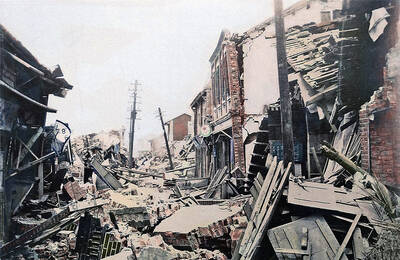
April 15 to April 21 Yang Kui (楊逵) was horrified as he drove past trucks, oxcarts and trolleys loaded with coffins on his way to Tuntzechiao (屯子腳), which he heard had been completely destroyed. The friend he came to check on was safe, but most residents were suffering in the town hit the hardest by the 7.1-magnitude Hsinchu-Taichung Earthquake on April 21, 1935. It remains the deadliest in Taiwan’s recorded history, claiming around 3,300 lives and injuring nearly 12,000. The disaster completely flattened roughly 18,000 houses and damaged countless more. The social activist and

Over the course of former President Ma Ying-jeou’s (馬英九) 11-day trip to China that included a meeting with Chinese Communist Party (CCP) leader Xi Jinping (習近平) a surprising number of people commented that the former president was now “irrelevant.” Upon reflection, it became apparent that these comments were coming from pro-Taiwan, pan-green supporters and they were expressing what they hoped was the case, rather than the reality. Ma’s ideology is so pro-China (read: deep blue) and controversial that many in his own Chinese Nationalist Party (KMT) hope he retires quickly, or at least refrains from speaking on some subjects. Regardless


 RSS
RSS