


It's May 15, and Italy's new president, 80-year-old Giorgio Napolitano, is being sworn in. A procession of liveried soldiers march outside Quirinale Palace and 21 cannons are shot from Gianicolo Hill to herald the president's arrival. A few hundred meters away at the chic Piazza Venezia, a ceremony of a different kind is taking place involving another, equally decorated 80-year-old: Ennio Morricone, the godfather of film music, is preparing to be interviewed.
"He can be quite grumpy," says the genial translator a little nervously as we wait in the cobbled courtyard of Morricone's building to be summoned by the maestro. "Once I translated for an American journalist who kept asking him about the Sergio Leone films.
"Morricone told me that if she asked him about Leone one more time, he was leaving."
This is not the first time I've been warned about the "Leone question." Morricone has written scores for more than 400 films since receiving his first commission in 1962, but his name will forever be linked with the haunting whistles, ticking pocket-watches and gloriously foreboding orchestral sweeps that give 1960s westerns such as A Fistful of Dollars and The Good, the Bad and the Ugly their mood and tension. Apparently he's not too happy about this. And he finds the common term for Leone's Italian-made recreations of the American west deeply offensive. I've been told that should I in any way connect the word "spaghetti" with "western," I might find a plate of the stuff tipped over my head.
Finally, we are summoned to Morricone's apartment. Huge double doors open on to a gilded palace of a flat. The flat is so immaculate -- even the stack of art books on the coffee table is in perfect geometric alignment -- it is hard to tell if it is actually inhabited or merely a showpiece for Roman living. But sitting in one of the sofas, looking like a modern-day emperor, is Morricone. He doesn't exactly smile, but he does not look hostile either. I try to butter him up by mentioning an obscure film called Stark System that he scored. He groans.
"I can't remember anything about it," he says, "except that the director was a woman." Further questions about little-known movies bring recollections of "a beautiful woman" whose "private parts" were featured in close-up, and "a stunning woman who was at least 1.80m tall." If nothing else, Morricone's career has brought him into contact with a lot of women.
Morricone's stubborn clarity of vision, combined with a rigorous training and an open mind, has put him in a class of his own among soundtrack composers. Born into a musical family in 1926 and educated at the Conservatory of the National Academy of Santa Cecilia, Morricone began working in film music by chance. "Once I finished my studies, I played trumpet with a small band just when the war had finished, a very bad time in our history," he says. "We used to play for American and British armies and I didn't like that -- I didn't enjoy playing other people's music, and if I hadn't worked in film I would have been a composer of free music. But a director called me, so I started writing scores. I have never once gone to a director and offered him ideas; they have always come to me."
Sergio Leone, a former school friend, came to Morricone when he needed music for his first film in 1964. Reasoning that not asking Morricone about A Fistful of Dollars would be like not asking Frank Sinatra about My Way, I promise to keep my questions about his Leone scores to a minimum, and ask how he came up with the brooding score.
"Who told him not to ask me about Leone?" he snaps at the translator, before eloquently detailing his working relationship with the director.
"Some of the music was written before the film, which is unusual," he explains. "Leone's films were made like that because he wanted the music to be an important part of it, and he often kept the scenes longer simply because he didn't want the music to end. That's why the films were so slow -- because they were following the pattern of the music."
Why did A Fistful of Dollars make such an impact? "I don't know. It's the worst film Leone made and the worst score I did. But there are other films I wrote music for that had bigger success. The Mission, Once Upon a Time in America and The Good, the Bad and the Ugly are all better."
After the success of the westerns, the commissions came flooding in. Morricone knocked out dark and brooding scores for the bloody Italian crime genre known as giallo, named after the yellow pages of Italian pulp fiction paperbacks. He wrote music for the films of Pier Paolo Pasolini, who was said to be so worried about Morricone's reaction to the depravity depicted in his film Salo that he refused to show the composer any rushes. ("It wasn't to my taste," says Morricone, who only saw the film once it was completed.)
His experimental tendencies were allowed full rein in his scores for the horror films of Dario Argento. "His films are full of blood, so contemporary electronic music works perfectly and the audience accepted the music as linked to those strong scenes." Did he ever work with Goblin, Dario Argento's own electronic group? He appears to take umbrage. "Nobody ever collaborates with me. I have had a few composers conducting my music but that is as far as it goes."
I ask where his ideas come from. "They come from me, of course!" he replies irritably. "The director doesn't tell me anything: it's my idea and even if the director comes along to tell me to do this or that, it's still my creation." I tell him that I wasn't disputing the originality of his work, but merely wished to know where the seeds of his musical thoughts germinate. That appears to pacify him.
"Sometimes the idea comes from very far away, and when you get to the end of it, you can't remember where the beginning was. One simple idea develops into something completely different."
Unusual among successful film composers, Morricone has never moved to Hollywood. He has also refused to learn English, which, having got some sense of his character over the last hour or so, is beginning to make sense. "I never had the time," he says of his lack of linguistic knowledge. As for relocating to the US, it was never an option, even after his high-profile success with Hollywood films such as The Mission, for which he was nominated for an Oscar.
America would just have to come to him.
"They said they would give me a villa," he says of the attempts Hollywood studios made to get him to move. "I told them I liked it in Italy, and there was no need to leave Rome because I only speak with the director about the score, not the studio." He is deeply critical of the Hollywood trend for composers to write a score that is then sent to a professional arranger. "In the history of music, composition is instrumentation -- a composer doesn't just write the music and then get someone else to do the orchestration. Nobody, apart from a few people in America, does this."
Morricone remains prolific. He spends most days writing at his Rome apartment. He takes a month off each summer but ends up composing anyway, working for an hour or so every morning. "When I do have free time, my concern is: will I ever be able to write again? But this is normal. There is a tenor singer I knew who used to wake up every morning convinced he no longer had a voice. So I keep going because the function fuels the organ; the work creates the work."
Does he have any thoughts of retiring? "Would you like me to retire? Actually, I already have. I receive my state pension and I pay taxes on my earnings. But nobody told me I had to stop working when I receive my pension."
It's taken a while for me to realize that this haughty old man, this Caesar of film music, is having a sly laugh at the expense of the rather earnest foreign journalist. I ask him if he has any unrealized ambitions. He almost smiles. "Of course. I would like to be the chess world champion. But perhaps I will have to wait until I'm reborn for that."
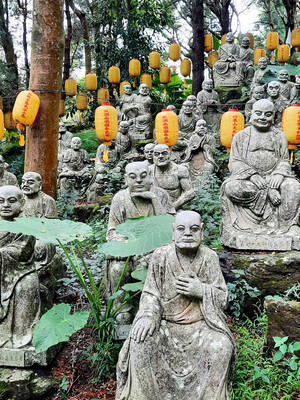
When Taiwan was battered by storms this summer, the only crumb of comfort I could take was knowing that some advice I’d drafted several weeks earlier had been correct. Regarding the Southern Cross-Island Highway (南橫公路), a spectacular high-elevation route connecting Taiwan’s southwest with the country’s southeast, I’d written: “The precarious existence of this road cannot be overstated; those hoping to drive or ride all the way across should have a backup plan.” As this article was going to press, the middle section of the highway, between Meishankou (梅山口) in Kaohsiung and Siangyang (向陽) in Taitung County, was still closed to outsiders
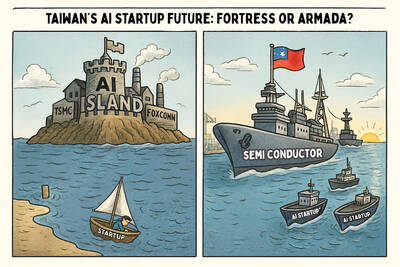
President William Lai (賴清德) has championed Taiwan as an “AI Island” — an artificial intelligence (AI) hub powering the global tech economy. But without major shifts in talent, funding and strategic direction, this vision risks becoming a static fortress: indispensable, yet immobile and vulnerable. It’s time to reframe Taiwan’s ambition. Time to move from a resource-rich AI island to an AI Armada. Why change metaphors? Because choosing the right metaphor shapes both understanding and strategy. The “AI Island” frames our national ambition as a static fortress that, while valuable, is still vulnerable and reactive. Shifting our metaphor to an “AI Armada”
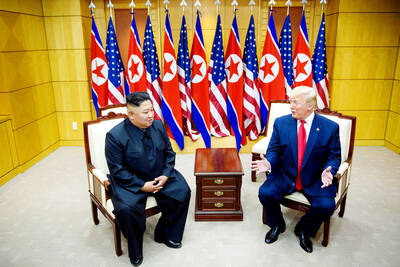
US President Donald Trump may have hoped for an impromptu talk with his old friend Kim Jong-un during a recent trip to Asia, but analysts say the increasingly emboldened North Korean despot had few good reasons to join the photo-op. Trump sent repeated overtures to Kim during his barnstorming tour of Asia, saying he was “100 percent” open to a meeting and even bucking decades of US policy by conceding that North Korea was “sort of a nuclear power.” But Pyongyang kept mum on the invitation, instead firing off missiles and sending its foreign minister to Russia and Belarus, with whom it
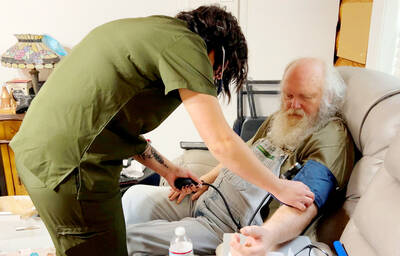
The older you get, and the more obsessed with your health, the more it feels as if life comes down to numbers: how many more years you can expect; your lean body mass; your percentage of visceral fat; how dense your bones are; how many kilos you can squat; how long you can deadhang; how often you still do it; your levels of LDL and HDL cholesterol; your resting heart rate; your overnight blood oxygen level; how quickly you can run; how many steps you do in a day; how many hours you sleep; how fast you are shrinking; how


 RSS
RSS