


This is one of the most compelling and moving novels I've read in many years. The fact that it concerns Afghanistan, a country that has up to now attracted the attention of few novelists writing in English, adds to its attraction, just as the contemporary importance of Afghanistan in international affairs adds to its significance. Its author is a San Francisco doctor of Afghan extraction, and because the main character in the novel is an aspiring writer, you can't help feeling there is a degree of autobiographical content in the book.
The title The Kite Runner refers to the game of flying kites with their strings coated in glue and powdered glass, so that they can be used to cut through the strings of competing kites. Such kite battles are an ancient sport in Asia, and constituted a regular date on the calendar in Kabul before the coming to power of the puritanical Taliban.
"The thing about you Afghanis is that — well, you people are a little reckless." This observation from a Peshawar hotel manager in the novel strikes at the heart of Afghanistan's many afflictions. Invaded by the Soviets in 1980, only to suffer again at the hands of the fundamentalist Taliban, you can only wonder why such a bold, free-spirited people, however reckless, should have to suffer under such a devastating double-assault.
The novel begins before the Soviet invasion with the childhood pranks of two Afghan boys. As with Alain-Fournier's classic Le Grand Meaulnes, this book presents a world that is now gone forever. Amir is officially the only son of Baba and lives in the relative luxury of his spacious Kabul house. His friend is Hassan, a servant-boy living in a hut in the family compound. Whereas Amir's mother haemorraged to death in giving birth, Hassan's mother eloped to join a group of travelling singers and dancers at the sight of her new-born's hare lip.
The contrast between Amir and Hassan is established from the beginning. Driven by a need for his father's approval, Amir teasingly exploits Hassan's illiteracy. Hassan, by contrast, is a pure innocent. Born into the Hezara tribe, he's happy to serve Amir's breakfast and cheerfully attends to his daily needs. Yet his capacity for intuitive thought, plus his unflinching loyalty, mark him out as an incomparable childhood companion.
Amir is a fledgeling writer, and when Hassan is tricked into hearing one of his stories, believing it's from the school anthology, his joyful, ecstatic response gives Amir the confidence he's previously lacked.
A casual remark by his father that Amir might win the biggest kite tournament in 25 years stimulates his ambitions. Hassan is his "kite runner" — the person who runs to claim the cut-free kites — but their eventual victory is marred by the intervention of Assef, one of Amir's classmates. Of mixed Afghan and German blood, he admires Hitler and loathes the Hezaras.
Pinning Hassan to the ground, Assef proceeds to rape the Hezara servant, while Amir turns his back on the scene, too terrified to protest. So begins Amir's inner guilt and ultimate quest for redemption.
Like many people who have witnessed and been tainted by a brutal event, Amir's initial response is to withdraw from Hassan. Their final meeting, involving a dysfunctional pomegranate fight, leaves Hassan smearing his own face with pomegranate juice rather than attack Amir, and they part in an unsatisfactory stalemate. Amir's indecision causes him to miss a decisive confrontation with Assef, something that's left to Hassan's son, years later, to enact.
The awkward relations between the two boys, and between Amir and his father, are parallelled by political turmoil. Amir and Baba flee to Pakistan with a view to settling in California. American soil revives Baba's up-beat nature, while for Amir America is "a river, roaring along, unmindful of the past," and for that reason welcome.
Amir goes on to take a wife, but remains childless. The sudden appearance of his father's oldest friend brings news of Hassan via a series of letters. In these Hassan conveys his delight at now being father to a son, Sohrab, who has already become expert with a slingshot. Rather more horrific news follows, however. With the Taliban now in power, all Hezaras, including Hassan and his wife, are liable to be executed under the flimsiest of pretexts. Finally the friend informs Amir that he and Hassan are in reality brothers, each the son of Baba. He then asks Amir to try to bring Hassan's son to California.
Sohrab turns out to be a troubled child, regularly abused in an orphanage on the vicious Assef's instructions. A fight eventually takes place between Assef, armed with brass knuckles, and Amir, but Sohrab intervenes and blinds Assef in one eye with his slingshot. Amir has escaped Assef, but neither he nor Sohrab are out of the woods yet. The bureaucracy's insistence that Sohrab return to the orphanage results in his attempted suicide, though the young boy's life is eventually saved.
The book ends, not with the sun parting gray clouds, but with the ghost of a smile. It was a smile that "didn't make everything all right" but was merely "a leaf in the woods, shaking in the wake of a startled bird's flight." Sohrab remains undecided about joining Amir in California, but Amir, now liberated from what he sees as his past sins of omission, can only look forward to the changes the new spring will bring.
This fine novel — both vivid and poetic — has already established a large following and can't fail to garner more. It's available in Taiwan at Eslite Bookstores.
Publishion Notes:
THE KITE RUNNER
by Khaled Hosseni
324 pages
BLOOMBURY

In late October of 1873 the government of Japan decided against sending a military expedition to Korea to force that nation to open trade relations. Across the government supporters of the expedition resigned immediately. The spectacle of revolt by disaffected samurai began to loom over Japanese politics. In January of 1874 disaffected samurai attacked a senior minister in Tokyo. A month later, a group of pro-Korea expedition and anti-foreign elements from Saga prefecture in Kyushu revolted, driven in part by high food prices stemming from poor harvests. Their leader, according to Edward Drea’s classic Japan’s Imperial Army, was a samurai

The following three paragraphs are just some of what the local Chinese-language press is reporting on breathlessly and following every twist and turn with the eagerness of a soap opera fan. For many English-language readers, it probably comes across as incomprehensibly opaque, so bear with me briefly dear reader: To the surprise of many, former pop singer and Democratic Progressive Party (DPP) ex-lawmaker Yu Tien (余天) of the Taiwan Normal Country Promotion Association (TNCPA) at the last minute dropped out of the running for committee chair of the DPP’s New Taipei City chapter, paving the way for DPP legislator Su

Located down a sideroad in old Wanhua District (萬華區), Waley Art (水谷藝術) has an established reputation for curating some of the more provocative indie art exhibitions in Taipei. And this month is no exception. Beyond the innocuous facade of a shophouse, the full three stories of the gallery space (including the basement) have been taken over by photographs, installation videos and abstract images courtesy of two creatives who hail from the opposite ends of the earth, Taiwan’s Hsu Yi-ting (許懿婷) and Germany’s Benjamin Janzen. “In 2019, I had an art residency in Europe,” Hsu says. “I met Benjamin in the lobby
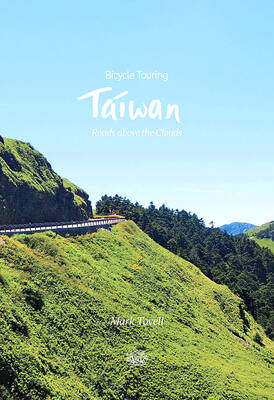
It’s hard to know where to begin with Mark Tovell’s Taiwan: Roads Above the Clouds. Having published a travelogue myself, as well as having contributed to several guidebooks, at first glance Tovell’s book appears to inhabit a middle ground — the kind of hard-to-sell nowheresville publishers detest. Leaf through the pages and you’ll find them suffuse with the purple prose best associated with travel literature: “When the sun is low on a warm, clear morning, and with the heat already rising, we stand at the riverside bike path leading south from Sanxia’s old cobble streets.” Hardly the stuff of your


 RSS
RSS