


For many lovers of good cuisine, offal is where they draw the line, thinking it best swiftly dumped in the garbage bin or left to hard-core foodies.
Barcelona native Paco de Horna Bosch-Lafulla is part of that growing hard-core crowd and also one of the sommeliers at El Bulli, one of the world's most-watched restaurants, run by superstar chef Ferran Adria.
Bosch-Lafulla couldn't be happier as he prowls Barcelona for his favorite eateries, showing how offal is making a steady comeback after years of decline in Spain.
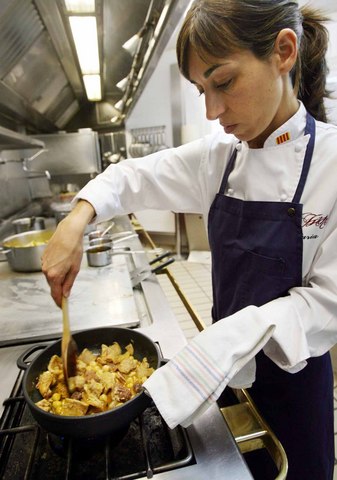
PHOTO: AFP
Although one of his friends describes offal as "the parts that no one wants to eat," Bosch-Lafulla said a growing number of Spanish are once again tucking into guts (and other parts) with gusto.
"It's got flavor and texture, and it's not monotone," he said. "They are dishes that might not be beautiful to see, but they are cheap and flavorful."
First stop on his guts tour is Menuts Rosa, an offal specialist in La Boqueria market, run by Maria Francisca Gabalda and her family since 1900.
She offers everything from hearts and lungs to feet and testicles, and customers waiting at her stall risk being splattered by bits of brain when one of her employees cleaves a sheep's head in two with a large butcher's knife.
"That can happen," said Gabalda, squelching a smile.
"Offal was eaten a lot in the post-war years — in the 1940s, 1950s, 1960s and 1970s," she said. "People liked it and it was cheap."
Once women became full-time workers, they had less time to spend in the kitchen.
"Cooking offal takes time and now, fewer people know how to make it. Women now know how to throw a steak on the grill — bam, bam!" she said, turning her hand over like she's flipping an entrecote, "and you eat it right away."
She sells some 70kg to 80kg of tripe a day, "and more on Fridays and Saturdays," at up to US$5 per kilogram — three to five times less than the cost of most steaks in the market.
But preparing offal can be time consuming, needing slow cooking to tenderise the meat. A good tripe dish can take a day of preparation and some chefs even give it an extra day soaking up flavors before serving.
"From the 1980s to now, it went like this," she said, skiing her hand downward to show the popularity decline, which hit a low around 2000 with the outbreak of mad cow disease, which deterred many European meat-eaters.
"Now, Ferran Adria and other new wave chefs are working on bringing it back," she explained.
Bosch-Lafulla said El Bulli, located in Roses, about two hours north of Barcelona, has had many forms of offal on the menu for years, referring back to a 1993 cookbook he owns.
A wave of South American and African immigrants to Spain has also helped boost offal's popularity, and many now line up every day to buy Gabalda's products and cook them in the traditional ways from back home.
Next on the guts lovers tour is the Bar Cafeteria Tupinamba, where Basco-Lafulla orders orejas and caillos — pigs' ears and tripe stew.
For him, the ears are the perfect starter. Crunchy and chewy, they not only have their own flavor, but also absorb the taste of the olive oil and paprika with which they are prepared.
The tripe is served Madrid-style, bubbling in a dish with ham, sausage, occasional bits of pigs' feet and varying degrees of hot pepper. In many parts of Spain, it is traditionally eaten as a hearty breakfast.
"People would start the day eating like this," he said. "It's like a continental breakfast."
Next, he strolled a couple of blocks to the Jofama cafe for a cap i pota — Catalan for "head and feet" — a salad made with calf bits along with black olives and slivers of red and green peppers. Served chilled, it's surprisingly refreshing in warmer weather.
Finally, he pulled into Alaska Bar and Restaurant for morros — deep fried bits of pork snout served at room temperature and doused with rock salt.
"It's like popcorn! No wait! It's like pork-corn!" he howled.
Ca l'Isidre is one of Barcelona's best-known restaurants and a classic destination for lovers of dishes like tripe and brains. "We've had them both on the menu for 38 years," said head chef Nuria Girones.
"When money started coming into the region, people wanted to eat other stuff," said her father, Isidre Girones.
"It was part of the new wave of cooking, but now, people want to go back to their roots and to find authentic products."
"It's not important whether it's showing up in new wave kitchens or not, but it's very important that it's cooked right," he added.
"Tripe needs one day of cooking and one day of resting before we serve it," he said, "otherwise, it's rubbery."

In late October of 1873 the government of Japan decided against sending a military expedition to Korea to force that nation to open trade relations. Across the government supporters of the expedition resigned immediately. The spectacle of revolt by disaffected samurai began to loom over Japanese politics. In January of 1874 disaffected samurai attacked a senior minister in Tokyo. A month later, a group of pro-Korea expedition and anti-foreign elements from Saga prefecture in Kyushu revolted, driven in part by high food prices stemming from poor harvests. Their leader, according to Edward Drea’s classic Japan’s Imperial Army, was a samurai

Located down a sideroad in old Wanhua District (萬華區), Waley Art (水谷藝術) has an established reputation for curating some of the more provocative indie art exhibitions in Taipei. And this month is no exception. Beyond the innocuous facade of a shophouse, the full three stories of the gallery space (including the basement) have been taken over by photographs, installation videos and abstract images courtesy of two creatives who hail from the opposite ends of the earth, Taiwan’s Hsu Yi-ting (許懿婷) and Germany’s Benjamin Janzen. “In 2019, I had an art residency in Europe,” Hsu says. “I met Benjamin in the lobby

April 22 to April 28 The true identity of the mastermind behind the Demon Gang (魔鬼黨) was undoubtedly on the minds of countless schoolchildren in late 1958. In the days leading up to the big reveal, more than 10,000 guesses were sent to Ta Hwa Publishing Co (大華文化社) for a chance to win prizes. The smash success of the comic series Great Battle Against the Demon Gang (大戰魔鬼黨) came as a surprise to author Yeh Hung-chia (葉宏甲), who had long given up on his dream after being jailed for 10 months in 1947 over political cartoons. Protagonist

A fossil jawbone found by a British girl and her father on a beach in Somerset, England belongs to a gigantic marine reptile dating to 202 million years ago that appears to have been among the largest animals ever on Earth. Researchers said on Wednesday the bone, called a surangular, was from a type of ocean-going reptile called an ichthyosaur. Based on its dimensions compared to the same bone in closely related ichthyosaurs, the researchers estimated that the Triassic Period creature, which they named Ichthyotitan severnensis, was between 22-26 meters long. That would make it perhaps the largest-known marine reptile and would


 RSS
RSS