


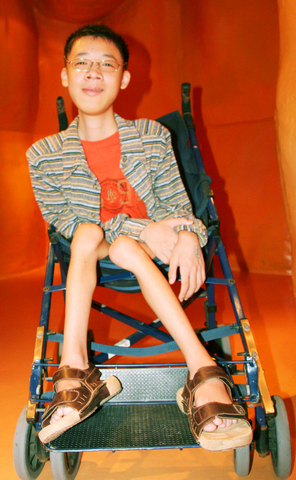
Like many teens Lin Po-ting (
Unlike most other lads his dream is to walk again.
The 15-year-old has Duchenne muscular dystrophy (DMD), a disease that has left him unable to look after himself and trapped in a body that is inexorably destroying itself.

PHOTOS: JULES QUARTLY, TAIPEI TIMES
Even so, Lin manages to overcome the daily problems related to his condition and has succeeded against all expectations by passing his junior high school exams and making it to the top senior high school in Hsinchu (新竹), where he lives.
"He has the same feelings and ambitions as everyone else," says his mother Chen Hui-yu (
Named after the French neurologist Guillaume Duchenne in the 1860s, DMD affects about one boy in 3,000 and is usually a hereditary disease, but can also be the result of spontaneous gene mutations. Those affected lack a muscle protein called dystrophin and this leads to progressive weakness that starts in the legs and affects the rest of the body.
The disease is incurable and fatal. Death usually results from respiratory failure. Sufferers can live to around 25, but according to one study the average life expectancy is 17 years. In 30 percent of cases there is mild mental retardation.
For Lin the symptoms began to show when he was a preschooler and had difficulty balancing. His calves swelled with fibrous material and felt rubbery. Muscle tightening in the calves pulled the foot down and back so he began to walk on his toes. In what is called Gower's maneuver, he used his arms and hands to raise himself to his feet.
"At 11 years old I started falling over and found it difficult to adapt. My life is not the same as other people because people have to look after me," Lin says on a trip to the Day in Pompeii exhibition at the National Taiwan Science Education Center in Shilin, Taipei.
When he looks in the mirror he sees an academic-looking kid with glasses and a few teenage spots. But his body is weak and his legs are painfully thin. His spine is deformed.
He has little control of his body and needs to be carried or pushed in a buggy. Though he can eat a hamburger with his hands, he finds it difficult to use chopsticks. It is increasingly hard for him to breathe or cough because he has a weak diaphragm and easily picks up infections.
Lin is aware that he's slowly wasting away, but dreams of becoming a famous researcher who finds a cure to the disease that afflicts him and others.
"I can't help myself, I can't go to the toilet, I can't walk, I don't know why I'm ill, so I would like to be a medical scientist and make myself better so that I can help other people like me," Lin says. "I would also like to exercise. Another dream would be to walk again one day."
At the exhibition he watches with unbroken concentration a BBC documentary about the end of Pompeii. He has to be carried up some stairs to see casts of those whose lives were cut short by the eruption in 79 AD.
Other kids flit from one exhibit to another, but Lin takes an intense interest in the remains of frescoes, ornaments and furniture of a city snuffed out in its prime.
His attitude is different, more mature, as if the disease has in fact accelerated his mental development. If you ask a dumb question you can detect a hint of impatience. He seems to soak up information and his mind seems to be a few steps ahead. It's like talking to an intellectual or a wise, old man.
"I used to fight with classmates a long time ago, but not any more," he says. "Now I'm a good kid and the worst I do is borrow my brother's books and computer games without asking sometimes."
It is easy to see why he has so many friends and why he is pop-ular with girls. He's charming, has a great sense of humor and a deep humanity that comes from suffering and understanding.
"Pretty much everyone is good to me, no one is cruel. Before, when people didn't know I was sick or saw me in the push chair, then they said bad things or laughed, but not really any more."
Asked about his elder brother, who is 19 years old and is going blind, he says, "I feel sorry for him because of his eyes. I am my brother's eyes and my brother's legs are mine, so we won't get lost."
Since graduating from Pei Yin Junior High School (
"He's so positive, his story is so motivational, that's why people are interested in it," says Lin's mother.
We talk about Stephen Hawking, who wrote A Brief History of Time and is acknowledged as the greatest physicist since Albert Einstein.
The UK scientist was diagnosed as having amyotrophic lateral sclerosis at university and was given just a few years to live. He's 60 now and though largely immobile manages to write books and give speeches with the aid of a computer controlled by the movements of his hand.
The similarities are not lost on Lin.
As for his future, next week he will undergo surgery to straighten his spine. He will study hard at his new school and think about getting an electric wheelchair so he can be more independent.
Life goes on. Hawking writes on his Web site: "I have had motor neuron disease for practically all my adult life. Yet it has not prevented me from having a very attractive family, and being successful in my work. ... it shows that one need not lose hope."

In late October of 1873 the government of Japan decided against sending a military expedition to Korea to force that nation to open trade relations. Across the government supporters of the expedition resigned immediately. The spectacle of revolt by disaffected samurai began to loom over Japanese politics. In January of 1874 disaffected samurai attacked a senior minister in Tokyo. A month later, a group of pro-Korea expedition and anti-foreign elements from Saga prefecture in Kyushu revolted, driven in part by high food prices stemming from poor harvests. Their leader, according to Edward Drea’s classic Japan’s Imperial Army, was a samurai

The following three paragraphs are just some of what the local Chinese-language press is reporting on breathlessly and following every twist and turn with the eagerness of a soap opera fan. For many English-language readers, it probably comes across as incomprehensibly opaque, so bear with me briefly dear reader: To the surprise of many, former pop singer and Democratic Progressive Party (DPP) ex-lawmaker Yu Tien (余天) of the Taiwan Normal Country Promotion Association (TNCPA) at the last minute dropped out of the running for committee chair of the DPP’s New Taipei City chapter, paving the way for DPP legislator Su

It’s hard to know where to begin with Mark Tovell’s Taiwan: Roads Above the Clouds. Having published a travelogue myself, as well as having contributed to several guidebooks, at first glance Tovell’s book appears to inhabit a middle ground — the kind of hard-to-sell nowheresville publishers detest. Leaf through the pages and you’ll find them suffuse with the purple prose best associated with travel literature: “When the sun is low on a warm, clear morning, and with the heat already rising, we stand at the riverside bike path leading south from Sanxia’s old cobble streets.” Hardly the stuff of your

Located down a sideroad in old Wanhua District (萬華區), Waley Art (水谷藝術) has an established reputation for curating some of the more provocative indie art exhibitions in Taipei. And this month is no exception. Beyond the innocuous facade of a shophouse, the full three stories of the gallery space (including the basement) have been taken over by photographs, installation videos and abstract images courtesy of two creatives who hail from the opposite ends of the earth, Taiwan’s Hsu Yi-ting (許懿婷) and Germany’s Benjamin Janzen. “In 2019, I had an art residency in Europe,” Hsu says. “I met Benjamin in the lobby


 RSS
RSS