


The subject matter was untested, the actors almost naked and the whole movie was to be made in a language spoken by only a tiny group of people -- but to film executive Brian Rosen, funding Australia's latest international film success, Ten Canoes, was a "no-brainer."
Even the fact that there was no conventional script, the cast were untrained and the set was a mosquito and crocodile-infested swamp in tropical northern Australia did not stop the ground-breaking movie from going ahead.
Filmed on location in the remote Arafura Swamp in northeastern Australia's Arnhem Land, the US$1.76 million-budget feature is the first to depict life in an Aboriginal community in the days before European invasion.
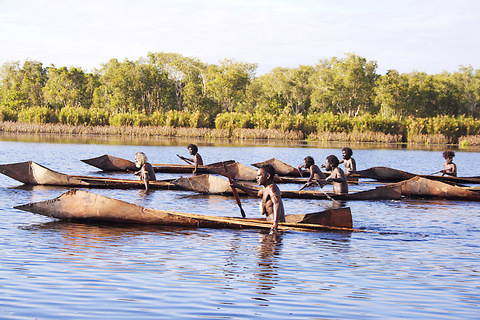
PHOTO: AFP
It switches between depictions of traditional life before contact with white people to more than a thousand years earlier during mythical times when the Aboriginal legends were formed.
"The one thing we felt when the project came in -- yes, it was directed by a white person -- but it was a very special story about indigenous mythology," Rosen, chief executive of the Australian Film Finance Corporation, said.
"On the one hand you could say that's pretty obscure, but on the other you could see it as a very important film."
Ten Canoes is the first Australian film to be shot entirely in indigenous language and its untrained cast come mainly from the remote post of Ramingining where one of the native tongues is Ganalbingu, which is spoken by fewer than 4,000 people.
The movie revolves around the story of a young man, Dayindi, who has taken a fancy to an older man's wife. The older man, aware of Dayindi's feelings, decides to tell him an ancient legend on the same theme.
While previous movies about Aboriginal communities have portrayed some aspect of their interaction with the white Europeans who began arriving here more than 200 years ago, this is the first to delve into their stories before colonization.
"We are going back to what it was like to live in Australia 1,000 years ago. The magical part of this film is that it's about their mythology," Rosen said.
"For the first time ever you are seeing their mythology on film. This is one that's a no-brainer. It's something about Australia that no one has seen before."
The film's reception has proven Rosen right. Ten Canoes won a special jury prize at the Cannes International Film Festival and has been picked up for distribution in the US and Europe.
Back home, the film has been welcomed by the local Aboriginal community in which it has awakened hopes of a revival of traditional indigenous culture.
Film-maker Rolf de Heer said he could not have made Ten Canoes without the assistance of the Ramingining community, which crafted the canoes, spears and housing needed for the movie and helped direct the narrative.
"It's unlike the normal way I would do a film because it's more I was a means by which I could make their story. I was, in a sense, their servant, in the best possible way I could be," he said.
"It was really me using the elements and parameters they gave me and fashioning that into something that would work for them and their community ... and the western world so their culture could be recognized."
For inspiration, the crew drew on the photographs of anthro-pologist Donald Thomson who lived in the area in the 1930s.
Included in his photographs are portrayals of traditional practices, such as magpie egg hunting, which have long since died out. The snapshots were instrumental in allowing the community to relearn how to make canoes and other artefacts.
De Heer said besides reviving these skills, the filming also unearthed traditional songs and provided the impetus for young people in the area to receive training in movie-making and for others to hold art exhibitions.
"Going up there a number of times, I thought I didn't want to do the thing that always happens, that you go in and you make a film and nothing gets left behind," he said.

In late October of 1873 the government of Japan decided against sending a military expedition to Korea to force that nation to open trade relations. Across the government supporters of the expedition resigned immediately. The spectacle of revolt by disaffected samurai began to loom over Japanese politics. In January of 1874 disaffected samurai attacked a senior minister in Tokyo. A month later, a group of pro-Korea expedition and anti-foreign elements from Saga prefecture in Kyushu revolted, driven in part by high food prices stemming from poor harvests. Their leader, according to Edward Drea’s classic Japan’s Imperial Army, was a samurai

Located down a sideroad in old Wanhua District (萬華區), Waley Art (水谷藝術) has an established reputation for curating some of the more provocative indie art exhibitions in Taipei. And this month is no exception. Beyond the innocuous facade of a shophouse, the full three stories of the gallery space (including the basement) have been taken over by photographs, installation videos and abstract images courtesy of two creatives who hail from the opposite ends of the earth, Taiwan’s Hsu Yi-ting (許懿婷) and Germany’s Benjamin Janzen. “In 2019, I had an art residency in Europe,” Hsu says. “I met Benjamin in the lobby

April 22 to April 28 The true identity of the mastermind behind the Demon Gang (魔鬼黨) was undoubtedly on the minds of countless schoolchildren in late 1958. In the days leading up to the big reveal, more than 10,000 guesses were sent to Ta Hwa Publishing Co (大華文化社) for a chance to win prizes. The smash success of the comic series Great Battle Against the Demon Gang (大戰魔鬼黨) came as a surprise to author Yeh Hung-chia (葉宏甲), who had long given up on his dream after being jailed for 10 months in 1947 over political cartoons. Protagonist

A fossil jawbone found by a British girl and her father on a beach in Somerset, England belongs to a gigantic marine reptile dating to 202 million years ago that appears to have been among the largest animals ever on Earth. Researchers said on Wednesday the bone, called a surangular, was from a type of ocean-going reptile called an ichthyosaur. Based on its dimensions compared to the same bone in closely related ichthyosaurs, the researchers estimated that the Triassic Period creature, which they named Ichthyotitan severnensis, was between 22-26 meters long. That would make it perhaps the largest-known marine reptile and would


 RSS
RSS