


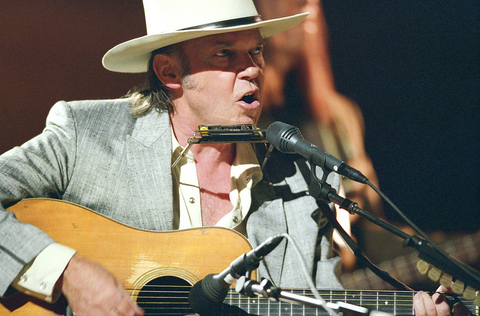
Neil Young's latest album, Living With War, was supposed to be more than a collection of protest songs. To optimistic critics of the occupation of Iraq, it heralded a tipping point -- the moment when the silent majority would finally make itself heard. One month on, as the album slides down the charts and George Bush's approval ratings climb steadily off the floor, the disappointment is deafening.
Impeach the President is not the anthem the anti-war movement has been waiting for, and Young cannot be the figurehead it needs. His proud record of conscientious objection has earned him unwaveringly loyal fans, but it also makes him an easy target, readily dismissed by Neo-Cons as an ageing Canadian hippie and a counter-cultural burnout. In the overheated climate of public opinion in the US, it is mud that sticks.
"I was waiting for someone to come along, some young singer 18 to 22 years old, to write these songs and stand up," Young told the Los Angeles Times. "I waited a long time. Then I decided that maybe the generation that has to do this is still the 1960s generation." The songs will be played live for the first time next month, by original longhairs Crosby, Stills, Nash and Young.
PHOTOS: AGENCIES
The first names on the sheet for any US peace concert would be -- with the possible exception of pop-punks Green Day -- musicians whose worldview was shaped by the Vietnam War. Bruce Springsteen (who has commented on Bush and the war to the fiftysomething audiences coming to watch him play Pete Seeger songs on his current tour), Wayne Kramer of the MC5, country singer Steve Earle, Chuck D of Public Enemy and former Dead Kennedys singer Jello Biafra are all old enough to have been affected by the conflict, if mostly too young to have been drafted. When Michael Stipe headlined the Bring Them Home Now gig in New York in March, he told the crowd how his father served in Korea and Vietnam when he was a child, and spoke of registering for the draft while Jimmy Carter was president. But it's been a while since any of these artists spoke directly to young people, as opposed to long-term fans.
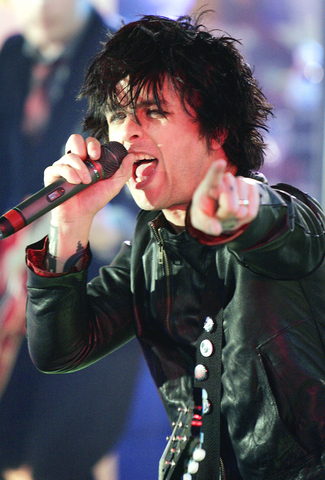
And the majority of the bands with a young audience taking an active stance against the war lack true mass appeal. Avowed socialists such as System of a Down and Anti-Flag are so virulent in their opposition to the Bush government that they stand little chance of getting their message across to middle America. While Green Day have topped charts and won awards for their avowedly anti-war American Idiot album, they have been a commercial force for more than a decade -- the punk band it's safe to like -- and the title song probably won more fans for its exhilarating guitars than its lyrical attacks on a "redneck agenda." Other anti-war artists, such as the "freak folk" singer Devendra Banhart, are too obscure to harness the media's mobilizing power. Banhart sings his protest song Heard Somebody Say at every opportunity, but admits the refrain: "It's simple, we don't want to kill" is preaching to the converted.
"Neil Young doesn't count," he says of rock's anti-war camp. "He's a singular poet, one of the greats. He has a very secure fanbase, but they're people who grew up listening to Ohio and know what he's referencing in that song. There aren't a lot of young musicians involved from the mainstream machine, and those who have opposed the murder of innocent people have done it in a casual way, a nonchalant way, in a whispered way, and that doesn't mean shit. It's just a strategy to appease the larger and larger amount of people who are beginning to oppose this. They're not prepared to write a blatant song, so I don't feel like it's coming from a genuine place. People hint that they're against it but I don't hear it in their songs."
The exception to this rule, among artists capable of inspiring thousands of young people to activism, is When the President Talks to God, by Bright Eyes, in which Conor Oberst wonders, "Does he ask to rape our women's rights and send poor farm kids off to die?" But Oberst himself is a reluctant spokesman, perhaps mindful of the "new Dylan" tag he has unwillingly labored under. He rarely makes any kind of statement in public and at the Bring Them Home Now event actually ran away from journalists requesting an interview. His set at the Hammerstein Ballroom that night, powerful though it was, contained nothing more rousing than "We all know why we're here" by way of spoken affirmation.
Adam Eidinger organized last September's Operation Ceasefire free concert in Washington. "One of the weaknesses of the anti-war movement is that the youth are not leading the charge," he says. "The main groups are still made up of people who opposed the Vietnam War, and the music reflects that. The fact is that folk music just isn't popular any more." His co-organizer, Scott Goodstein, agrees: "A lot of the leaders of the anti-war movement are the same age as my grandparents. They want to return to the music that motivated them, but that's not going to encourage kids to take to the streets."
So Operation Ceasefire's lineup balanced veteran campaigners Joan Baez, Steve Earle and Wayne Kramer with contemporary radicals such as the hip-hop group the Coup and leftist punks such as Anti-Flag and Ted Leo and Pharmacists. By the time the headliners Thievery Corporation performed, 150,000 people had gathered by the Washington Monument, making it the largest event of its kind since the invasion of Iraq.
It sounds a roaring success, but to put that number in perspective, in April more than 2 million people marched against proposed new immigration laws, including 500,000 in Los Angeles alone. But Jello Biafra, who hosted Operation Ceasefire, rejects the accusation that the anti-war movement is failing to mobilize its supporters. "People with long memories like Noam Chomsky point out that it's a lot larger and a lot stronger and a lot more organized than it was in the same time period after Lyndon Johnson went crazy with the Vietnam War," he says. "It has a way to go in bringing the troops home, but every bit of hammering against the war helps."
Any comparison with the mass protests of the mid-1960s must allow for two key differences. The first is the level of pre-war opposition: there was virtually no protest against the US military presence in Vietnam while John F. Kennedy was president, or in the early years of Johnson's presidency. In the run-up to the invasion of Iraq, millions of people took part in demonstrations worldwide and scores of musicians spoke out, including rappers P Diddy and Jay-Z, rock legends Lou Reed, David Bowie and David Byrne and a younger British contingent led by Damon Albarn and Thom Yorke. Three years on, that energy has dissipated.
"There's definitely been a numbing," says Banhart. "Without a doubt there's been a feeling of being reduced to a tick -- a tick that's being flicked off by what we feel is this gargantuan beast that we stand no chance against. If that's the mentality then there won't be any change."
The last significant burst of political energy in US rock occurred in the autumn of 2004, when tens of thousands of people in swing states came to hear REM, Springsteen and Pearl Jam on the Vote For Change tour in the run-up to the presidential election. That the shows merely demonstrated the political impotence of those American idols was a major setback.
Earle, who angered rightwing Americans with his 2002 song John Walker's Blues, about the so-called American Taliban, says: "So many people were involved in the Vote For Change movement and we're trying to keep them, because we're experienced, we've had our hearts broken already. But it's hard to keep them when they've put in so much effort and taken so much shit and failed." Kramer agrees: "I think there's a hardness and a cynicism in the air," he says. "And anyway, this guy's only got two more years. His time is over, so everyone's just staying at home and licking their wounds."
The second crucial distinction to be made between the anti-war movements of 1966 and 2006 is, of course, the draft itself, something that Kramer experienced first-hand. "I don't think most people really care that much about the war," he argues. "This war does not touch people in their hearts, in their stomachs. Vietnam did touch people where they lived, because it touched every young man in America. It was mandatory, it was the law of the land, and it touched you."

In late October of 1873 the government of Japan decided against sending a military expedition to Korea to force that nation to open trade relations. Across the government supporters of the expedition resigned immediately. The spectacle of revolt by disaffected samurai began to loom over Japanese politics. In January of 1874 disaffected samurai attacked a senior minister in Tokyo. A month later, a group of pro-Korea expedition and anti-foreign elements from Saga prefecture in Kyushu revolted, driven in part by high food prices stemming from poor harvests. Their leader, according to Edward Drea’s classic Japan’s Imperial Army, was a samurai

Located down a sideroad in old Wanhua District (萬華區), Waley Art (水谷藝術) has an established reputation for curating some of the more provocative indie art exhibitions in Taipei. And this month is no exception. Beyond the innocuous facade of a shophouse, the full three stories of the gallery space (including the basement) have been taken over by photographs, installation videos and abstract images courtesy of two creatives who hail from the opposite ends of the earth, Taiwan’s Hsu Yi-ting (許懿婷) and Germany’s Benjamin Janzen. “In 2019, I had an art residency in Europe,” Hsu says. “I met Benjamin in the lobby
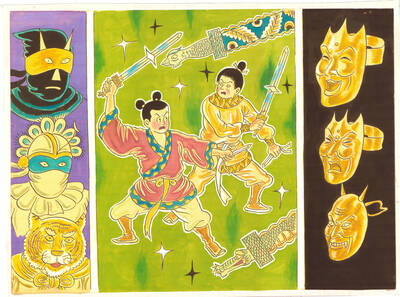
April 22 to April 28 The true identity of the mastermind behind the Demon Gang (魔鬼黨) was undoubtedly on the minds of countless schoolchildren in late 1958. In the days leading up to the big reveal, more than 10,000 guesses were sent to Ta Hwa Publishing Co (大華文化社) for a chance to win prizes. The smash success of the comic series Great Battle Against the Demon Gang (大戰魔鬼黨) came as a surprise to author Yeh Hung-chia (葉宏甲), who had long given up on his dream after being jailed for 10 months in 1947 over political cartoons. Protagonist

A fossil jawbone found by a British girl and her father on a beach in Somerset, England belongs to a gigantic marine reptile dating to 202 million years ago that appears to have been among the largest animals ever on Earth. Researchers said on Wednesday the bone, called a surangular, was from a type of ocean-going reptile called an ichthyosaur. Based on its dimensions compared to the same bone in closely related ichthyosaurs, the researchers estimated that the Triassic Period creature, which they named Ichthyotitan severnensis, was between 22-26 meters long. That would make it perhaps the largest-known marine reptile and would


 RSS
RSS