


A week before film director Cheng Yu-chieh (鄭有傑), 29, was due to premier his masterpiece Do Over (一年之初) at the Taipei Film Festival, he was still scrambling to coordinate subtitles with the movie’s frames at the Full Shine International Film Subtitling Company (福相國際電影字幕) in Ximengding (西門町).
“It’s better this way,” the young director said, referring to the looming deadline.
“Otherwise, I’d just keep making changes.”
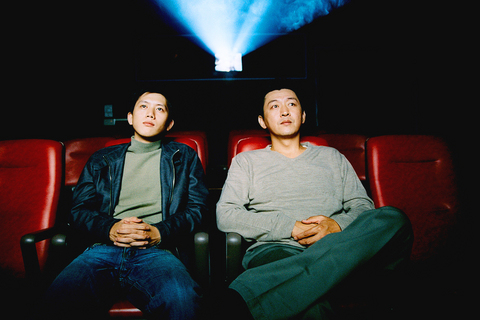
PHOTO COURTESY OF ATOM CINEMA
Do Over, Cheng’s first 35mm feature film, is a NT$16-million budget production, and is the talk of the town. Cheng secured a generous government subsidy to cover half the production cost, and all that cash was apparently well spent: The film was selected to compete in both the local and inter-national categories of the festival, and will likely come away with top prizes.
But viewers beware: the plot requires your full attention. The movie weaves together five parallel stories that span 24 hours from the last day of an unspecified year to the first day of the next year. Although Cheng layers the narrative by depicting a film crew shooting a film (within the actual film) — a rather hackneyed theme in films shot by young directors who slip into self-indulgence in trying to make a movie about what they know best (ie. shooting films) — Do Over is nevertheless a sophisticated piece in terms of its visual style and storytelling.
Local media and critics have lavished Cheng with attention ever since his first film Baby Face (私顏) hit the screens and won an award at the TFF when Cheng was a junior at National Taiwan University (國立台灣大學). However, Cheng seems impervious to all the glam and glitter, and is more focused than ever on creating quality cinematic art.
The product of a loving and nurturing family, the young director embodied the ideal son and student. He also came into his own as a sensitive and perceptive artist at an early age. “When I was little, there was a movie theater under our home. I saw lots of movies,” Cheng told the Taipei Times, adding, “my after-school entertainment was to watch rentals at home.”
In college, Cheng began to approach filmmaking as a possible career. “When I first watched films by Jim Jarmush, Wim Wenders, and Krzysztof Kieslowski, I was like, ‘Wow, they are so cool.’” Cheng began experimenting with videorecording and wrote the script of Baby Face. He failed to secure government funds to shoot his script, but that didn’t deter him; he took matters into his own hands.
“I submitted an advertisement to the Taipei Film Archives (台北電影資料館) recruiting actors and a crew to shoot a short movie.” That was when veteran director and cinematographer Yeh Si-guang (葉斯光) came to Cheng’s aid. Aware that Cheng lacked the knowledge and experience to make the film successfully, Yeh volunteered to guide him through the production process from start to finish.
“That’s how things work in this business. When a person says that he or she has a new project to make, everybody will help the person and boost his or her confidence. The people who choose to stay in the industry are truly passionate about cinema, and we always try our best to help each other,” Cheng said.
After Baby Face, Cheng set out to make the 16mm, 30-minute film Summer Dream (石碇的夏天), which won the best short film award at the Golden Horse Festival and the best feature film award at the TFF. The film’s plot involves a college student who meets a Canadian girl during the summer at his grandmother’s grocery store. In
narrating the story, the film also addresses issues of cultural identity, particularly among youth that swing between eastern and western cultures, and between
modernity and tradition.
Identity seems to be a recurrent motif in Cheng’s works. In the most successfully
narrated segment of Do Over, an illegal immigrant named Ding An (定安) from Thailand works for Taiwanese gangsters for years in the hope that the big boss would help him to get an ID card. Willing to risk his life for a legal identity, Ding An
confronts the boss in the climax, shouting out the question that concerns all the people living on the island: who we are?
The anomic life of young urban
dwellers is brought out in another segment of the film that tells the tale of two Taipei youngsters who use drugs and embark on an inner journey.
Visually stylish and imaginative, the story does a fitting job and creates a contem-porary image of the younger generation.
But the director said that it was not his intention to highlight the life and spirit of youth in the film. “I guess being a guy like me living in a city like this naturally makes the film tinged with such aura,” Cheng said.
Musician Lim Giong (林強), veteran film editor Chen Po-wen (陳博文) and award-winning sound editing master Tu Duu-chih (杜篤之) helped Cheng bring his project to fruition.
The Leader Group (利達集團), Taiwan’s foremost digital media postproduction company that has participated in the making of US blockbusters such as The Matrix, invested in Do Over and the firm has sought opportunities to help the local movie industry with its state-of-the-art equipment and software.
Leader’s advanced technology opened up new horizons for Cheng. “Technological support made lots of things possible and suddenly we had so many options. When you face technical limitations, your creativity is put to a test. But when the possibilities open up, your creativity is also put on trial,” Cheng said.
Though the visual effects in the film aim to startle, character is the center of Cheng’s cinematic world. “Actually the film is tailor-made for Huang Jian-wei (黃健瑋) [who plays the role of Ding An]. I think actors are the most important part of a film.
“When I create a role and leave it to the actor, the characters are no longer mine and it is up to the actor to bring the role alive. In this sense, it is a collective work of performers and myself,” Cheng said.
Like Huang, most of the actors in the film are graduates of National Taiwan University of Arts (國立台灣藝術大學) theater department.
“I don’t work on schedule. I hold my ideas and thought and let them settle in while thinking of my actors. And when the time is right, the film will come naturally,” Cheng said.
Setting no plan for the future as he believes the future is unmanageable, Cheng takes a leisurely pace toward his filmmaking prospect as he feels the need to spend time examining his life and himself as well as the possibilities his actors can offer before moving on to the next project. “Hopefully, it [Do Over] won’t be my last film,” Cheng said.

In late October of 1873 the government of Japan decided against sending a military expedition to Korea to force that nation to open trade relations. Across the government supporters of the expedition resigned immediately. The spectacle of revolt by disaffected samurai began to loom over Japanese politics. In January of 1874 disaffected samurai attacked a senior minister in Tokyo. A month later, a group of pro-Korea expedition and anti-foreign elements from Saga prefecture in Kyushu revolted, driven in part by high food prices stemming from poor harvests. Their leader, according to Edward Drea’s classic Japan’s Imperial Army, was a samurai

Located down a sideroad in old Wanhua District (萬華區), Waley Art (水谷藝術) has an established reputation for curating some of the more provocative indie art exhibitions in Taipei. And this month is no exception. Beyond the innocuous facade of a shophouse, the full three stories of the gallery space (including the basement) have been taken over by photographs, installation videos and abstract images courtesy of two creatives who hail from the opposite ends of the earth, Taiwan’s Hsu Yi-ting (許懿婷) and Germany’s Benjamin Janzen. “In 2019, I had an art residency in Europe,” Hsu says. “I met Benjamin in the lobby
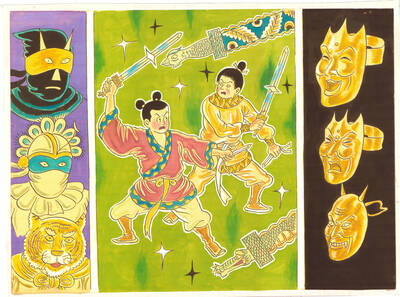
April 22 to April 28 The true identity of the mastermind behind the Demon Gang (魔鬼黨) was undoubtedly on the minds of countless schoolchildren in late 1958. In the days leading up to the big reveal, more than 10,000 guesses were sent to Ta Hwa Publishing Co (大華文化社) for a chance to win prizes. The smash success of the comic series Great Battle Against the Demon Gang (大戰魔鬼黨) came as a surprise to author Yeh Hung-chia (葉宏甲), who had long given up on his dream after being jailed for 10 months in 1947 over political cartoons. Protagonist

A fossil jawbone found by a British girl and her father on a beach in Somerset, England belongs to a gigantic marine reptile dating to 202 million years ago that appears to have been among the largest animals ever on Earth. Researchers said on Wednesday the bone, called a surangular, was from a type of ocean-going reptile called an ichthyosaur. Based on its dimensions compared to the same bone in closely related ichthyosaurs, the researchers estimated that the Triassic Period creature, which they named Ichthyotitan severnensis, was between 22-26 meters long. That would make it perhaps the largest-known marine reptile and would


 RSS
RSS