


A self-styled digital drifter, Taiwan-born artist Cheang Shu-lea (鄭淑麗) is a figure of mystery in the international contemporary art scene. From her queer and sexual politics-orientated feature films like Fresh Kill (1993) and IKU (2000), conceptual installation pieces like Bowling Alley (1995) and Brandon (1998), to popular art projects such as Baby Love, which is on display at the National Taiwan Museum of Fine Arts (國立台灣美術館) until today, Cheang is a cultural seer who easily reads the pulse of contemporary times and expresses her findings in provocative and enthralling art.
After graduating from National Taiwan University's history department, Cheang moved to New York to study filmmaking, and called the Big Apple home for over 20 years. A filmmaker and visual artist since the beginning of the 1980s, Cheang's early film works were informed by the East Coast art scene's avant-garde approach to multicultural and multi-sexual issues. "Be it sexual politics or ethnic exploration, I start from my own life experiences as an outsider in the country. But I never make the works a personal expression. I look back from a critical distance," Cheang said.
In the late 1980s, Cheang was a member of the Paper Tiger Television collective in New York, a movement that drove media activism, and in the early 1990s she embraced the Internet for its infinite possibilities of artistic expression.

PHOTO: SUNG CHIH-HSIUNG, TAIPEI TIMES
In 1995, Cheang created the Bowling Alley at the Walker Art Center in the US, in which she examined the interaction between virtual and real spaces by connecting a bowling alley, the museum and a Web site. Through integrating the transition of information from social spaces onto the private monitor, the artist debunked the question of whether the Internet is a public or a private domain.
In 1998, the Guggenheim Museum, New York, chose Cheang to make its first commissioned digital art work, the Brandon project, a Web site and interactive installation completed with the help of programmers and designers. The work tackles issues of gender and identity on the Internet and looks at the erosion of the distinction between a real body and a virtual body.
"In my digital works, you can see the network's culture evolve with time," Cheang said of her Net art.

PHOTO COURTESY OF NATIONAL TAIWAN MUSEUM OF FINE ARTS
Though Cheang works mostly with museums that she believes have greater access to the general public, the subversive and provocative nature of her work often sends bureaucratic art institutions into a panic.
"I always run into censorship problems. The Bowling Alley project was asked to bear a warning by the museum saying, "This site contains mature subject matter. Discretion is advised." And the sex channel project MILK [currently on display at IT Park (
In Cheang's view, whatever is displayed on the Internet is part and parcel of the network's culture and that includes sexual imagery. "Have we not been bombarded ... with sexual images in daily life?" she quipped.
Sex is the perennial theme in Cheang's art. Her Japanese sci-fi pornographic film IKU grabbed the attention of the local art scene and was subject to intense publicity in Japan. Screened in Paris for a year, IKU made Cheang a welcome heroine for liberal activists. "I don't need to pay at all in all the sex clubs in Paris," Cheang laughed.
Apart from the film's titillating homosexual, transsexual and virtual sex scenes, which subvert male dominance and patriarchy, IKU also portrays the artist's futuristic view of the fusion of the human body with technology as sexualized techno-bodies.
The theme of humans as digital, self-programming and self-upgrading beings recurs in Cheang's recent installation Baby Love in which biotic cloned babies receive, store and transmit human memories and emotions, and K in which human memory is measured in kilobytes that can be traded in a rewritable and loadable format.
Cheang works on a highly
conceptual level for all of her art, the technological complexity of which requires a team of professionals specialized in different fields to construct the finished product, and she challenges the romantic notion of an artist who is the sole creator of his or her art in the digital era.
For Cheang, art is never a form of self-expression: Digital media enable artists to subvert auteurs' authority and welcome the public's active participation in a collective moment on the Internet.
Every participant who shares in the production of Cheang's works is an art practitioner in his or her own right. Eight teams, including Taipei-based SQV Design International (漢邦國際設計), took four months to construct Baby Love, which will soon move to the San Jose Museum in the US.
"For me, working on a large-scale installation work is much like the process of making a film and vice versa. It's all about team work and the division of labor," Cheang said.
The artist has built a network of collaborators in France, German, the UK, Amsterdam and Tokyo who could work with her once a new project comes up. "I seem to have the ability to work well with different talents, and I have to constantly work with new people as old partners gain fame and you know, become expensive. It's a metabolic process," Cheang said.
For her next project, Cheang plans a return to the social and political realms with a plot-driven feature film called Love Me 2030. The project will be shot in different European cities and will examine the issues facing new immigrants and cultural conflicts in the expanding Europe. "I am always intrigued by the phenomenon of cultural remixing, so I guess I'll be staying in Europe for a while," Cheang said. So it seems that our digital nomad has found herself a new home, but for how long? That's a question even the artist herself can't answer.
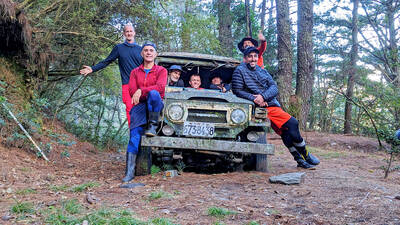
The year was 1991. A Toyota Land Cruiser set out on a 67km journey up the Junda Forest Road (郡大林道) toward an old loggers’ camp, at which point the hikers inside would get out and begin their ascent of Jade Mountain (玉山). Little did they know, they would be the last group of hikers to ever enjoy this shortcut into the mountains. An approaching typhoon soon wiped out the road behind them, trapping the vehicle on the mountain and forever changing the approach to Jade Mountain. THE CONTEMPORARY ROUTE Nowadays, the approach to Jade Mountain from the north side takes an

Last week Joseph Nye, the well-known China scholar, wrote on the Australian Strategic Policy Institute’s website about how war over Taiwan might be averted. He noted that years ago he was on a team that met with then-president Chen Shui-bian (陳水扁), “whose previous ‘unofficial’ visit to the US had caused a crisis in which China fired missiles into the sea and the US deployed carriers off the coast of Taiwan.” Yes, that’s right, mighty Chen caused that crisis all by himself. Neither the US nor the People’s Republic of China (PRC) exercised any agency. Nye then nostalgically invoked the comical specter

Relations between Taiwan and the Czech Republic have flourished in recent years. However, not everyone is pleased about the growing friendship between the two countries. Last month, an incident involving a Chinese diplomat tailing the car of vice president-elect Hsiao Bi-khim (蕭美琴) in Prague, drew public attention to the People’s Republic of China’s (PRC) operations to undermine Taiwan overseas. The trip was not Hsiao’s first visit to the Central European country. It was meant to be low-key, a chance to meet with local academics and politicians, until her police escort noticed a car was tailing her through the Czech capital. The

April 15 to April 21 Yang Kui (楊逵) was horrified as he drove past trucks, oxcarts and trolleys loaded with coffins on his way to Tuntzechiao (屯子腳), which he heard had been completely destroyed. The friend he came to check on was safe, but most residents were suffering in the town hit the hardest by the 7.1-magnitude Hsinchu-Taichung Earthquake on April 21, 1935. It remains the deadliest in Taiwan’s recorded history, claiming around 3,300 lives and injuring nearly 12,000. The disaster completely flattened roughly 18,000 houses and damaged countless more. The social activist and


 RSS
RSS