


Positioning itself as the southern counterpart of the Taipei Film Festival (
Beginning only one week before the Taipei Film Festival opens its doors, KFF, has followed closely the direction of its northern equivalent with an ambitious agenda, that is, to become a central platform to showcase works by local filmmakers and foster exchanges between domestic and international movers and shakers in the film industry.
However, with a smaller base of art-house moviegoers in Kaohsiung, KFF organizers know that a lot of work still needs to be done to raise the profile of non-mainstream movies.
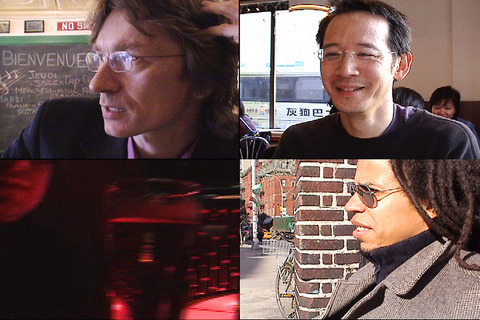
PHOTO COURTESY OF KFF
"Unlike Taipei where the Golden Horse International Film Festival (金馬國際影展) has built up a solid audience base for art-house movies over the years, Kaohsiung is still in its nascent phrase in this regard," KFF president Cheng Wen-tang (鄭文堂) said. "Even though our festival is in its sixth year, we still have a long way to go in fostering the audiences' interests and viewing habits for non-mainstream films."
To carry out this task, KFF has this year selected three award-winning Asian films from last year's Festival des 3 Continents (F3C) in France, an important channel that introduces the work of young Asian, African and Latin American directors to Europe.
Seventeen highlights from South Korea's Pusan International Film Festival have also been included on KFF's program.
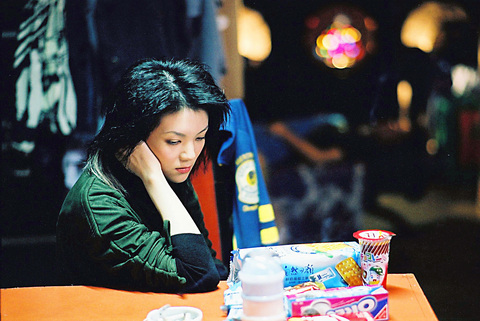
PHOTO COURTESY OF KFF
For Cheng, the most important mission of the annual film festival is to take Taiwanese films out of Taipei and expose audiences in the south to local productions.
"Taipei Film Festival has established a model in which young local directors can gain more visibility, and I think KFF should gradually steer in that direction. If more and more Taiwanese directors can be discovered through KFF, then it's safe to say that our festival fulfills its duty," Cheng said.
Both the programs on Asian and Taiwanese directors feature up-and-coming local filmmakers and includes commercial flicks such as Catch (
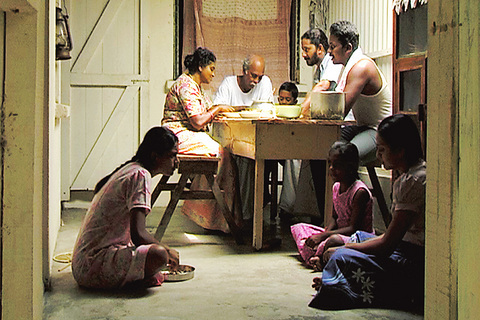
PHOTO COURTESY OF KFF
The highlight among the troop of local productions is 34-year-old director Yao Hung-i's (姚宏易) first feature film Reflections (愛麗絲的鏡子). An experienced cinematographer, Yao's debut has won him the young director's award at F3C and the best cinematography award at the Argentina International Film Festival and has continued its film festival tour in German, Spain, Rome and Amsterdam.
Working from the bottom up as part of film master Hou Hsiao-hsien's (
Focusing on the relationship between a young lesbian couple and a man, Yao said he doesn't think of his work as a gay movie but a colorful look at the anomic life and spirit of contemporary Taipei, a theme that echoes in the third story of Hou's Three Times (
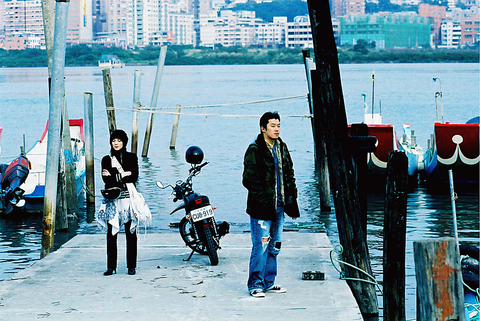
PHOTO COURTESY OF KFF
"Actually, Reflections and Three Times are two sides of the mirror. When I presented the synopsis to Hou, he was intrigued by one of my leading actresses OuYang Ching (
Even though the modest filmmaker sometimes expressed doubt over whether he had the talent to be a director, his film proved to be enlightening for Yao.
"The position of director and cinematographer are two very conflicting roles when it comes to filmmaking. As the director, you need to let your imagination roar, but as a cinematographer, you are trained to think in practical terms to transform the imagination into reality," Yao said. "I made a promise to myself before shooting the film that I would never use pretty cinematography to solve problems because as a small budget film, the most basic thing is to tell a good story rather than to pack the film with stylish visual elements."
Having a giant in the industry standing behind you can be a blessing and a burden. In its Taiwan premiere at KFF tomorrow, Reflections will meet the challenges from local film professionals and critics on the question of whether or not it conveys the contemporary spirit of Taiwan.
FESTIVAL NOTES
What: 2006 Kaohsiung Film Festival
Where: Kaohsiung Film Archive (
When: Tomorrow through June 25
Tickets: NT$100 for the screenings at the Warner Village Cinema, available at the door. For more information on the films, screening schedules and venues, go to www.twfilm.org/2006KFF

In late October of 1873 the government of Japan decided against sending a military expedition to Korea to force that nation to open trade relations. Across the government supporters of the expedition resigned immediately. The spectacle of revolt by disaffected samurai began to loom over Japanese politics. In January of 1874 disaffected samurai attacked a senior minister in Tokyo. A month later, a group of pro-Korea expedition and anti-foreign elements from Saga prefecture in Kyushu revolted, driven in part by high food prices stemming from poor harvests. Their leader, according to Edward Drea’s classic Japan’s Imperial Army, was a samurai

The following three paragraphs are just some of what the local Chinese-language press is reporting on breathlessly and following every twist and turn with the eagerness of a soap opera fan. For many English-language readers, it probably comes across as incomprehensibly opaque, so bear with me briefly dear reader: To the surprise of many, former pop singer and Democratic Progressive Party (DPP) ex-lawmaker Yu Tien (余天) of the Taiwan Normal Country Promotion Association (TNCPA) at the last minute dropped out of the running for committee chair of the DPP’s New Taipei City chapter, paving the way for DPP legislator Su

Located down a sideroad in old Wanhua District (萬華區), Waley Art (水谷藝術) has an established reputation for curating some of the more provocative indie art exhibitions in Taipei. And this month is no exception. Beyond the innocuous facade of a shophouse, the full three stories of the gallery space (including the basement) have been taken over by photographs, installation videos and abstract images courtesy of two creatives who hail from the opposite ends of the earth, Taiwan’s Hsu Yi-ting (許懿婷) and Germany’s Benjamin Janzen. “In 2019, I had an art residency in Europe,” Hsu says. “I met Benjamin in the lobby
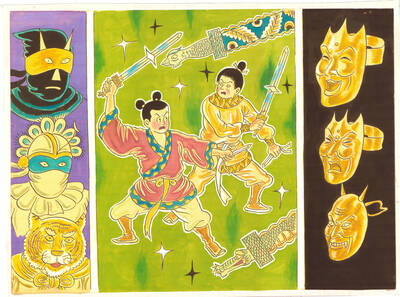
April 22 to April 28 The true identity of the mastermind behind the Demon Gang (魔鬼黨) was undoubtedly on the minds of countless schoolchildren in late 1958. In the days leading up to the big reveal, more than 10,000 guesses were sent to Ta Hwa Publishing Co (大華文化社) for a chance to win prizes. The smash success of the comic series Great Battle Against the Demon Gang (大戰魔鬼黨) came as a surprise to author Yeh Hung-chia (葉宏甲), who had long given up on his dream after being jailed for 10 months in 1947 over political cartoons. Protagonist


 RSS
RSS