


EVER felt your fitness regime was heading into reverse gear? Yes, we've all been there -- but now comes a new workout phenomenon whose purpose is precisely that. Retro walking is big, and growing: what it involves is running (or walking) backwards, and increasing numbers of enthusiasts say it is giving their exercise program a whole new perspective. Indeed, so popular is this bizarre activity that events such as the New York Road Runners Backwards Mile are now being staged. This year's was held in Hudson River Park and was run, appropriately, on April 1. Meanwhile, backwards fun runs around Europe are attracting huge numbers of entrants.
Such is the growth of this sport that records are being set and broken at a far faster rate than those of forward-moving counterparts. Last year, Arthur Magni reached the finishing line of the New York event first, breaking the tape with his back in a time of six minutes 28 seconds while Timothy Badyna, known as Backwards Bud, back-pedalled his way through a full 41.9km marathon in under four hours. Why, you may ask? Proponents claim the technique is kinder to knee and hip joints, with less of the pounding associated with regular jogging and, inspiringly, burns a fifth more calories.
"Your balance increases. Your hearing increases. Your peripheral vision increases," Badyna says. One wonders whether neck strain from twisting to see where you are going is common, but Badyna insists that while being blindsided is a downside, as long as you run somewhere safe, you can cut down the chances of unforeseen obstacles in your way.
Remarkably, scientists are beginning to discover there is some truth in the claims of retro runners. A study conducted at South Africa's Stellenbosch University, published in the International Journal of Sports Medicine last year, found that backward training improved cardiorespiratory fitness while helping to streamline the physique of a group of novice runners. Researchers in the university's department of medical physiology looked at the effects of a six-week, thrice-weekly backward running program on female students compared with a group who stuck to their regular activity schedule. At the end of the study, the retro-runners were found to have significant decreases in oxygen consumption, meaning they had become aerobically fitter, and had lost an average 2.5 percent of their body fat. "Our results provide evidence that backward locomotion can improve cardiorespiratory fitness and possibly lead to positive body composition changes in young women," was the researchers' verdict.
Retro-running dates back to the 1970s, when a small group of physio-therapists began recommending it to injured athletes and footballers. There is less movement of the hips running this way which means impact on the joints decreases, making it an ideal substitute for rehabilitation from knee and back problems. "It's a reasonable way to incorporate another means of exercise to lessen the stress on any given part of the body," says Professor Barry Bates, a biomechanics researcher at the University of Oregon who has carried out extensive studies on the activity. His findings indicate that retro runners need move at only 80 percent of the speed of forward runners to gain the same physiological and fitness benefits.
Getting started requires some forward thinking. Aside from the fact that you are going to attract some bemused glances should you step backwards out of your front door and proceed to retro-run down the local high street, there is the significant drawback of a lack of hindsight. Professor Jon Wang, an orthopaedic surgeon at the University of Arizona and an adviser to Runner's World magazine, recommends newcomers to start somewhere safe such as a track or familiar road where you will avoid potholes, road signs and other hazards. He says backwards running works well as part of a cool-down at the end of a gym session. "Easing into a gentle backwards run lets you gradually decrease your heart rate, and it stretches your calf, quadricep and hamstring muscles, which have all been working hard during forward running," Wang says.
He confirms Badyna's hunch that it will also "improve your balance and coordination" and suggests progressing to running backwards towards the end of a regular jog. "Go slowly, taking small steps at first, and stay in control," he says. "Let the ball of the foot contact first, then allow the heel to touch just briefly. If this feels OK, repeat the one-minute segments two or three times, jogging forwards slowly in-between." After a few weeks he promises you will feel less anxious about collisions and can begin to step up your retro running to five or six minutes in total. "At this point, you can try taking longer steps and, if you want to stretch your legs more, try running backwards on a slightly downhill slope," he says.
Even sceptical experts concede that, while backwards shouldn't fully replace forwards, it can have a place in a workout program.
For some sports, it is an essential element of training. Champion boxer Gene Tunney ran 6km to 12km a day backwards and Muhammad Ali incorporated it into his regime. "Professional footballers, rugby players and referees as well as top track and field athletes all use it routinely," says Nick Linthorne, a biomechanics researcher at Brunel University in London. "It does make sense for other people, especially the injured, to include a little backwards running or walking as the landing is smoother." But the real attraction for the masses, he says, is the novelty factor. Like striptease workouts and karaoke spinning, retro running will appeal to those prone to gym boredom. "If the prospect of running backwards inspires someone who wouldn't otherwise exercise to get out, then that can only be a good thing."
On the Web: www.backward-running-backward.com
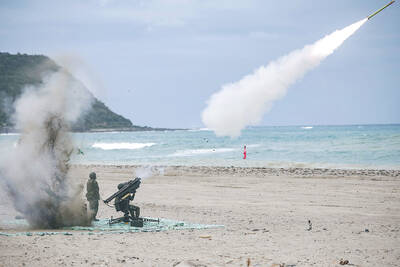
In late October of 1873 the government of Japan decided against sending a military expedition to Korea to force that nation to open trade relations. Across the government supporters of the expedition resigned immediately. The spectacle of revolt by disaffected samurai began to loom over Japanese politics. In January of 1874 disaffected samurai attacked a senior minister in Tokyo. A month later, a group of pro-Korea expedition and anti-foreign elements from Saga prefecture in Kyushu revolted, driven in part by high food prices stemming from poor harvests. Their leader, according to Edward Drea’s classic Japan’s Imperial Army, was a samurai

Located down a sideroad in old Wanhua District (萬華區), Waley Art (水谷藝術) has an established reputation for curating some of the more provocative indie art exhibitions in Taipei. And this month is no exception. Beyond the innocuous facade of a shophouse, the full three stories of the gallery space (including the basement) have been taken over by photographs, installation videos and abstract images courtesy of two creatives who hail from the opposite ends of the earth, Taiwan’s Hsu Yi-ting (許懿婷) and Germany’s Benjamin Janzen. “In 2019, I had an art residency in Europe,” Hsu says. “I met Benjamin in the lobby
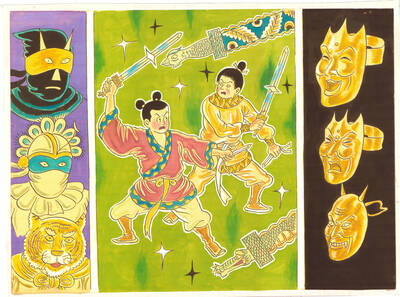
April 22 to April 28 The true identity of the mastermind behind the Demon Gang (魔鬼黨) was undoubtedly on the minds of countless schoolchildren in late 1958. In the days leading up to the big reveal, more than 10,000 guesses were sent to Ta Hwa Publishing Co (大華文化社) for a chance to win prizes. The smash success of the comic series Great Battle Against the Demon Gang (大戰魔鬼黨) came as a surprise to author Yeh Hung-chia (葉宏甲), who had long given up on his dream after being jailed for 10 months in 1947 over political cartoons. Protagonist

Peter Brighton was amazed when he found the giant jackfruit. He had been watching it grow on his farm in far north Queensland, and when it came time to pick it from the tree, it was so heavy it needed two people to do the job. “I was surprised when we cut it off and felt how heavy it was,” he says. “I grabbed it and my wife cut it — couldn’t do it by myself, it took two of us.” Weighing in at 45 kilograms, it is the heaviest jackfruit that Brighton has ever grown on his tropical fruit farm, located


 RSS
RSS