


World music means different things to different people. For Mongolian singer Urna Chahar-Tugchi, this most eclectic of genres presents an opportunity to evoke and transcend the musical traditions of her homeland before a global audience. For listeners, it offers the rare joy of discovery in a market increasingly dominated by formulaic copies.
"The beautiful thing is to represent my culture to other cultures," Urna said in an interview on Tuesday. "I present Mongolian culture to my audience and they bring their culture to me. It's like a connection."
The 37-year-old "voice of the Mongolian grasslands," who performs tomorrow and Sunday at Taipei's Sun Yat-sen Memorial Hall, won the RUTH prize in Germany for Best International Artist. Promoters say hearing her sing live is like a religious experience.

"I interpret my songs with all my life and energy; therefore, I feel rebirth after each performance," she said in a press release.
The continued appeal of a musician like Urna proves that many artists encountered in a record store's world music section offer more than just novelty. Canadian artist Matthew Lien, who first performed in Taiwan in the late 1990s, has sold hundreds of thousands of albums here over the last decade. Trees Music & Art (大大樹音樂圖), which distributes Urna's records, including her latest album Amilal, has earned a loyal following from a diverse clientele who trust the indie label's taste as much for its exotic new acts as for second and third releases by established artists.
"When we started many people had a hard time understanding what we were doing," said Chung She-fong (

PHOTOS: COURTESY OF TREES MUSIC & ART
Chung, who was interviewed in her company's office on Yongkang Street (
While more popular genres are constantly tripping over themselves to recreate what was once creative, listeners will always find that world music has something new to offer, Lien said.
"When you broaden your horizons to view the entire globe and all these different cultures and their musicality as your palette, you've just got an endless supply of possibilities," said Lien, who was interviewed by phone on Monday. "I think world music has an incredible amount of potential because it's always doing something new and passionate."
But to some extent the genre has fallen victim to its own success. And the advent of the digital age poses more challenges than benefits for a niche whose appeal often rests on subtle nuances of sound that lose their "feel" on computer speakers and monophonic mobile phone ring tunes.
"We were really popular five or 10 years ago," said Stella Chang (
Chang said consumers of world music have developed preferences for certain labels and certain kinds of music and are less likely to purchase a CD based on the novelty factor. At the same time, many exceptional artists who lacked a global audience before the genre came into existence have now been discovered. With each passing year the crop of new discoveries yields fewer gems.
Wind Music sells titles through Yahoo and Hinet, and visitors will be able to download music from its Web site next year. But as more people get their music online, fewer are wandering into the world music sections of record stores. And Wind Records' entire catalogue is available on several Chinese Web sites that sell pirated music.
"This makes us more careful," Chang said. The company's strategy has been to reduce the size of its catalogue and focus on music that addresses specific needs, such as albums for yoga or meditation, and to increase the media exposure of its artists.
Lien said the changes are a mixed blessing for artists like him. "For independent musicians, the Internet provides them with an opportunity to present their material to the public, which is cool, because music should be as free as a bird."
On the other hand, his music is expensive to produce because he hires real musicians, rather than relying on samples and computers. "I recognize the potential of a ring tone hit," he said, "but I'm deeply frustrated because I don't spend countless hours sweating it out in the studio getting a mix just right so somebody can listen to my music on mono."
When asked about her own label's sales, Chung indicated it was not her primary concern. She said she was more interested in expanding her customer's musical horizons.
"We're an independent label," she said. "If you're concerned about numbers, you shouldn't be in this business."
Performance Notes:
What: Urna
Where: Sun Yat-sen Memorial Hall, Taipei
When: Tomorrow and Sunday at 7pm
Tickets: NT$1,000 to NT$2,000 tickets still available for both performances through ERA ticketing, www.ticket.com.tw

In late October of 1873 the government of Japan decided against sending a military expedition to Korea to force that nation to open trade relations. Across the government supporters of the expedition resigned immediately. The spectacle of revolt by disaffected samurai began to loom over Japanese politics. In January of 1874 disaffected samurai attacked a senior minister in Tokyo. A month later, a group of pro-Korea expedition and anti-foreign elements from Saga prefecture in Kyushu revolted, driven in part by high food prices stemming from poor harvests. Their leader, according to Edward Drea’s classic Japan’s Imperial Army, was a samurai
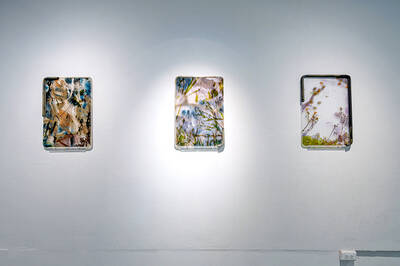
Located down a sideroad in old Wanhua District (萬華區), Waley Art (水谷藝術) has an established reputation for curating some of the more provocative indie art exhibitions in Taipei. And this month is no exception. Beyond the innocuous facade of a shophouse, the full three stories of the gallery space (including the basement) have been taken over by photographs, installation videos and abstract images courtesy of two creatives who hail from the opposite ends of the earth, Taiwan’s Hsu Yi-ting (許懿婷) and Germany’s Benjamin Janzen. “In 2019, I had an art residency in Europe,” Hsu says. “I met Benjamin in the lobby
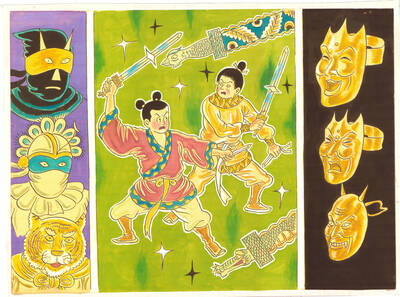
April 22 to April 28 The true identity of the mastermind behind the Demon Gang (魔鬼黨) was undoubtedly on the minds of countless schoolchildren in late 1958. In the days leading up to the big reveal, more than 10,000 guesses were sent to Ta Hwa Publishing Co (大華文化社) for a chance to win prizes. The smash success of the comic series Great Battle Against the Demon Gang (大戰魔鬼黨) came as a surprise to author Yeh Hung-chia (葉宏甲), who had long given up on his dream after being jailed for 10 months in 1947 over political cartoons. Protagonist

Peter Brighton was amazed when he found the giant jackfruit. He had been watching it grow on his farm in far north Queensland, and when it came time to pick it from the tree, it was so heavy it needed two people to do the job. “I was surprised when we cut it off and felt how heavy it was,” he says. “I grabbed it and my wife cut it — couldn’t do it by myself, it took two of us.” Weighing in at 45 kilograms, it is the heaviest jackfruit that Brighton has ever grown on his tropical fruit farm, located


 RSS
RSS