


David Watson has already begun thinking about his pitch for a new vaccine to block the sexually transmitted virus that causes cervical cancer.
"What I will probably do is point out that last year alone, more people died of cervical cancer, which was pretty much directly produced by Human Papillomavirus, than were killed in Sept. 11," said Watson, president of Pediatrics West, a private practice with offices in Concord, Westwood, and Groton, Massachusetts. "People appreciate those sorts of comparisons."
Parents will soon start hearing similar pitches from their children's doctors, supplementing a television and magazine ad campaign already begun by Merck & Co, the manufacturer of the vaccine, which is expected to receive federal approval next week.
While most pediatricians support the new vaccine, called Gardasil, they also recognize that it may not be quickly or universally adopted.
Early studies show that the vaccine is largely effective at preventing the cervical cancer and genital warts caused by four predominant strains of the sexually transmitted Human Papillo-mavirus, or HPV. But there are other strains the vaccine doesn't address, so women will still need to get annual Pap smears to check for cervical cancer, which kills 4,000 Americans annually and nearly half a million worldwide.
The vaccine is also inconvenient -- three separate shots must be given over six months -- and expensive, costing US$300 to US$500 for the required doses. Insurance companies generally cover the cost of vaccinations that receive federal approval.
Some parents are skeptical about vaccines in general, or are uncomfortable facing the fact that their cute preteen might someday be sexually active. Gardasil is likely to be recommended for girls as young as nine to 11.
"Most of us are a bit leery about going into the gory details about different sorts of sexual transmission," Watson said.
But that might not be necessary, he and other doctors said.
"I'll probably focus on the fact that the vaccine prevents cervical cancer in my sell, and not on the fact that this prevents a sexually transmitted disease," said Joseph Hagan, a Burlington, Vermont, pediatrician active in the American Academy of Pediatrics. "You know why? Because my Dad sold insurance, and I know what to emphasize and what not to emphasize."
Parents, too, say they might not get into awkward questions of sexuality. In general, said Lynn Randall of Concord, whose daughters are 12 and 15, when one of her girls gets a shot, "We're not telling her what she's being vaccinated against; usually it's just a shot to her -- one of many shots she gets in her pediatrician's visits."
Irene Freidel, of Littleton said that if her 11-year-old daughter, Claire, were vaccinated tomorrow, she would most likely tell the girl only that "it was something that was going to protect her, like any other vaccination, and is good for her health."
"She just turned 11," Freidel said. "We have talked about the facts of life, but I don't know that she's ready at this point to get into more than we've already discussed." They will talk more in the future about the hazards of sexuality, she said, but right now, "I cling to her innocence."
Overall, Freidel said, she welcomes the vaccine and does not worry that, as some advocates of abstinence have warned, it might encourage promiscuity.
"I adore my daughter more than anything in the world," she said, "and I can't predict what she's going to do as a teenager, what risks she's going to be exposed to. To me, this is just extra protection."
Such pro-vaccine parents are sure to be the majority, said Jessica Kahn, of Cincinnati Children's Hospital Medical Center, who has researched the expected attitudes.
A national survey of 513 pediatricians published in March, found that about three-quarters of pediatricians would recommend the vaccine, 40 percent thought parents would be reluctant to have their children vaccinated against a sexually transmitted disease, and 70 percent expected parents to worry about the safety of a new vaccine. In a separate paper published earlier this month in the journal Pediatrics, a survey mailed to 1,600 parents found that 65 percent would lean toward permitting their preteen child to get the vaccine.
"Most parents will be eager to have their daughters vaccinated against HPV as long as they know they're sending the right preventive messages: that they still need to practice safe sexual behaviors, postpone sexual initiation as long as possible," and the like, Kahn said.
The logistics may pose even more problems than parental attitudes, several doctors said.
Initially, the vaccine will likely not be covered by insurance or paid for by the state, and it could cost as much as US$500. "That's a dealbreaker right there," said Victoria McEvoy, medical director and chief of pediatrics of the Massachusetts General West Medical Group.
Massachusetts has not made a decision yet on whether to fund the vaccine.
"We are several months away from making a decision," said Donna Rheaume, spokeswoman for the state Department of Public Health.
The three-visit regime that the vaccine will require is also a "huge problem," McEvoy said. Without getting the full three-dose regimen, teens won't get the full benefit of the vaccine.
"Adolescents, unless they're dragged by their parents, don't come in unless they think they're pregnant, they have acne, or they need a note for soccer or work."
Nonwhites and those with poor access to healthcare stand to benefit the most from the vaccine because they are the least likely to get annual Pap smears and follow-up care after a problematic test, said Elizabeth Garner, a gynecological oncologist at Brigham and Women's Hospital.Yet they are precisely the people who will have the hardest time getting access to the vaccine and getting the full dosage, she said.
McEvoy said she'll likely wait a year or so before offering the vaccine in her own practice, waiting for it to "sort itself out a little bit," get covered by insurance, and paid for by the state. She'll also be watching for reports of unexpected side effects; after 28 years of practice, she likes medical innovations to accum-ulate some history of safety before she recommends them.
In contrast, Hagan of Vermont plans to offer the vaccine to his patients as soon as it's available, confident that the state Health Department will subsidize it.
"If we have a safe and effective way to prevent a particularly prevalent form of cancer, then why wouldn't we do that?"

Last week Joseph Nye, the well-known China scholar, wrote on the Australian Strategic Policy Institute’s website about how war over Taiwan might be averted. He noted that years ago he was on a team that met with then-president Chen Shui-bian (陳水扁), “whose previous ‘unofficial’ visit to the US had caused a crisis in which China fired missiles into the sea and the US deployed carriers off the coast of Taiwan.” Yes, that’s right, mighty Chen caused that crisis all by himself. Neither the US nor the People’s Republic of China (PRC) exercised any agency. Nye then nostalgically invoked the comical specter

Relations between Taiwan and the Czech Republic have flourished in recent years. However, not everyone is pleased about the growing friendship between the two countries. Last month, an incident involving a Chinese diplomat tailing the car of vice president-elect Hsiao Bi-khim (蕭美琴) in Prague, drew public attention to the People’s Republic of China’s (PRC) operations to undermine Taiwan overseas. The trip was not Hsiao’s first visit to the Central European country. It was meant to be low-key, a chance to meet with local academics and politicians, until her police escort noticed a car was tailing her through the Czech capital. The
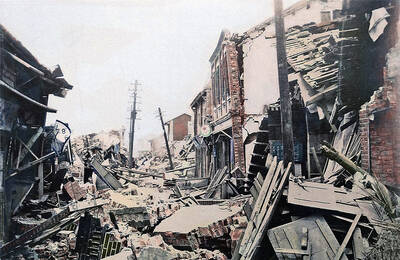
April 15 to April 21 Yang Kui (楊逵) was horrified as he drove past trucks, oxcarts and trolleys loaded with coffins on his way to Tuntzechiao (屯子腳), which he heard had been completely destroyed. The friend he came to check on was safe, but most residents were suffering in the town hit the hardest by the 7.1-magnitude Hsinchu-Taichung Earthquake on April 21, 1935. It remains the deadliest in Taiwan’s recorded history, claiming around 3,300 lives and injuring nearly 12,000. The disaster completely flattened roughly 18,000 houses and damaged countless more. The social activist and

Over the course of former President Ma Ying-jeou’s (馬英九) 11-day trip to China that included a meeting with Chinese Communist Party (CCP) leader Xi Jinping (習近平) a surprising number of people commented that the former president was now “irrelevant.” Upon reflection, it became apparent that these comments were coming from pro-Taiwan, pan-green supporters and they were expressing what they hoped was the case, rather than the reality. Ma’s ideology is so pro-China (read: deep blue) and controversial that many in his own Chinese Nationalist Party (KMT) hope he retires quickly, or at least refrains from speaking on some subjects. Regardless


 RSS
RSS