


It was early in the morning at the International Conference Center (國際會議中心) and French concert violinist, filmmaker and writer Bruno Monsaingeon was excited about his first visit to Taipei to attend the first International Public Television Screening Conference (INPUT 2006) in Asia held earlier this month.
Here in Taipei to present his works and share his views on filmmaking at INPUT, which showcased 83 public television programs from 37 countries, Monsaingeon is a familiar name to people who collect classical music DVDs. For the past 30 years, the versatile artist has worked on and directed films with major contemporary classical musicians including Yehudi Menuhin, Sviatoslav Richter, Glenn Gould, Paul Tortelier, Nadia Boulanger and Dietrich Fischer-Dieskau, among many others. The gray-haired artist is not only a devoted musician but an accomplished director who conveys the power of music through film.
Ensconced in a room away from the bustling conference lobby, the modest and courteous Monsaingeon began talking about his life-long love affair with classical music: "The first sad thing about my life is the fact that I was born to this world. I figured I had to direct my life towards a meaningful path to take advantage of this tragedy. I was taken by music at a very early age, around four when I heard Yehudi Menuhin playing."

PHOTOS COURTESY OF PTS
Twelve years later, Monsain-geon seized the chance to attend classes taught by Menuhin, who is considered by many as the 20th century's greatest violinist. Their life-long friendship and association led to numerous film productions such as the highly acclaimed Menuhin in China and Yehudi Menuhin: Violin of the Century, a personal documentary on the US-born violinist made to celebrate the artist's 80th birthday.
Despite his artistic partnership with Menuhin, it is Monsaingeon's remarkable camaraderie with Canadian pianist Glenn Gould that has become legendary. Their relationship began in 1971 when Monsaingeon was hired to play violin for a series of TV programs on the history of classical music. After one-year of shooting experience, the young musician started toying with the idea of doing a project of his own, and the reclusive musician Gould came to mind. Back then, Gould was still an unheard-of figure in Europe, having declined invitations to perform and severed his connections with the outside world since 1964.
Monsaingeon discovered Gould's music in Moscow in 1965. "I went to a record store that had a very small collection of classical music. So I bought all the records and among them there was one copy of Gould's album.
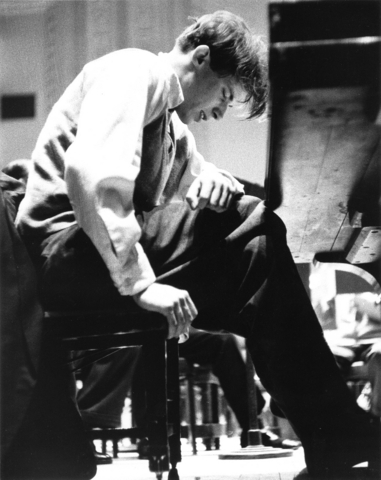
PHOTO COURTESY OF PTS
The first time I listened to Gould's music, I heard a voice saying `come and follow me.' It was a transcendent and communing experience. I was totally over-whelmed and blown away," Monsaingeon recalled.
So in 1971, Monsaingeon wrote a letter to Gould, and a few months later, the solitary musician replied with a 26-page letter. After exchanging views, he invited Monsaingeon to meet him in Toronto. "It was the middle of the summer, Gould came to my room wearing an over coat, gloves, scarf, sunglasses and snow boots. I leaned forward to shake his hand, but Gould immediately bounded back. Later I found out that physical contact was intolerable for him. We started talking in the early afternoon and Gould left the room around 6am the next morning," Monsaingeon said.
The meeting initiated 10-years of friendship which ended with Gould's death in 1982. Their collaboration produced seven films, a 23-episode television series and four books introducing the eccentric musical genius to the world.
To Monsaingeon, Gould's eccentricity was testimony to the extreme intensity of a genius. Talking at length and with
profound devotion and respect about his relationship with Gould, Monsaingeon revealed how his music transformed the lives of many, and how as a philosopher with total coherence between his thoughts and deeds, his energy and inspiration were omnipresent and expressed without a moment of rest.
An extreme example of Gould's almost religious austerity was his eating habits. "Glenn rarely ate food. He didn't like to eat when he was hungry and the word food was never mentioned in our conversations. I never saw him dine until five years after our first meeting. It was 5am in his hotel room, a space he lived in as a home and studio. Glenn suddenly said to me, `It's about time for me to eat.' He ordered scrambled egg on toast and ate it in a personal ritual," Monsaingeon said.
Having worked with a great number of idiosyncratic musicians, Monsaingeon himself is also an artist of unique sensibility who transforms what could be the unimaginative commentary of films about music and musicians into gateways for understanding some of the greatest minds of our time. In his works, one will find no arid compilation of archive footage and interviews that have often pushed the genre of films about classical music into rarely visited
cinematic ghetto.
In Glenn Gould Hereafter (2005), which took seven years to complete, Monsaingeon structured the film around the musical notion of polyphony by which disparate themes converge, forming a whole and pointing directly to the core of Gould's musical ethos.
Musical films are also an integral part of the artist's creative life in that they serve as a vital connection between his inner complexity and the wider world. "I'm not a composer, and filmmaking is the medium through which I can express myself in a creative way. It's a channel [through which] to transmit my own emotions into some kind of universal significance and enable my own experiences to be shared by the public," Monsaingeon said.
As a classical-music purist who says he has never heard of The Rolling Stones, Monsaingeon admitted he finds inspiration only in the classical and some folk music. "I would still like to be convinced that there is something original and creative about popular music," Monsaingeon said. But so far, the conviction has evaded him.
The proof of his insistence on musical immaculateness came later when as we headed out for a late lunch after the interview. In a cab, the artist politely asked the driver to turn down the radio and later at the restaurant, he did the same thing with the irritating background music. His eyes met our understanding smiles, and the amiable gentleman stuck out his tongue with an apologetic smile: "Ah, I just can't bear that music is reduced to such a crude state."

In late October of 1873 the government of Japan decided against sending a military expedition to Korea to force that nation to open trade relations. Across the government supporters of the expedition resigned immediately. The spectacle of revolt by disaffected samurai began to loom over Japanese politics. In January of 1874 disaffected samurai attacked a senior minister in Tokyo. A month later, a group of pro-Korea expedition and anti-foreign elements from Saga prefecture in Kyushu revolted, driven in part by high food prices stemming from poor harvests. Their leader, according to Edward Drea’s classic Japan’s Imperial Army, was a samurai

Approaching her mid-30s, Xiong Yidan reckons that most of her friends are on to their second or even third babies. But Xiong has more than a dozen. There is Lucky, the street dog from Bangkok who jumped into a taxi with her and never left. There is Sophie and Ben, sibling geese, who honk from morning to night. Boop and Pan, both goats, are romantically involved. Dumpling the hedgehog enjoys a belly rub from time to time. The list goes on. Xiong nurtures her brood from her 8,000 square meter farm in Chiang Dao, a mountainous district in northern Thailand’s
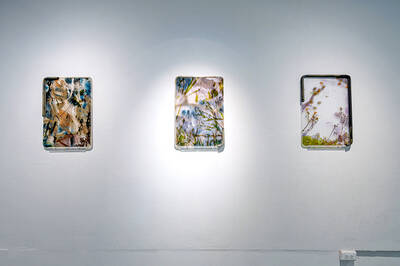
Located down a sideroad in old Wanhua District (萬華區), Waley Art (水谷藝術) has an established reputation for curating some of the more provocative indie art exhibitions in Taipei. And this month is no exception. Beyond the innocuous facade of a shophouse, the full three stories of the gallery space (including the basement) have been taken over by photographs, installation videos and abstract images courtesy of two creatives who hail from the opposite ends of the earth, Taiwan’s Hsu Yi-ting (許懿婷) and Germany’s Benjamin Janzen. “In 2019, I had an art residency in Europe,” Hsu says. “I met Benjamin in the lobby
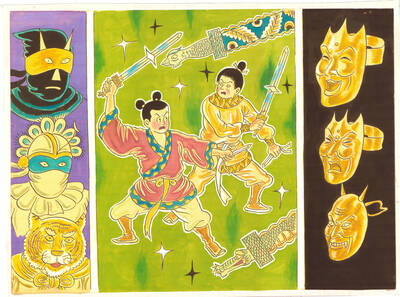
April 22 to April 28 The true identity of the mastermind behind the Demon Gang (魔鬼黨) was undoubtedly on the minds of countless schoolchildren in late 1958. In the days leading up to the big reveal, more than 10,000 guesses were sent to Ta Hwa Publishing Co (大華文化社) for a chance to win prizes. The smash success of the comic series Great Battle Against the Demon Gang (大戰魔鬼黨) came as a surprise to author Yeh Hung-chia (葉宏甲), who had long given up on his dream after being jailed for 10 months in 1947 over political cartoons. Protagonist


 RSS
RSS