


Coach Fatih Kale rises most Sundays at 6am to cook lunch for the Shih-Chih Soccer Club (SCSC). The team of 10 to 12-year-old boys practices once a week, but last year won 29 games out of thirty played and in the losing game was beaten by national champion Chiao-ai Elementary School (
But his team, which plays futsal or five-a-side soccer, was not the second-ranked team in its age group in Taiwan last year. That honor went to a team from Pingtung that SCSC beat 3-0. As a club team, SCSC is not recognized by the Chinese Taipei Football Association (中華台北足球協會) and can only play in unofficial tournaments.
For Kale, the 40-year-old owner of a pet supply business who was born in Turkey and moved here in 1991, this situation symbolizes what is wrong with soccer in Taiwan. His players are not particularly athletic or physically imposing for their age, but they consistently beat teams that are because he teaches them tactics and because they love the sport.
"With school teams, the sport selects the players, and these are often children that come from poor families or have troubled backgrounds," he said. "They practice six hours a day on school days, and on weekends from nine in the morning until seven, eight, or nine o'clock" at night. "When they play us, they don't want to see the ball anymore."
"Right now, they just kick the ball and run after it," he said of his competitors. "If you teach these kids a little bit of technical play, we wouldn't stand a chance because they're physically better."
Taiwan needs more teams like SCSC if it hopes to ever redeem its dismal record in international football competitions. Inter-national football's governing body FIFA ranks the current national team 156th out of 205 worldwide, below those of several microstates whose entire populations would fit inside Taipei's City Square.
Local fans like to talk about Taiwan's two Asian Games championships, but that was half a century ago and the players all came from Hong Kong. Taiwan's recent record in the "beautiful game" has been anything but. The national team yielded two-dozen goals in six recent World Cup qualifying matches. In a March qualifier for the 2007 Asian Cup, it lost 4-0 at Taipei's Zhongshan Soccer Stadium (
The men's ranking "is unacceptable, considering all the effort and money we put in," said Michael Huang (
Huang said club sports don't exist on a meaningful level in Taiwan because students don't have time and because most parents don't want their children playing sports after school. Those who compete often do so only to get into a good high school or university. "We need to change that phenomenon and it's very tough," he said. "In thousands of years of Chinese culture, studying has been the only way to be successful."
He added that his agency spends roughly one-third of its annual budget on subsidizing national teams and successful university squads. This includes the NT$260 million it pays towards the operating costs of teams that compete in the Olympic or Asian Games, including the Chinese Taipei Football Association. It also sponsors baseball programming on public television to the tune of NT$13 million each year so that people who can't afford cable can watch Taiwanese athletes play baseball overseas.
The idea is that fostering sports heroes will encourage more grassroots participation. To this end, the government expects to pass a bill later this month that would allow schools to hire professional coaches, as opposed to physical education teachers, to train their teams. It is hoped this will improve the level of play while providing more opportunities for students who choose to pursue athletics as a career.
"The ultimate goal is to encourage a true love of sports on a local level," Huang said, "and have more people like Kale, who do this because they love it."
Officials at the Chinese Taipei Football Association already see improvement. The men's team is better and is more confident, said Jong Chien-wu (
Wu said two-dozen teams played in youth leagues under his association four years ago. Last year there were 62, now there are 136. This year, the association is permitting youth teams to play seven-a-side soccer on smaller fields, which will allow schools that lack a regulation-sized pitch to field teams. But there seems to be little emphasis on club teams, which would select the best players and bring competition to a higher level.
SCSC will field seven-a-side and 11-a-side teams this year, and Kale wants to join the Chinese Taipei Football Association because it is the only body recognized by FIFA and because it will allow his club to play more games. Although Jong said there are plans to create a league for clubs, Kale was told recently that the association could not recognize his club because it lacked a regulation-sized field.
Another reason given was that if club teams competed successfully against schools teams, principals and teachers would not gain points on their resumes for fielding successful teams and would thus lose the incentive to organize teams at their schools.
Kale would love to see the association form a club league, but he would like it even more if club teams were allowed to play school teams in the Chinese Taipei Football Association's tournaments. "It would be nice if it happens," he said, "but my players are getting older." In the meantime, his club must content itself with playing a smaller schedule in tournaments run by groups that aren't recognized by FIFA.
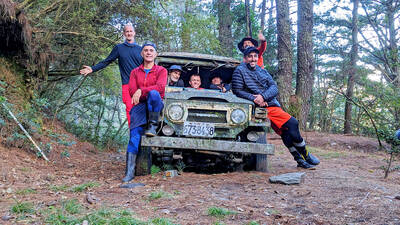
The year was 1991. A Toyota Land Cruiser set out on a 67km journey up the Junda Forest Road (郡大林道) toward an old loggers’ camp, at which point the hikers inside would get out and begin their ascent of Jade Mountain (玉山). Little did they know, they would be the last group of hikers to ever enjoy this shortcut into the mountains. An approaching typhoon soon wiped out the road behind them, trapping the vehicle on the mountain and forever changing the approach to Jade Mountain. THE CONTEMPORARY ROUTE Nowadays, the approach to Jade Mountain from the north side takes an

Last week Joseph Nye, the well-known China scholar, wrote on the Australian Strategic Policy Institute’s website about how war over Taiwan might be averted. He noted that years ago he was on a team that met with then-president Chen Shui-bian (陳水扁), “whose previous ‘unofficial’ visit to the US had caused a crisis in which China fired missiles into the sea and the US deployed carriers off the coast of Taiwan.” Yes, that’s right, mighty Chen caused that crisis all by himself. Neither the US nor the People’s Republic of China (PRC) exercised any agency. Nye then nostalgically invoked the comical specter

Relations between Taiwan and the Czech Republic have flourished in recent years. However, not everyone is pleased about the growing friendship between the two countries. Last month, an incident involving a Chinese diplomat tailing the car of vice president-elect Hsiao Bi-khim (蕭美琴) in Prague, drew public attention to the People’s Republic of China’s (PRC) operations to undermine Taiwan overseas. The trip was not Hsiao’s first visit to the Central European country. It was meant to be low-key, a chance to meet with local academics and politicians, until her police escort noticed a car was tailing her through the Czech capital. The
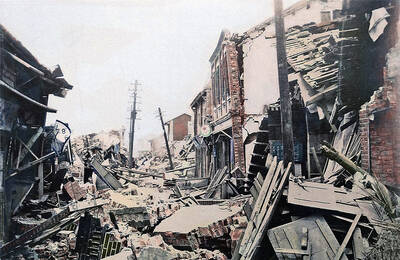
April 15 to April 21 Yang Kui (楊逵) was horrified as he drove past trucks, oxcarts and trolleys loaded with coffins on his way to Tuntzechiao (屯子腳), which he heard had been completely destroyed. The friend he came to check on was safe, but most residents were suffering in the town hit the hardest by the 7.1-magnitude Hsinchu-Taichung Earthquake on April 21, 1935. It remains the deadliest in Taiwan’s recorded history, claiming around 3,300 lives and injuring nearly 12,000. The disaster completely flattened roughly 18,000 houses and damaged countless more. The social activist and


 RSS
RSS