


If John Galliano, the designer at Dior, were not so recognizably talented, he might be considered a joke.
For every show he changes his look, and his guises are as varied as Cindy Sherman's. On the day of the recent Costume Institute gala at the Met, he slipped into a booth at the Four Seasons wearing a well cut, if severe, brown pinstripe suit and a snap-brim cap. Four hours later, materially transformed by sequins and golden curls, Juan Carlos Antonio Galliano looked like Davy Crockett in drag. The bloggers went to town.
But there is the fact of his talent, which rises up to greet you like a brick wall. It is unavoidably great. In two decades, he has staged at least half a dozen shows that people still vividly remember.
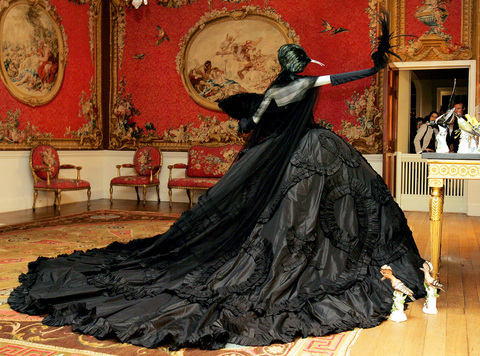
PHOTO: AP
These include the 1993 Princess Lucretia show in which he used electrical wire to give his skirts swing; a 1994 show in an empty Paris mansion in which all the dresses were made from black satin-backed crepe (it was a fabric he could afford and it could be used on both sides); the 1999 Matrix show, at Versailles, in which he offended Dior's old clients and established the house's modernity; and the 2000 hobo show that put fashion on the front page.
He is one of the few designers working today who actually knows how to cut cloth. If your daughter is wearing a bias-cut prom dress this spring, it is largely because years ago Galliano pushed manufacturers to try the technique on an industrial scale. His clothes have been judged unwearable and, more recently, overly commercial and safe. But as with all far-sighted talent, the judgments are eventually reversed. What once looked unwearable now seems ordinary, and what once seemed banal now looks right.
On May 15, Galliano was in New York to present Dior's resort collection. Though resort clothes don't get (or deserve) the news media attention of couture and ready-to-wear, Dior decided to make an event of it, inviting fashionistas as well as movie people, like Spike Lee and the producer Harvey Weinstein, and feeding them baked potatoes with caviar and Champagne at a dinner afterward. Bernard Arnault, the chairman of LVMH Moet Hennessy Louis Vuitton, which owns Dior, flew from Paris with his wife, Hilhne, as did the editors of French Vogue and Le Figaro.
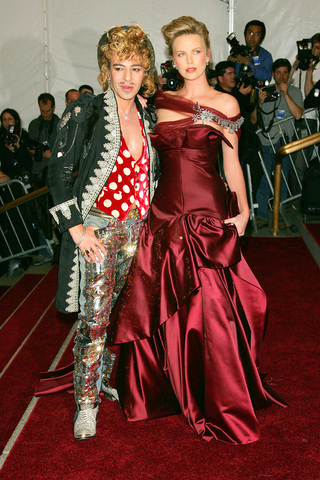
PHOTO: AFP
To the Hollywood guests, the scene at the show must have had an ancient regime quality despite the modern setting of the LVMH Tower on East 57 Street. "I don't know how you do it," a Hollywood guest said with a grin to a journalist. "You're always looking at the same people at these shows. They never change!"
Well, in a way this is also Galliano's problem. How does a maverick at age 46 perform magic when those judging him remember the old tricks, and even occasionally complain he was better then? And how does Galliano satisfy his own creativity when he has to feed a global business, its annual sales approaching US$1 billion, with more than 200 stores and new customers who suddenly and perceptibly don't care about what a glamorous windbag in New York thinks about his genius cutting?
Like the Artful Dodger, whose sense of freedom he transmits in both his own style and his runway collections, Galliano has an instinct for survival. A couple of years ago, when he started showing more conventional-looking clothes, along with handbags, many people took this as a sign that, at least in his ready-to-wear shows, he had finally been reined in by Dior executives.
But over lunch recently, Galliano said: "That was me. I decided to do that. Very odd to see a girl walking down the runway with a bag, I agree. But, at the same time, I knew that a certain girl with a certain shaped bag would get the image out there." And of course, increasingly the image is the message.
"It's also a question of time as well," he said. "Gone are the days of the great Balenciaga and M. Dior, when you had six months to create a line, a silhouette. That's what I try to do in haute couture. But the timing is very different today."
Does he feel he has time to be creative? "It's programmed," he said. "I mean, you can't come into the studio one day and say, `I'm really feeling this design."' He laughed. "It's more programmed than that. No, it doesn't bother me. I need it."
At almost every turn in his 10 years at Dior, beginning with the Matrix show, which included clothes that had been taken apart and put together backward or upside down, Galliano has demonstrated a greater ability to change than his audience. I know: in a review of the Matrix show, I wrote, "Even if there was something believably modern here, the sort of world Galliano was envisioning hardly needs haute couture."
I took the clients' side. Wrong move. In haute couture, at least as it's practiced by Galliano and Karl Lagerfeld, you trust the designer. The modernity of Galliano's torn-apart approach was eventually borne out in the imitations.
In the late 1980s, in a small Italian magazine called Westuff, Galliano said he considered himself part of the establishment. Given his circumstances at the time -- near poverty, no regular source of financing and serious amounts of clubbing -- this may have been a case of telling a journalist what he wanted to hear. Yet despite his working-class upbringing and the outlaw poses, Galliano's understanding of fashion and business does lie with the establishment.
Reminded of the article, he said: "I was a baby. How bold of me to say I want to be an international designer and have a house in Paris! But there you go. There's no point fighting it. Embrace it. Work within it, and then do things."
He acknowledged the front-row complaints that Dior has gone too commercial without addressing them. "Um, can it ever be too commercial?" he said. "I think what we're doing is right for the time. I don't want Dior to rest as a niche brand."

In late October of 1873 the government of Japan decided against sending a military expedition to Korea to force that nation to open trade relations. Across the government supporters of the expedition resigned immediately. The spectacle of revolt by disaffected samurai began to loom over Japanese politics. In January of 1874 disaffected samurai attacked a senior minister in Tokyo. A month later, a group of pro-Korea expedition and anti-foreign elements from Saga prefecture in Kyushu revolted, driven in part by high food prices stemming from poor harvests. Their leader, according to Edward Drea’s classic Japan’s Imperial Army, was a samurai
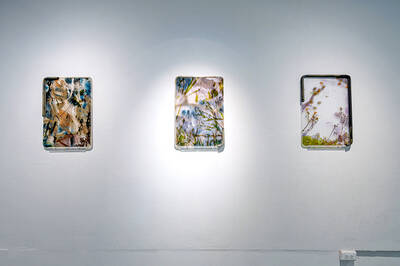
Located down a sideroad in old Wanhua District (萬華區), Waley Art (水谷藝術) has an established reputation for curating some of the more provocative indie art exhibitions in Taipei. And this month is no exception. Beyond the innocuous facade of a shophouse, the full three stories of the gallery space (including the basement) have been taken over by photographs, installation videos and abstract images courtesy of two creatives who hail from the opposite ends of the earth, Taiwan’s Hsu Yi-ting (許懿婷) and Germany’s Benjamin Janzen. “In 2019, I had an art residency in Europe,” Hsu says. “I met Benjamin in the lobby
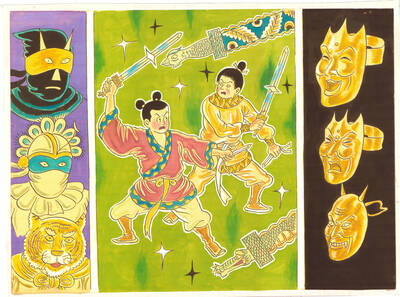
April 22 to April 28 The true identity of the mastermind behind the Demon Gang (魔鬼黨) was undoubtedly on the minds of countless schoolchildren in late 1958. In the days leading up to the big reveal, more than 10,000 guesses were sent to Ta Hwa Publishing Co (大華文化社) for a chance to win prizes. The smash success of the comic series Great Battle Against the Demon Gang (大戰魔鬼黨) came as a surprise to author Yeh Hung-chia (葉宏甲), who had long given up on his dream after being jailed for 10 months in 1947 over political cartoons. Protagonist

Peter Brighton was amazed when he found the giant jackfruit. He had been watching it grow on his farm in far north Queensland, and when it came time to pick it from the tree, it was so heavy it needed two people to do the job. “I was surprised when we cut it off and felt how heavy it was,” he says. “I grabbed it and my wife cut it — couldn’t do it by myself, it took two of us.” Weighing in at 45 kilograms, it is the heaviest jackfruit that Brighton has ever grown on his tropical fruit farm, located


 RSS
RSS