


Rhodesians Worldwide is a Web site through which old Rhodies communicate, and wonder about the lives they might have lived if Robert Mugabe had not won the war to liberate from white minority rule the country that became Zimbabwe. These dispa-tches are inevitably nostalgic and Rhodesia is remembered as a kind of Arcadia, when these reluctant exiles were enjoying the time of their lives, unburdened, it seems, by any sense of racial or liberal political conscience. The contributions to the site can be read as an exercise in willed denial; what is missing is any curiosity about the lives of the black Africans among whom they once lived, what they thought, believed or wanted.
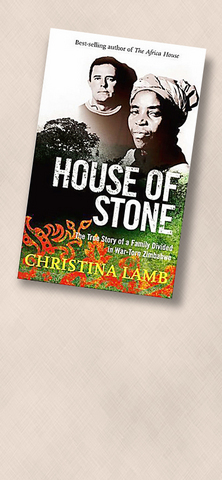
Denial is the subject of Chris-tina Lamb's book, which tells the story of a white farmer called Nigel Hough and his black maid, Aquinata, and how they were brought together and changed by the farm invasions that began in 2000 and have since led to the ruin of the agricultural infrastructure of one of the most fertile countries in Africa and to the misery and poverty of its people.
Nigel's father, an Englishman, settled in Rhodesia in the late 1940s, attracted there by the ease of the lifestyle, the climate, the landscape, and by the privileges of being white in this part of colonial Africa. What is often
forgotten about Rhodesia is how resolutely suburban it was. To visit the capital, Salisbury, was like finding yourself in any provincial English town on a Sunday afternoon; the polite hush and the prejudices were certainly the same. How can this be Africa, you thought?
Nigel grew up certain of his superiority over the black majority: the "munts," the "kaffirs." Later, they would become the "terrs" -- terrorists -- as the whites, led by the ferociously stubborn Ian Smith, fought a long, futile and, above all, murderous civil war to prevent the inevitability of black majority rule. He went to one of the best schools in the country, where he excelled at sports and, as war intensified out in the bush, dreamed of becoming a commando, even of serving in the elite Selous Scouts. The Scouts were an SAS-style unit who, operating behind enemy lines, committed some of the worst atrocities of the war.
Growing up in a village, Aqui had her own dreams and aspirations. She wanted to be educated, and she wanted to be a nurse. She believed in the war to liberate her people and she was sure that once the whites were defeated and the blacks controlled their own destiny, there would be equality and the country would flourish.
For a brief period following the free election of Robert Mugabe as president in 1980, there was hope that reconcil-iation between the black majority and the remaining whites was possible. In his post-election address to the nation, Mugabe spoke of forgiveness and urged whites to stay on to build the new country. The white farmers, despite faltering attempts at reform, were allowed to continue very much as before, working the richest and most fertile land.
Nigel was encouraged; Africa was his home, he was a white African; he wanted to believe, as Aqui did, in the possibility of a harmonious future. He stayed on and, in time, married a local white woman and settled on a farm in the tobacco-growing district of Marondera. It was there that Aqui came to work for him, her life before then, even in liberated Zimbabwe, amounting to a convoy of sorrows: raped as a child by a schoolmaster, a drunken, abusive husband, absolute poverty.
Nigel and Aqui's stories are told in alternating chapters, their own words, rendered in italics, merging with the flow of Lamb's hurried prose. But there is a problem: too often one struggles to differentiate Aqui's voice (her English would surely be Shona-inflected) from Hough's. In their flatly modulated diction they both sound like Christina Lamb.
Although Lamb is a courageous and excellent reporter, she can be a careless writer. She thanks her editor "who somehow turned round her manuscript in record time" in her acknowledgements. But her editor failed to prevent her worst excesses: repetition, overstatement and a serious absence of attribution. One section, on the Selous Scouts, reads as if hastily paraphrased from a Web site dedicated to the Scouts. If this site was indeed one of her sources, as it must have been, why isn't it cited? Why wasn't she advised to include a bibliography or source notes, in what is, after all, not only reportage but a semi-scholarly history of Zimbabwe?
The final section of the book, the best, sees Lamb back in
Zimbabwe, illegally. The farms have been destroyed. The shanty settlements of the blacks in the cities who dared to vote against Mugabe in the last election have been demolished as part of Operation Clean Up the Filth. Most of the whites who can have emigrated, and the prevailing mood is one of menace and fear -- a geriatric tyrant holding on to power at any cost. The Houghs remain in the country, though they have lost their farm, and Aqui is still working for them in a subordinate role. Nigel and Aqui now live without dreams, illusions or hope. Yet they have mutual respect -- and a greater understanding of what it means to be black, and indeed white, in southern Africa. But, oh, the pain, and the regret.

Last week Joseph Nye, the well-known China scholar, wrote on the Australian Strategic Policy Institute’s website about how war over Taiwan might be averted. He noted that years ago he was on a team that met with then-president Chen Shui-bian (陳水扁), “whose previous ‘unofficial’ visit to the US had caused a crisis in which China fired missiles into the sea and the US deployed carriers off the coast of Taiwan.” Yes, that’s right, mighty Chen caused that crisis all by himself. Neither the US nor the People’s Republic of China (PRC) exercised any agency. Nye then nostalgically invoked the comical specter
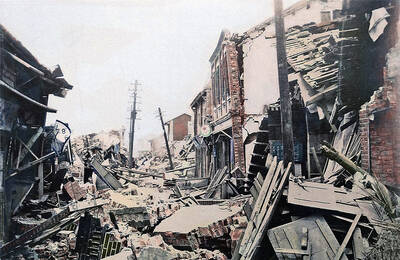
April 15 to April 21 Yang Kui (楊逵) was horrified as he drove past trucks, oxcarts and trolleys loaded with coffins on his way to Tuntzechiao (屯子腳), which he heard had been completely destroyed. The friend he came to check on was safe, but most residents were suffering in the town hit the hardest by the 7.1-magnitude Hsinchu-Taichung Earthquake on April 21, 1935. It remains the deadliest in Taiwan’s recorded history, claiming around 3,300 lives and injuring nearly 12,000. The disaster completely flattened roughly 18,000 houses and damaged countless more. The social activist and

Over the course of former President Ma Ying-jeou’s (馬英九) 11-day trip to China that included a meeting with Chinese Communist Party (CCP) leader Xi Jinping (習近平) a surprising number of people commented that the former president was now “irrelevant.” Upon reflection, it became apparent that these comments were coming from pro-Taiwan, pan-green supporters and they were expressing what they hoped was the case, rather than the reality. Ma’s ideology is so pro-China (read: deep blue) and controversial that many in his own Chinese Nationalist Party (KMT) hope he retires quickly, or at least refrains from speaking on some subjects. Regardless

Approaching her mid-30s, Xiong Yidan reckons that most of her friends are on to their second or even third babies. But Xiong has more than a dozen. There is Lucky, the street dog from Bangkok who jumped into a taxi with her and never left. There is Sophie and Ben, sibling geese, who honk from morning to night. Boop and Pan, both goats, are romantically involved. Dumpling the hedgehog enjoys a belly rub from time to time. The list goes on. Xiong nurtures her brood from her 8,000 square meter farm in Chiang Dao, a mountainous district in northern Thailand’s


 RSS
RSS