


When Lytton Strachey was hunting for eminent Victorians to skewer, Isabella Beeton loomed as a tempting target. For generations of middle-class Englishwomen, her encyclopedic Book of Household Management was a standard wedding gift, the final word on cooking, sewing and the fine art of hiring a servant.
She really was an eminent Victorian, although not, as Strachey imagined her, "a small, tublike lady in black -- rather severe of aspect, strongly resembling Queen Victoria." In The Short Life and Long Times of Mrs. Beeton, Kathryn Hughes' scrupulously researched, definitive study, Mrs. Beeton, as she was universally known, emerges as a fascinating blend of Betty Crocker and Emily Post, with a little Martha Stewart or Nigella Lawson thrown in for good measure.
In the turbulent social waters of mid-Victorian England, she kept a steady hand on the tiller, helping the confused, upwardly mobile daughters of servants and tradesmen to run their households on efficient modern lines.
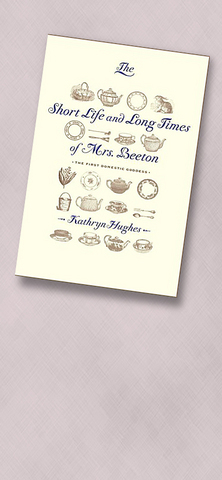
The plump matron imagined by Strachey was actually the young, attractive wife of a go-ahead publisher and pub-owner's son named Samuel Beeton. Mr. Beeton, dashing and feckless, saw a market niche in the swelling ranks of the lower middle classes, for which he created inexpensive periodicals like The Boy's Own Magazine and The Englishwoman's Domestic Magazine. In a pinch, Mrs. Beeton took over the Cooking, Pickling and Preserving column for The Englishwoman's Domestic Maga-zine and started a new column, The Nursery. These evolved into a full-fledged reference work, riginally published in a series of 24 pamphlets and issued in one volume as The Book of Household Management in 1861.
It was a curious production, a cut-and-paste compilation of recipes, medical advice, rules of etiquette, procedures for cleaning and essays on natural history and chemistry. What made the whole greater than the sum of its mostly stolen parts was the tone and the point of view. Isabella Beeton was born to organize. She visualized the well-run household as a whirring machine, and in crisp, unadorned English she presented the task of running it as something like a profession.
"After reading The Book of Household Management the middle-class housewife who was unlucky enough not to have a full complement of housemaids and footmen no longer felt herself a drudge," Hughes writes. "She was, rather, the Commander of an Army, albeit an army that consisted of a teenage girl and a boy who came in once a week."
Hughes, the author of George Eliot: The Last Victorian and The Victorian Governess, treats Mrs. Beeton's work as a window onto the world of mid-19th-century England. It serves admirably as an index to the daily problems faced by Victorian women, as well as their social aspirations. Both can be gauged precisely, thanks to Mrs. Beeton's orderly approach of itemizing exactly what could and could not be done on annual incomes ranging from a few hundred US dollars a year to more than a thousand.
The high end of the scale, Hughes suggests, was fantasy, since "the real heartland of Beeton's readership remains that of a modest family, struggling to keep up the newly genteel style of living required of the middle class on an income that is often actually not much higher than that of a skilled laboring man."
Mrs. Beeton knew the constraints and the dreams. She grew up in a family of 21 children and spent a good part of her childhood in the grandstand at Epsom Downs, where her stepfather published the race cards and rose to become an
important official at the track. Destined for finer things, she studied in Heidelberg, where she learned German and French. After marrying at 19, she set up house in a new London suburb, and in many respects shared the life that her readers either lived or hoped to live.
The biographical record is thin. (Lack of material caused Strachey to abandon his proposed biography of Mrs. Beeton.) The record has also been muddled by partisan biographers and meddling descendants unable to separate fact from myth. Most of them despised Sam Beeton, whom they accused of working his wife to death at 28, soon after she gave birth to her second child.
Hughes, who has taken advantage of newly discovered family papers, expends a good deal of energy revisiting old controv-ersies that will mean little or nothing to American readers. She sometimes overinterprets the sparse material at hand. At the same time, her searching social eye does wonders with the small cache of letters between Isabella and Sam, written during their courtship. Annotating each line, she constructs a detailed picture of fashions and social customs at the high-water mark of the Victorian age. For readers of Dickens and Trollope, this section of the book is pure gold.
Carefully unraveling the histor-ical record, Hughes makes a
compelling circumstantial case that Sam Beeton contracted syphilis in his bachelor days, passing the disease on to his wife and eventually dying of it at 46, after years of increasingly erratic behavior. At The Englishwoman's Domestic Magazine he created a scandal by encouraging a long-running discussion, in the letters column, of sadomasochistic practices involving corsets and whips.
It was only after her death that Mrs. Beeton's career truly took off, as her masterwork spun off dozens of smaller titles (including, in recent years, Microwaving With Mrs. Beeton). Like Betty Crocker, she lived on as a shrewdly marketed symbol. Her name, attached to meat pies and fruit tarts, still carries weight in the marketplace, evoking wholesome English cooking and bedrock national values. In the end, the Victorian tub turned out to have an astoundingly long shelf life.

Last week Joseph Nye, the well-known China scholar, wrote on the Australian Strategic Policy Institute’s website about how war over Taiwan might be averted. He noted that years ago he was on a team that met with then-president Chen Shui-bian (陳水扁), “whose previous ‘unofficial’ visit to the US had caused a crisis in which China fired missiles into the sea and the US deployed carriers off the coast of Taiwan.” Yes, that’s right, mighty Chen caused that crisis all by himself. Neither the US nor the People’s Republic of China (PRC) exercised any agency. Nye then nostalgically invoked the comical specter

Relations between Taiwan and the Czech Republic have flourished in recent years. However, not everyone is pleased about the growing friendship between the two countries. Last month, an incident involving a Chinese diplomat tailing the car of vice president-elect Hsiao Bi-khim (蕭美琴) in Prague, drew public attention to the People’s Republic of China’s (PRC) operations to undermine Taiwan overseas. The trip was not Hsiao’s first visit to the Central European country. It was meant to be low-key, a chance to meet with local academics and politicians, until her police escort noticed a car was tailing her through the Czech capital. The
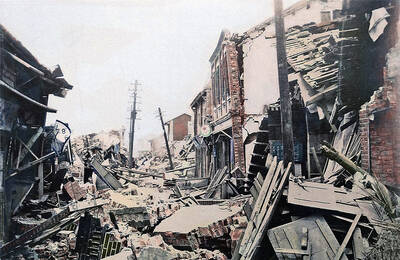
April 15 to April 21 Yang Kui (楊逵) was horrified as he drove past trucks, oxcarts and trolleys loaded with coffins on his way to Tuntzechiao (屯子腳), which he heard had been completely destroyed. The friend he came to check on was safe, but most residents were suffering in the town hit the hardest by the 7.1-magnitude Hsinchu-Taichung Earthquake on April 21, 1935. It remains the deadliest in Taiwan’s recorded history, claiming around 3,300 lives and injuring nearly 12,000. The disaster completely flattened roughly 18,000 houses and damaged countless more. The social activist and

Over the course of former President Ma Ying-jeou’s (馬英九) 11-day trip to China that included a meeting with Chinese Communist Party (CCP) leader Xi Jinping (習近平) a surprising number of people commented that the former president was now “irrelevant.” Upon reflection, it became apparent that these comments were coming from pro-Taiwan, pan-green supporters and they were expressing what they hoped was the case, rather than the reality. Ma’s ideology is so pro-China (read: deep blue) and controversial that many in his own Chinese Nationalist Party (KMT) hope he retires quickly, or at least refrains from speaking on some subjects. Regardless


 RSS
RSS