


Christians are outraged and albinos are offended and people around the world who have not even seen the film are angry simply, it seems, in preparation for being angry.
But everyone can just take a deep breath and calm down. Because the The Da Vinci Code is finally coming to theaters, and its biggest sin has nothing to do with the supposedly blasphemous nature of the source material, Dan Brown's blockbuster page turner.
Rather, its sin is of omission. Even at two and a half hours, director Ron Howard's adaptation feels cursory and rushed.
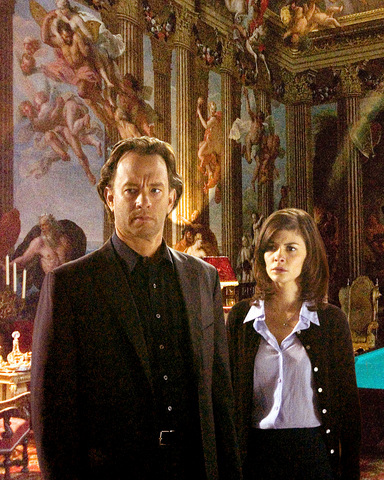
Then again, maybe Howard was doomed from the start. In taking an intricate book about a centuries-old religious mystery that's sold 60 million copies, Howard and screenwriter Akiva Goldsman -- with whom he spun gold with 2001's Oscar-winning A Beautiful Mind -- inevitably had to trim something. Otherwise, they would have ended up with a miniseries.
What they have jettisoned, however, is the tension.
The novel is by no means great literature, but it is enormously engrossing. Much of what sucks you in is watching Harvard symbologist Robert Langdon and police cryptologist Sophie Neveu piece together clues left for them at a murder scene at the Louvre museum and at religious sites across Europe. They think things through; they draw from their experiences. They make mistakes; they finally solve one puzzle and move on to the next. And you are right alongside them, every breathless step of the way.
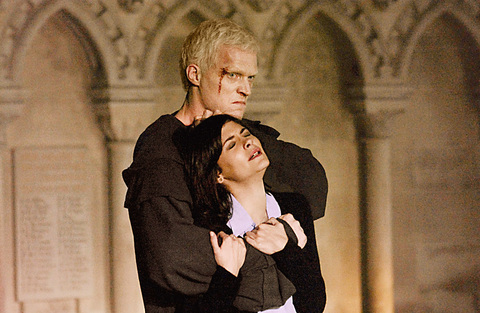
As played by longtime Howard favorite Tom Hanks and French actress Audrey Tautou, Robert and Sophie proceed from one problem to the next with such speed and ease, it's as if they are high-school kids on a scavenger hunt, looking for a stop sign and a No. 2 pencil.
Within seconds of finding the words "So dark the con of man," written on a painting in invisible ink, they realize it is an anagram for a work by Leonardo Da Vinci, which leads them to the next clue. And that mathematical sequence scrawled on the gallery floor? Of course it is the number of a Swiss bank account containing a hugely important portion of the secret.
It would help if we cared deeply about the characters who are willing to risk their lives to uncover this vast church cover-up -- to find the long-hidden truth about the relationship between Jesus and Mary Magdalene. Here, Robert and Sophie are barely fleshed out. We know a bit more about her because her mystery is the film's mystery; she finds out who she is as we find out more about the true nature of the Holy Grail. And Tautou, who's much prettier and more petite than the character in the book, nonetheless exhibits the necessary spunk and inquisitiveness for the role.
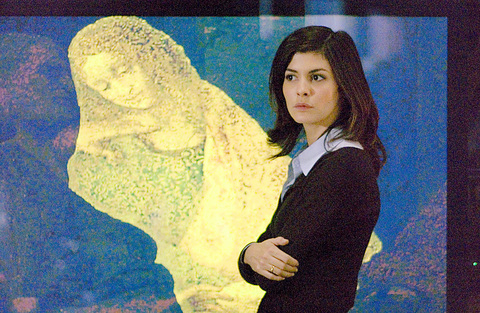
But Robert Langdon is little more than a tour guide in this version of The Da Vinci Code -- though the tour, much of which was shot on location in Paris and London, is beautifully and ominously photographed by Salvatore Totino, who also shot Howard's Cinderella Man.
In the book, Robert was a respected professor and famously sought-after bachelor in Boston. In the movie, he seems to have borrowed Rick Springfield's haircut, circa Jessie's Girl, and that's his most distinctive personality trait. As sturdy and versatile an actor as Hanks can be, he cannot work miracles when he has got nothing to work with.
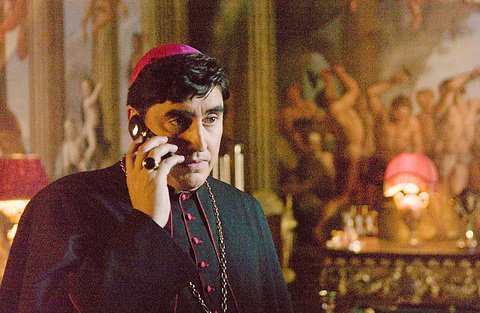
The movie is actually more interesting when Robert and Sophie are not in it -- when they are on the run and everyone else is chasing them, from police captain and Opus Dei member Bezu Fache (a perfectly cast Jean Reno) to the opportunistic Bishop Aringarosa (an underused Alfred Molina) to Silas, the sadomasochistic albino assassin monk.
Clearly, this would be a juicy role for anyone to play; Paul Bettany, who also co-starred in Howard's A Beautiful Mind, manages to do something totally unexpected. He makes us fear Silas and feel sorry for him at the same time. He makes us stare at his naked, scarred body not because the sight of it is gratuitous, but because it helps us understand his need for self-flagellation, the depth of his torment, the extent of his will. All this in just the first few scenes.
And then there is Ian McKellen, who could have walked on a sound stage and read the entire Bible and made it worthy of a movie ticket. As Sir Leigh Teabing, the eccentric millionaire grail expert who provides Robert and Sophie with sanctuary and more answers than they had hoped for, McKellen flat-out steals every moment he inhabits. He livens things up, immediately and gracefully, as a brilliant but dirty old man wandering around his cluttered French castle with a pair of canes and a mind full of conspiracy theories.
But it is where he leads Robert and Sophie, and ultimately the film itself, that might irk a whole different group we have not mentioned yet: Da Vinci Code purists. We would not dream of giving any secrets away. We will just say the ending is slightly different, for better and for worse.
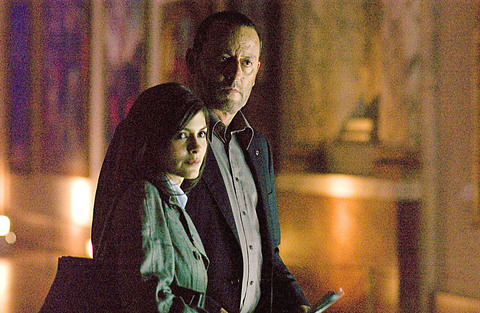
PHOTOS COURTESY OF SONY ENTERTAINMENT
Something Robert says as the film reaches its conclusion, though, is more significant than anything else anyone has said about the film -- off-screen, that is, not on it.
As Sophie struggles to understand her true identity, Robert tries to assuage her: "What matters is what you believe." Later in the scene, he repeats that phrase, placing the emphasis on the word "you." Surely this is Howard's olive branch to the critics and protesters, who are vocal and organized -- his assurance that what he is offering is filmic fiction, and nothing blasphemous intended to undermine anyone's faith.
It's the strongest statement in the entire movie. And it comes far too late.

In late October of 1873 the government of Japan decided against sending a military expedition to Korea to force that nation to open trade relations. Across the government supporters of the expedition resigned immediately. The spectacle of revolt by disaffected samurai began to loom over Japanese politics. In January of 1874 disaffected samurai attacked a senior minister in Tokyo. A month later, a group of pro-Korea expedition and anti-foreign elements from Saga prefecture in Kyushu revolted, driven in part by high food prices stemming from poor harvests. Their leader, according to Edward Drea’s classic Japan’s Imperial Army, was a samurai

Located down a sideroad in old Wanhua District (萬華區), Waley Art (水谷藝術) has an established reputation for curating some of the more provocative indie art exhibitions in Taipei. And this month is no exception. Beyond the innocuous facade of a shophouse, the full three stories of the gallery space (including the basement) have been taken over by photographs, installation videos and abstract images courtesy of two creatives who hail from the opposite ends of the earth, Taiwan’s Hsu Yi-ting (許懿婷) and Germany’s Benjamin Janzen. “In 2019, I had an art residency in Europe,” Hsu says. “I met Benjamin in the lobby
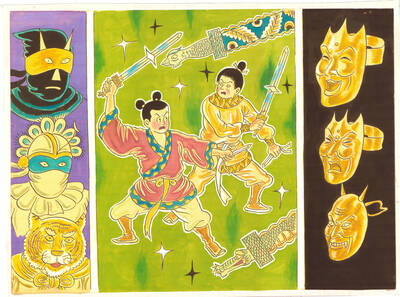
April 22 to April 28 The true identity of the mastermind behind the Demon Gang (魔鬼黨) was undoubtedly on the minds of countless schoolchildren in late 1958. In the days leading up to the big reveal, more than 10,000 guesses were sent to Ta Hwa Publishing Co (大華文化社) for a chance to win prizes. The smash success of the comic series Great Battle Against the Demon Gang (大戰魔鬼黨) came as a surprise to author Yeh Hung-chia (葉宏甲), who had long given up on his dream after being jailed for 10 months in 1947 over political cartoons. Protagonist

A fossil jawbone found by a British girl and her father on a beach in Somerset, England belongs to a gigantic marine reptile dating to 202 million years ago that appears to have been among the largest animals ever on Earth. Researchers said on Wednesday the bone, called a surangular, was from a type of ocean-going reptile called an ichthyosaur. Based on its dimensions compared to the same bone in closely related ichthyosaurs, the researchers estimated that the Triassic Period creature, which they named Ichthyotitan severnensis, was between 22-26 meters long. That would make it perhaps the largest-known marine reptile and would


 RSS
RSS