


In the early 1990s, when Chinese contemporary art was just beginning to take off, a young painter here named Zhou Tiehai (
He would succeed by beating the art market at its own game, exposing its commercialism while exploiting it to the hilt. He would produce paintings that he hoped would be acclaimed by the same Western collectors and journalists who, in his mind, had advanced the careers of too many mediocre Chinese artists.
And he would do all this without lifting a brush: He would delegate that work to hirelings.
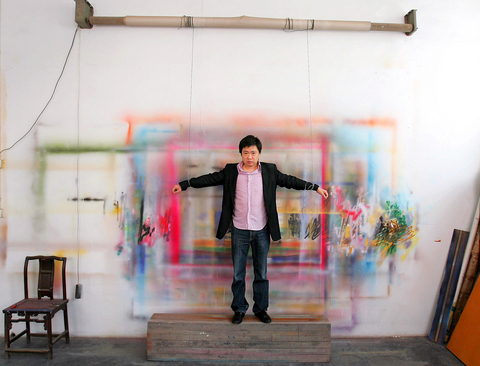
PHOTO: NY TIMES NEWS SERVICE
Somehow, he pulled it off. Zhou is now one of China's hottest artists. His meteoric rise from marginalized rebel to mainstream superstar culminated in a solo exhibition of his works at the Shanghai Art Museum in March.
Many of the biggest names in Chinese contemporary art were on hand for the opening. Zhou choked up with tears, seemingly awed by the lofty stage he had ascended.
For more than a decade, his work has mocked the art scene. In an era when every leading Chinese artist seems to have a recognizable brand, a series of obvious signature pieces, Zhou slyly appropriated Joe Camel from the American cigarette ads and transformed it into his own improbable brand. (Many people here refer to Zhou -- pronounced Joe -- as the Joe Camel guy.) Now important collectors boast of owning his paintings. His works, which command prices as high as US$100,000, have been shown in New York, London and at the Venice Biennale.
That he doesn't paint them himself seems to make little difference, even, or perhaps especially, to those clued in to his game. Karen Smith, a Beijing-based art critic, calls him "the child who dares to suggest the emperor is indeed naked." Others hail him as a marketing genius.
"The fact that he doesn't paint much doesn't bother me," said Uli Sigg, a former Swiss ambassador to China and a major collector of Chinese contemporary art. "Jeff Koons doesn't touch anything. Bridget Riley has workers. It's accepted today. It doesn't have to have traces of your own hand."
In an interview in his studio here, Zhou, 39, said that what was most important was the concept behind the work.
"You need to get someone's attention," he said, sipping tea as three of his workers busily sketched and painted (sometimes with air brushes) a variety of portraits he had first drafted on computer. Typically Zhou comes up with an idea -- for example, transposing the head of Joe Camel onto a classical European painting, which he then executes on his computer using Photoshop. After that, staff members take over, using a printout of the image as a guide.
When Zhou recounts the story of his own improbable rise, he can't help chuckling, as if the joke were on the foreign collectors and journalists now flocking to his studio.
"From the beginning I knew I'd be successful," he said. "It's really not that hard to create art."
Although he doesn't paint anymore, Zhou says that he can. He grew up in Shanghai and in 1989 earned an arts degree from the School of Fine Arts at Shanghai University.
While in college, he painted and created collages on discarded newspapers. As Beijing's avant-garde movement got under way in the late 1980s, he formed his own circle of artists here and even experimented with performance art.
"It was mostly violent stuff," he said. "I would sometimes stick needles in people onstage."
When his career failed to take off, Zhou took a job at an advertising agency, producing commercials for state-owned television. But before long he regretted his decision to drop out of the art world.
In 1993, he met the American writer Andrew Solomon, who was working on an article about Chinese contemporary art for the New York Times Magazine. Solomon looked at his work but did not mention him in the article.
Zhou said he decided it would not be necessary for him to do the painting himself, since, to his thinking, his competitors were not terribly skilled painters anyway. His initial subject matter was what he saw as the absurdities of the art market.
One early work pictured Solomon, the writer who had passed him over, as Columbus discovering the new world of Chinese contemporary art.
Then came a series of fake magazine covers, including one of Newsweek proclaiming Zhou a rising star, and a fake newspaper article about a stock called Zhou Tiehai that went public and steadily gained value thanks to foreign buyers.
None of this, of course, was a solitary act of creation. Zhou hired a team of artists to execute his ideas. This left him free, he says, to focus on refining his concepts, and networking with collectors and gallery owners like Lorenz Helbling, founder of the ShanghART gallery.
"I came to Shanghai in 1994 and saw his works on paper," Helbling said. "I thought he was interesting. I remember a Belgian collector came to my home to look at some works. He found one of Zhou's pieces in a suitcase and he got excited about it." That was in 1996, and it was one of the first pieces Zhou sold, Helbling said.
Later, Zhou's work caught the eye of other big collectors like Sigg.
"The fact that he criticized the system brought him right into it," Sigg said in a telephone interview. "It was a clever strategy."
Since then, Zhou's evolving series of Joe Camel paintings have become his signature work. Zhou calls Joe Camel a likable character. But many in the art industry here say it is more clever than that. Joe Camel, they say, is the prototypical Westerner (Westerners are often referred to as "big noses" in China), but also Zhou's alter ego.
His Joe Camel is a globe-trotter who likes to play in the Western art world, wears dark sunglasses and does mischievous things, like inserting himself, Zelig-like, into paintings of historical scenes.
In creating his own brand, Zhou says he has beaten China's great artists at their own game, and no one really seems to mind.
On April 23 in Shanghai, there was an art show opening for Zhou Chunya, best known for his Green Dog series. Many of China's most successful artists were there, including Zhou. At the banquet afterward, upstairs at a fashionable restaurant, he strolled among tables, cigarette and wine glass in hand, hugging fellow artists and joining them in toasts. He was now firmly in the inner circle.
Asked how it felt, he grinned and said: "Ten years ago I wanted to show people how easy it is to make art. And I did that. Now I'm on the list."

In late October of 1873 the government of Japan decided against sending a military expedition to Korea to force that nation to open trade relations. Across the government supporters of the expedition resigned immediately. The spectacle of revolt by disaffected samurai began to loom over Japanese politics. In January of 1874 disaffected samurai attacked a senior minister in Tokyo. A month later, a group of pro-Korea expedition and anti-foreign elements from Saga prefecture in Kyushu revolted, driven in part by high food prices stemming from poor harvests. Their leader, according to Edward Drea’s classic Japan’s Imperial Army, was a samurai

Located down a sideroad in old Wanhua District (萬華區), Waley Art (水谷藝術) has an established reputation for curating some of the more provocative indie art exhibitions in Taipei. And this month is no exception. Beyond the innocuous facade of a shophouse, the full three stories of the gallery space (including the basement) have been taken over by photographs, installation videos and abstract images courtesy of two creatives who hail from the opposite ends of the earth, Taiwan’s Hsu Yi-ting (許懿婷) and Germany’s Benjamin Janzen. “In 2019, I had an art residency in Europe,” Hsu says. “I met Benjamin in the lobby
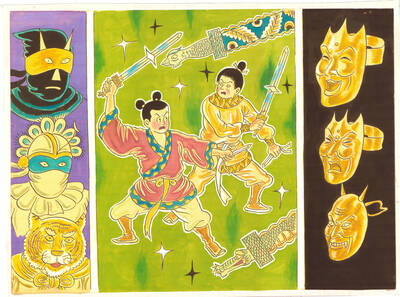
April 22 to April 28 The true identity of the mastermind behind the Demon Gang (魔鬼黨) was undoubtedly on the minds of countless schoolchildren in late 1958. In the days leading up to the big reveal, more than 10,000 guesses were sent to Ta Hwa Publishing Co (大華文化社) for a chance to win prizes. The smash success of the comic series Great Battle Against the Demon Gang (大戰魔鬼黨) came as a surprise to author Yeh Hung-chia (葉宏甲), who had long given up on his dream after being jailed for 10 months in 1947 over political cartoons. Protagonist

Peter Brighton was amazed when he found the giant jackfruit. He had been watching it grow on his farm in far north Queensland, and when it came time to pick it from the tree, it was so heavy it needed two people to do the job. “I was surprised when we cut it off and felt how heavy it was,” he says. “I grabbed it and my wife cut it — couldn’t do it by myself, it took two of us.” Weighing in at 45 kilograms, it is the heaviest jackfruit that Brighton has ever grown on his tropical fruit farm, located


 RSS
RSS