


For a billionaire looking for somewhere special to display his contemporary-art collection, the venerable Palazzo Grassi on Venice's Grand Canal is not bad for a second best.
True, Francois Pinault, the French owner of a myriad department stores as well as Christie's, Gucci and Yves Saint Laurent, had originally planned to build his own US$195 million museum, designed by Tadao Ando, on an island in the Seine southwest of Paris. But, last May, after five years of wrestling with red tape, he abandoned the project in frustration.
"Eternity is for art, not for projects that aim to serve it," he noted at the time.
PHOTOS: AGENCIES
So it is in Venice that the publicity-shy mogul is showing part of his vast art collection for the first time. And up to now, even few people in the art world knew what the collection included.
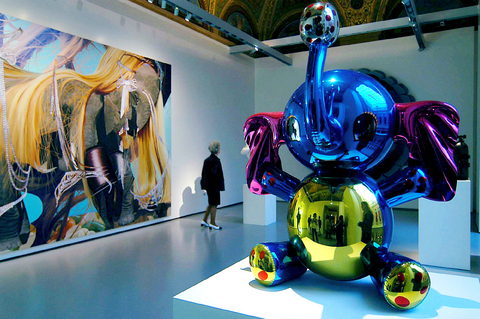
For this first exhibition of some 200 of his 2,500 artworks, the likes of Picasso, Miro and Picabia have been omitted. Instead, Pinault has chosen to focus on crucial artists of the last half-century, from Mark Rothko, Donald Judd, Gerhard Richter and Lucio Fontana to Richard Serra, Bruce Nauman, Cindy Sherman, Jeff Koons and Damien Hirst.
Few museums could offer such an overview. And, inevitably, the show has whetted the appetite of contem-porary-art lovers to discover the rest of his collection.
For Venice, it is no less a coup. This city may be better known for its Titians and Tintorettos, but it is also home to the Peggy Guggenheim Collection of modern art and the high-profile Venice Biennale of contemporary art. In fact, Mayor Massimo Cacciari would dearly like to see the entire Pinault collection installed here permanently.
Pinault, 69, has other plans. After collecting art for the last 30 years, he noted in the show's catalog, "the desire to possess -- born at the moment I first came in contact with art -- has been transformed into a profound need to share." Thus, his current idea is to hold exhibitions of different facets of his collection at a "network" of sites around Europe.
Still, the 18th-century Palazzo Grassi is a good place to start. Over the last two decades, under Fiat's ownership, it has won plaudits for organizing major exhibitions, in many cases tackling broad artistic and historical themes like the Celts, the Etruscans, the Maya and the Greeks. Visitors to Venice have come to expect quality shows here.
After Pinault acquired the building last year, he asked Ando to renovate it. Jean-Jacques Aillagon, a former French culture minister who earlier headed the Georges Pompidou Center, is now director of the palazzo. And Alison Gingeras, a young adjunct curator at the Solomon R. Guggenheim Museum in New York, has organized the first show, Where Are We Going?, which runs through Oct. 1.
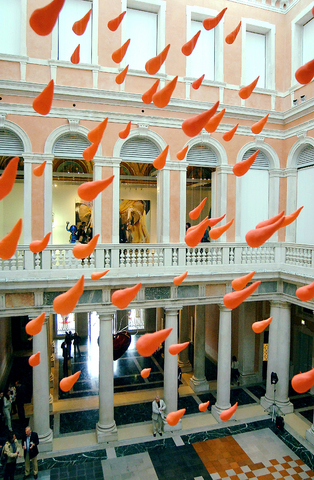
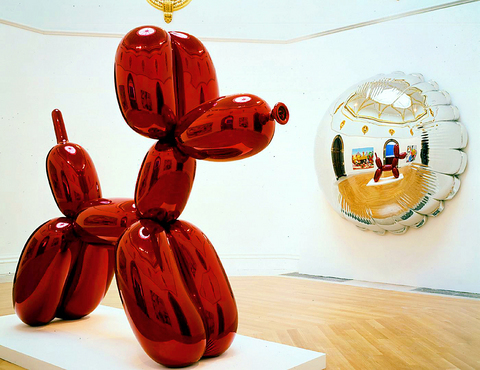
Already from the Grand Canal, change is announced by Your Wave Is, an illuminated filigree by Olafur Eliasson that covers the facade of the palace. Also outside are Koons' Balloon Dog (Magenta) and two bizarre figures by Takashi Murakami. And visible through the building's main doors is Koons' large Hanging Heart, a newly completed red heart with golden bows that weighs no less than 2 tons.
Two other unusual works complete the introduction to the show. Carl Andre's 37th Piece of Work covers the courtyard with 1,296 metal plates of different colors and materials, while Piotr Uklanski's Untitled (Monsieur Francois Pinault) comprises a color photograph of a scanned image of the collector's head, in effect a skull to which the artist has added crossbones.
"It's a sort of vanity, a memento mori," Pinault said an interview with Paris-Match, adding drolly: "It's one of the possible answers to Where Are We Going?"
The rest of the exhibition fills two floors of the palazzo, where Ando has created self-contained spaces for individual artists and for group displays. And while some rooms are small, their windows face the courtyard or the canal, giving, for instance, three large Rothko oils ample breathing space.
The third floor, which dwells on Minimalism, gives its front gallery to six fine Judd sculptures, which look very much at home. Cy Twombly, Robert Ryman, Dan Flavin and Brice Marden also have their own rooms and, from Pinault's large collection of Arte Povera, there are works by Mario Merz, Jannis Kounellis, Pier Paulo Calzolari, Giuseppe Penone and Michelangelo Pistoletto.
The front gallery of the second floor is devoted to the eclectic art of Hirst, including two of his sliced cows preserved in formaldehyde, a steel cabinet lined with colored pills called Infinity, and The Fragile Truth, shelves covered by boxes of medicine. Gingeras has borrowed the show's title from Hirst's cabinet with animal skeletons, called Where Are We Going? Where Do We Come From? Is There A Reason?
Also presented alone are Koons and Sherman (with disturbing photographs of the genitalia of strange mannequins), while Mike Kelley, Paul McCarthy and Charles Ray confirm Pinault's interest in American art. More unexpected, though, is Maurizio Cattelan's Him, a schoolboy-size figure kneeling and looking into the corner of a room: closer inspection reveals Him to be a miniature Adolf Hitler.
Pinault has explained that he likes to collect artists in depth, while occasionally selling isolated works to strengthen other parts of his collection. (In June, he sold Robert Rauschenberg's Rebus to the Museum of Modern Art in New York for around US$30 million.) But Gingeras noted that he was also continually "pushing toward things he doesn't know."
Clearly, it helps to be rich. In the catalog, Pinault recalls the first painting that "deeply affected" him: "I took the painting home with me." And, fascinated by a Mondrian, "I bought it." But now, since he has handed the reins of his corporate empire to his son, Francois-Henri, art consumes his life. "Living with artworks has led me to question myself more," he writes, "to avoid being a prisoner of my convictions, to break with the comfort of habit."
Aillagon, who is charged with planning the Palazzo Grassi's future shows, said they will reach outside Pinault's collection. This fall, for example, the palace will present Picasso and the Joie de Vivre, followed next year by an exhibition exploring creativity in 1967 and an Arte Povera show, which will rely on Pinault's holdings.
Every two years from 2008 through 2016, Aillagon is preparing major exhibitions addressing Europe's relations with the world through the ages, starting with Rome and the barbarians and continuing with Christianity and Islam and successively with Europe and the Americas, the Far East and Africa.

Last week Joseph Nye, the well-known China scholar, wrote on the Australian Strategic Policy Institute’s website about how war over Taiwan might be averted. He noted that years ago he was on a team that met with then-president Chen Shui-bian (陳水扁), “whose previous ‘unofficial’ visit to the US had caused a crisis in which China fired missiles into the sea and the US deployed carriers off the coast of Taiwan.” Yes, that’s right, mighty Chen caused that crisis all by himself. Neither the US nor the People’s Republic of China (PRC) exercised any agency. Nye then nostalgically invoked the comical specter
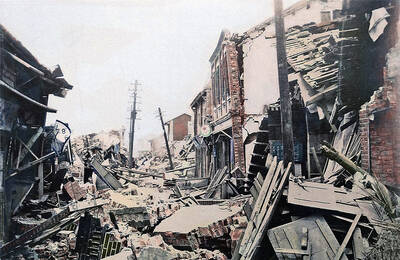
April 15 to April 21 Yang Kui (楊逵) was horrified as he drove past trucks, oxcarts and trolleys loaded with coffins on his way to Tuntzechiao (屯子腳), which he heard had been completely destroyed. The friend he came to check on was safe, but most residents were suffering in the town hit the hardest by the 7.1-magnitude Hsinchu-Taichung Earthquake on April 21, 1935. It remains the deadliest in Taiwan’s recorded history, claiming around 3,300 lives and injuring nearly 12,000. The disaster completely flattened roughly 18,000 houses and damaged countless more. The social activist and

Over the course of former President Ma Ying-jeou’s (馬英九) 11-day trip to China that included a meeting with Chinese Communist Party (CCP) leader Xi Jinping (習近平) a surprising number of people commented that the former president was now “irrelevant.” Upon reflection, it became apparent that these comments were coming from pro-Taiwan, pan-green supporters and they were expressing what they hoped was the case, rather than the reality. Ma’s ideology is so pro-China (read: deep blue) and controversial that many in his own Chinese Nationalist Party (KMT) hope he retires quickly, or at least refrains from speaking on some subjects. Regardless

Approaching her mid-30s, Xiong Yidan reckons that most of her friends are on to their second or even third babies. But Xiong has more than a dozen. There is Lucky, the street dog from Bangkok who jumped into a taxi with her and never left. There is Sophie and Ben, sibling geese, who honk from morning to night. Boop and Pan, both goats, are romantically involved. Dumpling the hedgehog enjoys a belly rub from time to time. The list goes on. Xiong nurtures her brood from her 8,000 square meter farm in Chiang Dao, a mountainous district in northern Thailand’s


 RSS
RSS