


Wind is simple. It is nothing more than air moving between zones of high pressure and low pressure, traveling in a straight line until
deflected by the rotation of the earth. Unfortunately things get very complicated after that, as Marq de Villiers explains in Windswept: The Story of Wind and Weather, his lively, engaging treatise on wind and the weather it makes.
The devil is in the details. As it moves across the earth, wind takes innumerable local detours and appears in a thousand guises, like the sirocco that blows sand from the Sahara as far north as Britain, the mistral that rips tiles off

Provencal roofs, the foehn that whistles through the Alps.
Everywhere felt but nowhere seen, wind can be the merest whisper, barely powerful enough to scatter the seeds of a dandelion, or it can blast with mind-numbing fury, taking the form of a cyclone, tornado, waterspout or hurricane. A hurricane that today would be classified as Category 5 struck the Florida Keys in 1935 and sandblasted some of its victims into particles, leaving only bones, leather belts and shoes.
Like other "ingredient" books, which treat single topics -- like codfish, oak or clay -- almost as if they were biographical subjects, Windswept serves up a little
history, a fair amount of science and many colorful stories. De Villiers, the co-author of Sahara and Sable Island, blends these elements with a skillful hand.
He explains the science clearly, and he describes the workings of wind, weather and the natural world with enormous gusto. He is a greedy observer, with plenty of wind and storms to watch from his seaside home in Eagle Head, Nova Scotia.
Simply as a catalog of statistics, Windswept is a grabber. In one day a moderate hurricane releases the energy equivalent of 400 20-megaton nuclear bombs: enough, if converted to electricity, to power New England for a decade. Even during a powerful storm, in an open field with no obstructions, the wind velocity at ground level is zero. Fungal spores and bacterial cysts riding on African sand travel as far as the Caribbean, where they are destroying coral. That same dust accounts for the red sunrises in Miami.
Wind is perplexing and always has been. Aristotle was stumped. He argued that it was absurd to think that wind was flowing air. That would mean that all winds were one wind since all air is one air, a self-evident absurdity, like saying that all rivers are the same river. As late as the 17th century, Martin Lister proposed that the trade winds were caused by the breathing of seaweed.
Sailors, for their part, ignored the philosophers and developed a rough, practical understanding of winds and storms. Columbus, after experiencing just one hurricane in the Caribbean, knew enough to recognize the warning signs of the second one. But
neither he nor anyone else understood that weather traveled. "Even the most apocalyptic storms were thought to develop, wreak havoc and then dissipate, in one place," De Villiers writes.
In time, scientists mapped the winds. But the complex inter-actions of wind and weather, and the maddening unpredictability of both, still keep them busy. The broad patterns are fairly well understood, but in a sense all weather is local. On Corsica, in the Mediterranean, to take a striking example, there can be gale-force winds on its west coast while the east coast is calm and an unrelated gale blows in the Strait of Bonifacio, three places only a dozen kilometers apart.
In a running subplot De Villiers tracks the course of Hurricane Ivan, which came to life in spring 2004 as a turbulent air system in the Darfur region of Sudan, slowly made its way across the Atlantic to the Caribbean and, with erratic zigs and zags, slammed the Gulf Coast and split, one half heading all the way up the Eastern seaboard to de Villiers' home in Nova Scotia. Along the way Ivan
reached Category 5 three times, the only recorded hurricane ever to do so. The storm that devas-tated Galveston, Texas, in 1900 made it all the way to Europe and onward to Siberia.
Small local events can translate into big changes in the nature and direction of a storm. De Villiers gives a sympathetic account of how weather data is gathered, and notes its increasing accuracy, while conceding that prediction remains half art, half science.
Wind, as the sailors in The Odyssey found out when they untied the wind-filled bags given by Aeolus, can be full of surprises. In 2002 a team of wind-tunnel researchers tried to unravel the mysteries of the hellish winds that torment players at the 12th hole at Augusta National golf course. The scientists created a scale model of the so-called Amen Corner, with tiny trees and tiny people (all men, presumably) and artificial wind. After painstaking study, they concluded that there was no relation between the prevailing winds and the winds that blew over the hole, so golfers teeing off might as well pray.
Maddening, unpredictable wind might offer a way out of the global energy crisis however. De Villiers concludes by examining the debate over global warming and the
commercial potential of wind farms. He is lucid and skeptical. Both sides exaggerate shamelessly. But look to the Danes, who have designed quiet, stylish windmills that generate nearly all of the renewable-source energy that
accounts for 27 percent of that country's power.
The wind still bloweth where it listeth, but everybody has some, and some have a lot. In a beautiful, wind-powered world, Scotland could be the new Saudi Arabia.
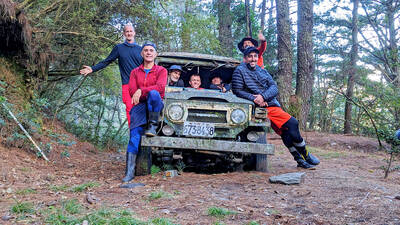
The year was 1991. A Toyota Land Cruiser set out on a 67km journey up the Junda Forest Road (郡大林道) toward an old loggers’ camp, at which point the hikers inside would get out and begin their ascent of Jade Mountain (玉山). Little did they know, they would be the last group of hikers to ever enjoy this shortcut into the mountains. An approaching typhoon soon wiped out the road behind them, trapping the vehicle on the mountain and forever changing the approach to Jade Mountain. THE CONTEMPORARY ROUTE Nowadays, the approach to Jade Mountain from the north side takes an

Last week Joseph Nye, the well-known China scholar, wrote on the Australian Strategic Policy Institute’s website about how war over Taiwan might be averted. He noted that years ago he was on a team that met with then-president Chen Shui-bian (陳水扁), “whose previous ‘unofficial’ visit to the US had caused a crisis in which China fired missiles into the sea and the US deployed carriers off the coast of Taiwan.” Yes, that’s right, mighty Chen caused that crisis all by himself. Neither the US nor the People’s Republic of China (PRC) exercised any agency. Nye then nostalgically invoked the comical specter

Relations between Taiwan and the Czech Republic have flourished in recent years. However, not everyone is pleased about the growing friendship between the two countries. Last month, an incident involving a Chinese diplomat tailing the car of vice president-elect Hsiao Bi-khim (蕭美琴) in Prague, drew public attention to the People’s Republic of China’s (PRC) operations to undermine Taiwan overseas. The trip was not Hsiao’s first visit to the Central European country. It was meant to be low-key, a chance to meet with local academics and politicians, until her police escort noticed a car was tailing her through the Czech capital. The
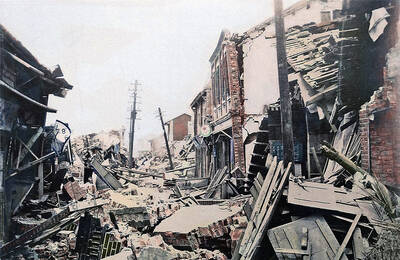
April 15 to April 21 Yang Kui (楊逵) was horrified as he drove past trucks, oxcarts and trolleys loaded with coffins on his way to Tuntzechiao (屯子腳), which he heard had been completely destroyed. The friend he came to check on was safe, but most residents were suffering in the town hit the hardest by the 7.1-magnitude Hsinchu-Taichung Earthquake on April 21, 1935. It remains the deadliest in Taiwan’s recorded history, claiming around 3,300 lives and injuring nearly 12,000. The disaster completely flattened roughly 18,000 houses and damaged countless more. The social activist and


 RSS
RSS